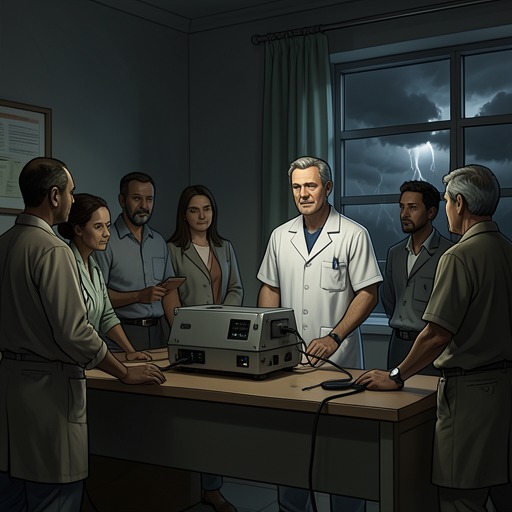
Miles Vorkosigan’s seizure-control implant procedure
MemoryMiles Vorkosigan’s seizure-control implant procedure marks a change from enduring seizures as unpredictable episodes to managing them with an experimental device he can activate himself. The treatment does not promise to eliminate the seizures: its first test deliberately triggers one. Its significance lies instead in the measured reduction of symptoms and in the new, demanding routine through which Miles is asked to monitor and control them.
An offer made under suspicion
The procedure begins with a call from Dr. Chenko at the Imperial Military Hospital’s veterans clinic. The microengineering work has taken longer than expected, but Chenko reports that his team has developed a device small enough to insert beneath Miles’s skull. The design is intended to trigger seizures safely; if the initial test succeeds, the team will complete its calibrations and schedule an operation to install it.
The offer arrives while Miles is waiting for a systems analysis report from Lucas Haroche’s team. He suspects that once the report comes in, events may move quickly, and he knows a clever man trained by ImpSec has made him a target. Against that background, the proposed brain implant does not feel like a straightforward medical advance. Miles wonders whether the experimental device contains protein circuits and what became of the missing capsule. He is chilled by the thought of people he does not know well installing equipment he does not understand in his brain, and declines to commit to an appointment the next day.
That hesitation is not a rejection of treatment. It reflects the convergence of a personal medical risk with an unresolved security threat: Miles cannot assess the proposed device independently, and the investigation has given him reason to worry about concealed biological interference. When Chenko asks whether he has had more episodes since the seizure induced in the laboratory, Miles says he has not. The implant therefore remains an option under consideration rather than an immediate response to a newly reported seizure.
Surgery under observation
Miles eventually proceeds. The operation to install the device’s internal portion proves shorter and less frightening than he expected. Chenko, increasingly familiar with Miles’s suspicious outlook, allows him to remain awake and watch the procedure on a monitor positioned above his head-clamp. The arrangement gives Miles a view of what is being done rather than requiring him to submit without observation. Chenko lets him go home the following morning.
Two afternoons later, Miles returns to Chenko’s neurology laboratory for a smoke-test. The test is a controlled trial of the installed system, not merely a check that the implant is present: Miles is to activate it and observe the resulting seizure. Chenko asks whether he wants to perform the activation himself. Miles agrees, adding that he might have to do so in practice. Chenko cautions that he should not make a habit of testing it alone and recommends having someone nearby, especially at first.
The first activation
Chenko gives Miles a new mouth guard and an activation unit small enough to fit neatly in his palm. Lying back on the examination table, Miles checks the settings once more, presses the unit against his right temple, and switches it on. The test brings colored confetti, then darkness. When he opens his eyes, he spits out the mouth guard and moves his jaw. Chenko retrieves the guard and keeps a hand on Miles’s chest to stop him sitting up while the team completes its measurements. The activation unit is on a nearby monitor; Miles wonders whether he caught it as it came down, but the scene does not establish that he did.
Even after the test, Miles checks a security concern: he wants the activation signals encoded so the device cannot be set off accidentally by a security scan. Chenko reassures him that the signals are encoded. He also says that trauma severe enough to damage the internal unit would leave Miles with a much graver problem than the device itself. The exchange shows that Miles’s mistrust has not disappeared with implantation; it now takes the form of practical questions about accidental activation and the implant’s vulnerability.
Results and the new routine
Chenko’s measurements show a qualified but concrete improvement. On this run, Miles’s convulsive symptoms last barely half as long as during his uncontrolled seizures, and his body movements are suppressed. Chenko expects the hangoverlike effects Miles has reported to be reduced as well, but asks him to observe how he feels over the next day-cycle and report his own impressions. The first test thus supplies clinical measurements and leaves part of the assessment to Miles’s experience afterward.
The device also imposes a recurring practice. Chenko tells Miles to make its use part of his daily routine, like brushing his teeth: he should check the activation unit’s neurotransmitter-level readout at the same time each evening, preferably before bed, and discharge the levels once they pass one-half but before they exceed three-quarters. Miles accepts the instructions and immediately asks whether he can fly. Chenko says he can do so the next day; Miles presses for an explanation of why he cannot fly that day. The exchange gives the treatment a practical consequence beyond the laboratory: even after a successful test, the device requires monitoring, and Miles’s return to an activity he wants to resume is delayed.
Significance
The episode turns a proposed intervention into a working, though still experimental, management system. Miles’s initial fear is grounded in uncertainty about the device and in the unresolved possibility of sabotage; his later participation does not erase that context. Instead, the operation and test make him an informed witness and active operator: he watches the implantation, checks the settings, triggers the test, and questions how activation is protected. The improvement is substantial but limited to what the first run demonstrates—a seizure of roughly half the uncontrolled duration, with reduced movement—not a cure. Its lasting consequence is a daily regimen that asks Miles to watch his own readings and act within prescribed thresholds.