Duv Galeni’s arrest and exoneration
MemoryDuv Galeni’s arrest and exoneration turns a public accusation of treason into evidence of General Haroche’s effort to protect himself: Galeni is seized at Gregor’s reception, but Miles Vorkosigan refuses a merely expedient release and works to expose the real culprit. The arrest threatens not only Galeni’s liberty but also his reputation and standing within ImpSec; its later reversal reveals how deliberately those stakes were manipulated.
The arrest at the reception
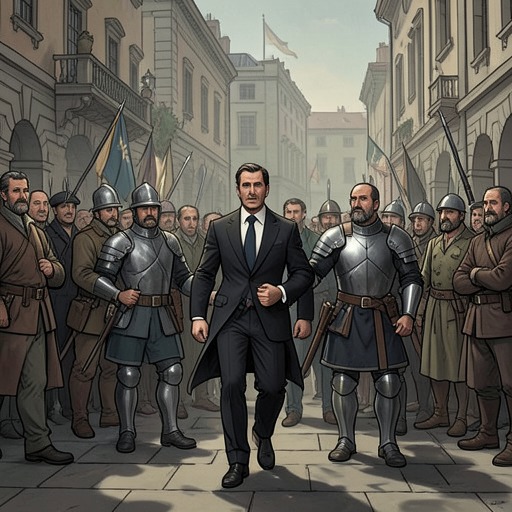
During a fast-paced mirror dance with Laisa Toscane, Miles spots Galeni in the reception room, where an ImpSec colonel and two enlisted guards have confronted him. Delia Koudelka stands nearby, visibly alarmed. Galeni’s rigid posture and contained rage make clear that the exchange is close to becoming physical. The colonel gestures urgently and puts a hand on Galeni’s sleeve; Galeni shakes him off, while one guard loosens the stunner in his holster. The confrontation has begun in the middle of a celebration, before a roomful of witnesses.
Miles steps away from Laisa and asks quietly what is wrong, trying to lower the volume as attention turns toward the group. The colonel tells him that General Haroche has ordered Galeni’s arrest. No charge has been specified, and the colonel is required to remove him immediately from the Imperial Residence. Haroche is not there yet; he is following on. The absence of an explanation leaves the order especially alarming, while its setting makes the arrest impossible to treat as a private or inconspicuous matter.
Miles advises Galeni to go quietly while he looks into the order. Galeni’s baffled suspicion and frustration register the cost of complying, but Miles sees that resistance could get him stunned or manhandled in front of the reception guests. After Galeni asks Ivan Vorpatril to ensure Delia gets home safely, the guards escort him out without touching him. Once they turn a corridor corner, however, they push him against a wall and begin frisking and binding him. Miles intervenes just before Galeni swings on them, telling the officers that this is unnecessary and insisting that Galeni will accompany them as a fellow officer. Galeni unclenches his fists and straightens his tunic rather than fighting.
Only when Miles presses the colonel for the real charge does the officer disclose it: treason. Galeni reacts furiously, and Miles immediately rejects the accusation while using a hand on Galeni’s sleeve to restrain any more violent response. He tells Galeni that he will come to see him after speaking with Haroche. In the moment, Miles can prevent a physical escalation, but not the arrest itself.
Why Miles does not simply secure his release
The eventual explanation makes the public scene look less like clumsiness than choreography. Miles later recognizes that having Galeni arrested at the Imperial Residence, in front of so many people, was meant to destroy his reputation. In that light, a quick release or an acquittal based only on insufficient evidence would not necessarily undo the suspicion left behind. Miles concludes that he has to identify the real culprit, rather than merely exercise his authority to free Galeni.
The delay is consequential. When Galeni finally leaves detention, he is still wearing the dress greens from Gregor’s reception, now rumpled; he is unshaven, red-eyed, pale from lack of sleep, and still visibly tense. Delia is at his side as he completes his exit documentation under the supervision of General Allegre and the duty officer. Miles arrives with Simon Illyan and Ivan looking on. Galeni angrily confronts Miles, saying he had expected him to follow through and that he intends to quit ImpSec as soon as he is out. His fury has been sharpened by the uncertainty of waiting without knowing what Miles was doing.
Miles apologizes and explains that a seizure interrupted him, after which he had to sort through Haroche’s misdirection in the comconsole report and fetch Vaughn Weddell from his laboratory at the Imperial Science Institute. He had not dared to contact anyone by comconsole from Vorkosigan House, so he had to go in person. The work took the day: Miles says he had to assemble evidence sufficient to clear Galeni, not simply issue an order that could be dismissed as favoritism. Illyan observes that only five days have passed since the sabotage was discovered, while Miles wryly notes that producing his Auditor’s report will take longer than solving the case.
Haroche exposed and Galeni cleared
Miles identifies Haroche as the culprit and says that he wanted a promotion. General Allegre confirms the accusation, and Galeni turns to him in astonishment. Miles explains the sequence as he understands it: once the bioengineered prokaryotes were discovered, Haroche could no longer count on his sabotage passing undetected. He then needed a scapegoat, not necessarily a perfect one, but one who could create enough confusion to halt the search for someone else. Haroche disliked Miles, judged Galeni to fit the profile, and found a way to bring both men down at once.
That account changes the meaning of the treason charge. Galeni was not simply caught up in a mistaken investigation: Haroche’s plan used the public arrest to stain his reputation while turning him into a plausible suspect in the sabotage. The attempt to implicate Miles at the same time joined the two men’s immediate danger, even as it made Galeni’s arrest part of a broader effort to obstruct the search for the actual perpetrator. The exposed motive is professional advancement, pursued through deception and the deliberate use of suspicion against colleagues.
Miles also acknowledges the personal cost of keeping Galeni uninformed. He had asked Delia to leave Galeni in the dark because, while the outcome was uncertain, he did not want to make promises he might not be able to keep. When Galeni understands that Haroche was responsible, he tells Miles to forget what he said; General Allegre still anxiously asks whether that includes Galeni’s threat to resign his commission. The exchange does not erase the indignity or the hours of fear, but it marks the shift from suspected traitor to a man whose arrest has been explained as a frame-up.
The event’s reversal
The arrest and exoneration hinge on a distinction between immediate authority and demonstrated innocence. Miles can interrupt the guards’ rough handling and advise Galeni to cooperate, but he does not treat his position as enough to make the accusation disappear. By waiting until he can identify Haroche, he seeks a clearance that can withstand the suspicion the public arrest was designed to create. The same choice prolongs Galeni’s detention and leaves him to endure the consequences before Miles can explain the case.
The episode also makes the manner of arrest part of the evidence of intent. At first, the reception’s visibility looks like an inexplicable failure of discretion; in retrospect, Miles recognizes it as a means of damaging Galeni in the eyes of others. The conclusion therefore reverses the public image created at the beginning: the officer marched away under a treason charge is not the saboteur, but a deliberately chosen scapegoat. His release follows the identification of Haroche, not a quiet withdrawal of suspicion, and exposes how the investigation itself had been turned into an instrument of concealment.