Gregor and Laisa’s betrothal ceremony
MemoryGregor and Laisa Toscane’s betrothal ceremony transforms their accepted marriage plans into a public Imperial ritual, at once a family celebration and a carefully managed statement about Barrayar and Komarr. Its winter setting, formal exchanges, and modified traditions show how the couple’s union is being fitted to inherited ceremony without being wholly governed by it.
Political Stakes and the Betrothal’s Timing
The ceremony follows a marriage proposal that Gregor and Laisa have accepted, but the public arrangements take time. Gregor wants the betrothal ceremony immediately; Lady Alys Vorpatril insists that its announcement wait until after her return from Komarr, where she is to serve as Gregor’s Voice to Laisa’s parents and oversee the proper forms. Their compromise puts the formal betrothal after that return, while the wedding remains planned for nearly a year later. Lady Alys also argues that the Vor ladies need time to prepare their dress, a practical concern that Miles Vorkosigan suggests may help bring the conservative Old Vor faction around to Gregor’s plans.
The timing carries political weight because Laisa is Komarran. Miles recognizes that her possible future as Empress could alarm both conservative Vor lords and radical Komarrans, even as the Centrist Coalition might be persuaded to support the match. Gregor, for his part, sees the marriage as a possible symbol of Imperial unity. He later voices the hope that it might help heal relations with Komarr; Miles answers that the marriage of Duv Galeni and Delia Koudelka could reinforce the same cross-planetary connection. The ceremony therefore places a personal commitment within a wider, unsettled argument about belonging and Imperial rule.
Gregor and Lady Alys also consider holding two weddings, one in Barrayar and one on Komarr. Gregor calls the prospect a double ordeal, but says it would be worth it. The distinction matters: the betrothal takes place at the Imperial court, while the plans already anticipate that the marriage will need to address both sides of the couple’s political and family worlds.
Winterfair in a Blizzard
Lady Alys, urged on by Gregor, schedules the Emperor’s formal betrothal ceremony as the first social event of the hectic Winterfair season. The day before it, Vorbarr Sultana and three surrounding Districts are struck by the worst Winterfair blizzard in four decades. Commercial shuttleports close, activity at the military port is sharply reduced, and the arriving Viceroy of Sergyar is stranded in orbit. Snow drives horizontally past the windows of Vorkosigan House and piles up to second-story height in some parts of the capital.
The weather alters the preparations as well as the city’s movement. Miles abandons his plan to fly himself to the Imperial Residence and instead joins the Countess Vorkosigan and her retinue in groundcars. His attempt to get everyone out early is interrupted when he discovers that Zap the Cat has made a nest among his boots and clothing and given birth to six kittens. He salvages his best boots and House uniform, sending them to Armsman Pym for hurried cleaning; the Countess, delighted by the new kittens, stays to admire them. The morning’s domestic disorder helps explain why Lady Alys’s party reaches its appointment with tradition an hour late.
The ceremony takes place in the largest ballroom because it draws a huge crowd and is the first social event of Winterfair. With the city effectively snowbound, the gathering does not end with the formal proceedings: the party continues for hours. The blizzard thus frames the event as both an Imperial spectacle and a community held together indoors by circumstance.
The Ceremony and Its Participants
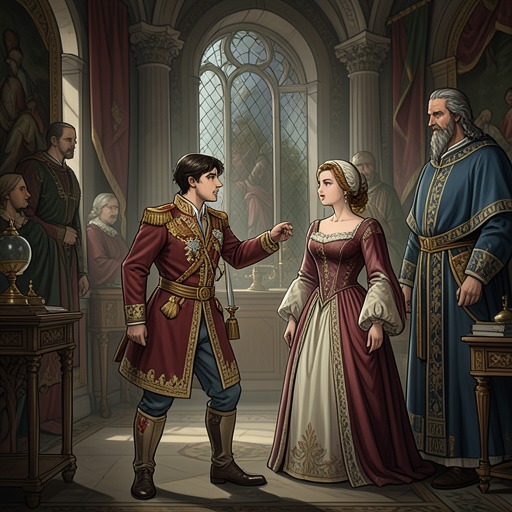
The two parties face one another in lines like small armies. Laisa stands with her parents and a Komarran woman-friend serving as her Second; Gregor is flanked by his foster parents, Count Vorkosigan and Countess Vorkosigan, and by Miles Vorkosigan as his Second. Lady Alys Vorpatril acts as go-between. Laisa wears a Komarran jacket and trousers in Winterfair red, a compromise that makes her Komarran dress legible within Barrayaran ceremony without erasing either side.
The role of Second retains the language of an older and more dangerous custom, but not its former legal burden. Once, a Second could be obliged to marry the surviving fiancé if a fatal accident occurred between betrothal and wedding. By the time of Gregor and Laisa’s ceremony, Seconds are instead responsible for carrying ceremonial gifts between the parties. The ritual preserves the form of an exchange while shedding that particular coercive consequence.
The gifts make the exchange tangible. Laisa’s parents offer money in elaborate wrappers; Gregor’s side brings food, including colored groats tied with silver tinsel, maple mead, and wine. A silver-gilt bridle arrives without a horse, leaving its symbolism unclear to Miles. Laisa’s mother also offers a small, blunt-edged, scalpel-like knife as a pledge of her daughter’s genetic cleanliness, but that gift has quietly been removed from the ceremony. The assortment mixes legible tokens of provision and status with older customs whose meanings are more awkward or obscure.
The Admonishments and the Pledges
As Gregor’s Second, Miles reads the Admonishments to the Bride from a parchment scroll. He delivers the traditional text in a clear voice and with a straight face, approaching it as if it were a briefing to the Dendarii. The performance gives the ceremony a moment of dry formality, but the text itself has been discreetly revised.
Most notably, its comments on the Duty to Bear an Heir no longer imply that Laisa must bear a child in her own body. The alteration acknowledges the physical dangers of pregnancy without turning the ceremony into an open dispute over tradition. Miles notices that the wording has been subtly changed; Laisa’s mother, less comfortable with the remaining admonitions, seeks reassurance from Countess Vorkosigan, who responds with discreet gestures encouraging her not to take them too seriously. The revisions allow the old ritual to proceed while making room for a different understanding of the bride’s obligations.
There are no reciprocal Admonishments to the Groom, an imbalance Miles associates with Elli Quinn’s likely criticism. After the reading, the fiancés join hands—not directly, but each by taking one of Lady Alys’s hands—and exchange promissory pledges at this carefully chaperoned distance. The ceremony’s gestures make their commitment public, even as its arrangement keeps the couple within prescribed forms.
Aftermath and Significance
Once the pledges are exchanged, the ceremony gives way to a long party. Gregor first claims his father’s attention, while Miles moves among the guests. He sees the Koudelka family and Duv Galeni in serious conversation with his prospective father-in-law, the Commodore, with Delia beside Galeni. Galeni has decided not to resign his commission, to Miles’s relief, and is being considered for leadership of Komarran Affairs. His presence with Delia’s family offers a visible counterpoint to the damage still lingering from Lucas Haroche’s calculatedly clumsy arrest of him at Vorkosigan House weeks earlier. Marriage, here too, brings a Komarran into Barrayaran family and political networks.
The betrothal does not settle the strains it symbolizes. Gregor hopes that his marriage can contribute to reconciliation, but the political reactions Miles anticipates make clear that a ceremony cannot by itself resolve resentment or make Imperial unity uncontested. Its importance lies instead in making the intended union public: Komarran dress appears in Winterfair red, revised language enters an old text, and two family parties exchange pledges under Imperial auspices. The event affirms a future shared across political boundaries without pretending those boundaries have disappeared.