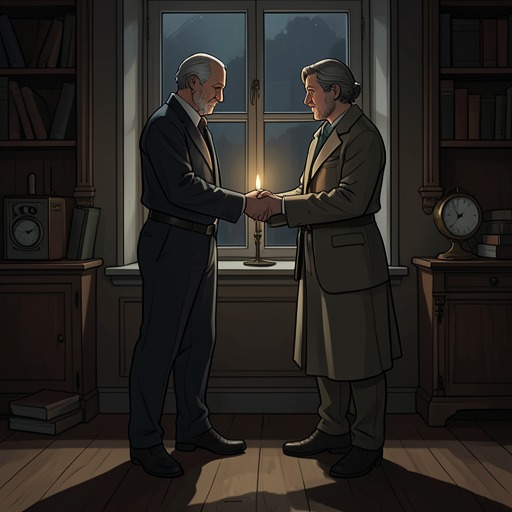
Miles and Elli choose separate paths
MemoryMiles Vorkosigan and Elli Quinn choose separate paths when they recognize that staying together would require one of them to abandon an essential part of who they are. Miles asks Elli to build a life with him on Barrayar, but she cannot accept the role of Lady Vorkosigan in exchange for their closeness. He, in turn, cannot preserve their relationship by suspending the life and identity he has chosen. Their parting is painful, but it becomes an act of honesty: each is asked to choose as a whole person, not as a selectively edited version of themselves.
The Future Miles Offers
The conversation turns from Miles’s newly stated career ambition to the consequences of his choice for their relationship. Elli has not imagined this particular ambition in him before, and she asks what it means for them. If he is not returning to the Dendarii, she may never see him again. The controlled way she raises the possibility does not make the stakes smaller; it gives the question a precise edge. The decision about work has become a decision about where, and with whom, their lives can continue.
Miles has wanted to speak to her personally before the next day’s business overtakes them. He proposes that she come to Barrayar and become Lady Vorkosigan, so that they could be together. The offer is intimate, but it also carries an assumption that Elli makes explicit: living beside Lord Vorkosigan would not necessarily mean living with Miles as she knows him. She distinguishes the public identity he would occupy from the person she loves, and refuses to treat marriage as a simple route around that difference.
Miles does not answer by promising that the conflict will disappear. He acknowledges that he is constrained, and asks her to choose whether she can come with him even if she would be unhappy. His appeal is neither a picture of easy adjustment nor a claim that Barrayar will become welcoming by itself. He suggests that Elli might make the place less dreadful, but the possibility does not cancel the cost she sees in the proposed life. Their exchange keeps the choice concrete: not love in the abstract, but a home and a social role that Elli does not want to inhabit.
A Choice Between Whole Selves
Elli says that she cannot be what Miles wants from her, cannot be his Lady Vorkosigan. Miles answers that he can give her everything he has, but cannot offer a lesser or selectively divided version of himself. He has spent years trying to extinguish Lord Vorkosigan, yet has not succeeded even for her. The admission recasts the offer: he is not asking her to join a life from which his Barrayaran identity can be removed. That identity is part of the person and future he brings to the relationship.
Elli names the corresponding cost for herself. In her view, accepting his proposal would mean Admiral Quinn being annihilated and Lady Vorkosigan rising in her place. She is unwilling to describe that transformation as a minor compromise or a costume she could take off later. Her request that they leave together presses toward a different answer: rather than her entering his chosen life, Miles could leave it with her. His refusal shows that the impasse is not simply a failure to find a compromise. Each proposal asks one of them to move away from a life that the other cannot honestly promise to relinquish.
The exchange also clarifies what Miles means by asking her to choose herself. When Elli identifies herself as Admiral Quinn, he says he had understood that already. He presses her to decide now, and accepts her objection that he, not she, is forcing the choice. He does not deny the pressure he has created. Instead, he says he can continue with her or continue without her, but cannot freeze in place for her. The language of preservation marks the danger in their attempted bargain: keeping the relationship unchanged would not be the same as keeping either person alive to their own future.
Parting Without Erasure
After the choice is spoken, the conversation does not turn into a claim that either person has stopped loving the other. Elli recognizes the part of Miles that wants her to be free, while questioning whether freedom is something she can exercise whenever she chooses. Her answer leaves room for difficulty without retracting her decision. They look at each other at length, as if trying to retain the image of the other, and she wishes him well in finding his Lady Vorkosigan. Miles shares the hope, while admitting that he dreads the search; Elli calls him lazy. Their final exchange preserves their familiar affection even as it confirms that affection cannot settle the practical question.
They spend one last night together, framed as both farewell and a final attempt to please one another enough to change the outcome. Miles recognizes that changing their minds would not suffice: they would have to change their whole selves. That realization gives the intimacy its melancholy shape without turning it into a reconciliation. The relationship reaches an ending in shared care, but not in agreement about where to live or which identity to surrender. The evidence establishes this parting and its emotional terms; it does not establish what either of them will choose in every later circumstance.
Significance of the Separation
The scene refuses the consoling idea that love automatically resolves conflicts of vocation, home, and identity. Miles will not make his future conditional on preserving the relationship, and Elli will not exchange her identity as Admiral Quinn for the status of Lady Vorkosigan. Their decision is painful precisely because neither reduces the other to an obstacle or a villain. Each understands what the other is asking, and each sees why the other cannot simply comply.
The separation also makes choice more demanding than a declaration of independence. Miles tells Elli to choose who she is, but the decision is shaped by a real cost: a shared life with him is not available without the Barrayaran future he insists on inhabiting. Elli's freedom is therefore neither taken from her nor effortless. Likewise, Miles's resolve is not a claim that he can avoid grief. He accepts that he may have to continue without her, and rejects immobility as the price of keeping her. The ending leaves both characters with loss, but not with a demand to pretend that one person's selfhood can be traded for the other's desire.