Miles's Dismissal for Falsifying Reports
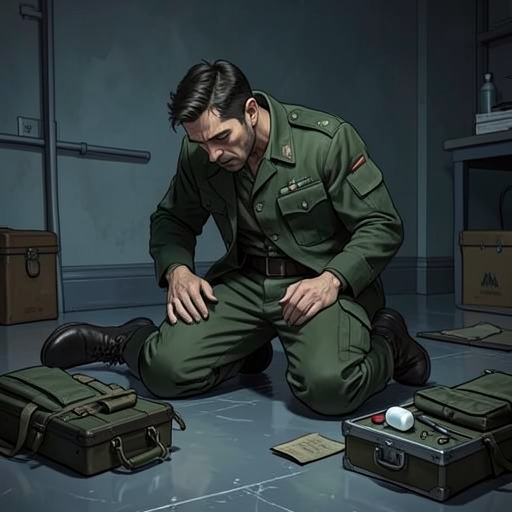
MemoryMiles Vorkosigan’s dismissal from ImpSec severed him from the service and covert identity around which he had built his adult life. The decisive cause was not his post-cryo-revival seizures but his falsification of a report; the distinction left him medically vulnerable, professionally disgraced, and unable to return to the career he had tried to protect.
Career and the concealed medical crisis
For roughly a decade, Miles had cultivated the cover identity of Admiral Naismith, leader of the Dendarii Free Mercenary Fleet, while serving as one of ImpSec’s most creative agents in galactic affairs. The mercenary identity let him operate beyond the Barrayaran Empire’s ordinary political and geographic reach. He regarded this work not as a detachable assignment but as the hard-won form of a life’s ambition.
That career continued after Miles was revived from cryogenic stasis, despite a serious unresolved medical problem. Soon after his revival, he experienced several seizures, each involving convulsions that lasted two to five minutes and seemed to be triggered by extreme stress. His surgeon expected them possibly to resolve on their own, as his memory loss and shortness of breath had begun to do; when the seizures appeared to subside, Miles did not disclose them to his ImpSec doctors. In a later account, he admitted that they had occurred three or four—or perhaps five—times soon after he was brought back.
The concealment meant that his service did not know about a condition he himself described as a danger in his head. It also shaped the stakes of his subsequent choices: Miles feared losing the professional identity he had spent years constructing, yet his silence placed that identity alongside a growing pattern of self-deception. The seizures explain the pressure under which he was operating, but they were not the stated grounds for his eventual discharge.
The dismissal and its stated cause
Miles later made the cause explicit: ImpSec had not removed him for having seizures; it had removed him for falsifying a report. He called the matter substantial rather than minor. The available account does not specify the report’s contents, so the significance of the act lies in the breach itself and in Miles’s acknowledgment that it was his responsibility.
The distinction also undercut the medical-discharge explanation he gave at the gate after leaving the service. When a guard addressed him as a lieutenant, Miles corrected him: he had mustered out altogether, ostensibly on medical grounds. The guard accepted the explanation without pressing him. That exchange shows how an account designed to spare embarrassment could stand in for the more painful truth, even as Miles privately recognized that the dismissal was disciplinary, not simply a consequence of illness.
Consequences for career and identity
The dismissal cost Miles thirteen years of career effort, as he later described it, and turned the future he had imagined into civilian life. At nearly thirty, he had never expected to find himself a civilian. His grief was sharpened by the sense that he had sacrificed his integrity to preserve an identity that was due to be taken from him within a year anyway. That counterfactual did not undo the falsification; it clarified the bitter mismatch between what he had risked and what he could have gained.
Gregor had seen Miles as a member of his own generation who might be entrusted with real power and responsibility in the upper reaches of government. Miles’s removal therefore represented more than the loss of an operational post. It closed off a path toward public authority that Gregor had hoped to make possible, and left Miles confronting the consequences of having damaged the very trust on which such responsibility depended.
No simple route back
When asked why he had not pursued treatment, Miles rejected the idea that a medical cure would restore his position. Even if doctors could guarantee that he would be fully fit the next day, he reasoned, that would not change the fact that ImpSec had dismissed him for falsifying a report. He believed Simon Illyan would not take him back—not because of the seizures, but because principle made reinstatement impossible.
The event therefore marks both an institutional separation and a moral reckoning. Miles’s undisclosed illness had been real, and his fear of losing his vocation was understandable, but the dismissal turned the concealed crisis into a question of trust. His later willingness to describe the sequence plainly—to connect the seizures, the lie about them, the falsified report, and the discharge—begins a different kind of self-accounting, one no longer secured by the Admiral Naismith persona.