Himmel Station
Mickey7Himmel Station is the orbital waystation where Mickey Barnes’s life aboard the Drakkar begins to take shape. It is at once an assembly-site waiting room, a training ground, and the setting for his first backup. The station’s brief place in the chronology is therefore unusually consequential: before Mickey faces repeated death and regeneration, Himmel Station teaches him how the machinery works and gives him a framework for asking whether memory can preserve a self.
An orbital threshold
Mickey arrives by shuttle two days after interviewing Gwen Johansen and three days after an encounter with one of Darius Blank’s minions. The shuttle docks at the orbital assembly plant where workers are completing the Drakkar. Although Hieronymus Marshall is there when Mickey arrives, the welcome is not an easy one: Mickey has never experienced free fall, and the shuttle’s gravitics cut out on approach. The station introduces him to a physical condition he had previously imagined, from entertainment broadcasts, as something like floating in an ocean.
Marshall waits in the lounge by a viewport opposite the air lock. Once the shuttle’s dozen would-be colonists have drifted inside and the inner air-lock door has shut, he addresses them as the expedition’s designated commander. He has them identify who has been off-planet before and who is trying not to vomit; the exchange places the station between ordinary terrestrial experience and a journey from which there is no simple return. He explains that Himmel Station will be their home until the Drakkar is cleared for boarding. From the lounge, Midgard turns below them, about five hundred kilometers away, making the station both a staging point and a visible separation from the world the colonists are leaving.
Learning the ship and its hazards
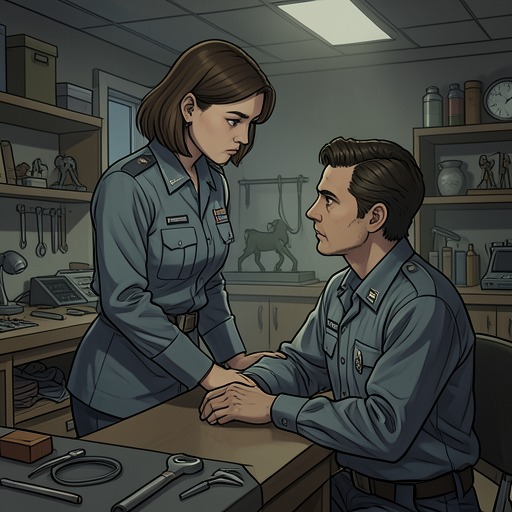
During almost all of Mickey’s stay, Jemma teaches him. Her instruction is patient and attentive: she brings hot chai to morning sessions, slows down and repeats an explanation when he struggles to pick something up, and never lets him see if she thinks he is unintelligent. The station’s role as a place of preparation is measured not only in the subjects she covers but in this steady adjustment of the lessons to the person who must use them.
Their first day’s work concerns the Drakkar’s engine systems. Mickey studies where the antimatter is stored, how it is contained, where the reactants are kept, and how the two are brought together. Jemma emphasizes what could happen if a component failed, including the failure of antimatter containment. The lesson makes the ship’s propulsion inseparable from its dangers: Mickey is being taught not simply how the systems function, but what their failure would mean.
Other sessions give him practical familiarity with equipment he will later use. Jemma teaches him the basics of handling a Linear accelerator through a realistic simulation in which he fights space zombies; when he eventually uses a real one years later, he finds the experience not much different. She also teaches him to get in and out of a vacuum suit and assemble a full set of combat armor. Himmel Station thus prepares him through both explanation and rehearsal, giving him a first encounter with procedures that would otherwise meet him only under pressure.
The station outside the classroom
On the sixth day, Jemma takes Mickey outside. For an hour they clamber around the station’s hull, practicing how to tighten and loosen bolts with recoilless wrenches. The exercise turns maintenance into a bodily task performed in the station’s exposed exterior, rather than an abstract diagram or classroom instruction. It also gives Mickey a view that remains distinct in his memory: standing with Jemma on the station’s underside, he watches Midgard’s night side roll past and identifies a bright patch as Kiruna.
Himmel Station is also a small, crowded social environment. Mickey later recalls seeing Nasha around from as far back as the station, where fewer than two hundred people lived in the same giant canister. Yet seeing someone is not the same as knowing them: he had never spoken to Nasha there, partly because many people aboard the Drakkar wanted nothing to do with him and he responded by avoiding them in turn. Their eventual meeting takes place about a year after the collision that kills One and Two, during the journey’s coast phase, not at the station. In retrospect, Himmel Station marks the beginning of their shared orbit without pretending that proximity alone created a relationship.
Backup and the question of continuity
Mickey’s first backup takes place on the morning of his twelfth day at Himmel Station. The procedure gathers a blood sample, a small piece of skin from his belly, and cerebrospinal fluid, then uses a scanner for three hours to map the distribution and chemical makeup of every cell in his body. Jemma is waiting when he comes out. She tells him that the way he looks then will be how he looks each time he emerges from the tank for the rest of his life. The comment makes the procedure concrete: the station is not just explaining a future possibility but recording the body that will serve as the template for Mickey’s returns.
Jemma also gives Mickey a way to understand regeneration, comparing the body’s gradual replacement over time with the much faster rebuilding that occurs when an Expendable goes to the tank. She argues that preserved memory makes this rapid remodeling no different in kind from ordinary bodily change. Mickey later recalls her teaching when Cat Chen asks whether he is still Mickey Barnes or another man in Mickey’s clothes. He can say that he feels like the person he was on Midgard, but he cannot know for certain; the absence of a measurable difference leaves the question unanswerable. Himmel Station’s significance, then, extends beyond the period spent there. It is where Mickey receives the backup that enables his continued service and the argument that makes that continuity intelligible, even as the argument cannot settle what, exactly, has continued.