Gault
Mickey7Gault is a beachhead colony whose relatively hospitable conditions could not compensate for the political isolation built into its founding. Established by wealthy settlers who rejected Eden’s social compact, it became the stage for Alan Manikova’s multiplication of himself, his conquest of the planet, and, later, an impact so destructive that Gault could not recover. Its history links a doctrine of radical self-reliance to the failure of collective defense—and makes the name a byword for the consequences of Manikova’s existence.
Founding and Settlement
Gault was founded by a private group made up mostly of extremely wealthy people dissatisfied with the taxes levied on owners of automated production systems in Eden, Midgard, and most other Union worlds. Those taxes supported people who did not own the systems that produced society’s goods. The founders’ stated alternative was Radical Liberty and Self Reliance, a principle that shaped the colony’s institutions from the moment its settlers landed.
The first expedition consisted of 120 colonists. They divided almost immediately into more than twenty family groups, each attempting to make its own way rather than contribute to a common good. Gault was comparatively hospitable, and the settlers had brought substantial resources, so most groups managed to establish themselves. But when a group ran into trouble, its neighbors did not help. The colony’s decentralized ideal therefore offered little protection to people who lacked the means to solve a crisis alone.
By the time Manikova arrived, Gault had grown to about ten thousand people. Many were reasonably settled and not in immediate danger of starvation, yet the population remained fragmented into separate communities, none doing particularly well. The colony’s initial prosperity and its inability to cooperate existed side by side: Gault was not an empty or uniformly desperate world, but it had no effective solidarity to draw on when a threat crossed the boundaries between its enclaves.
Manikova’s Arrival and the Colony’s Fracture
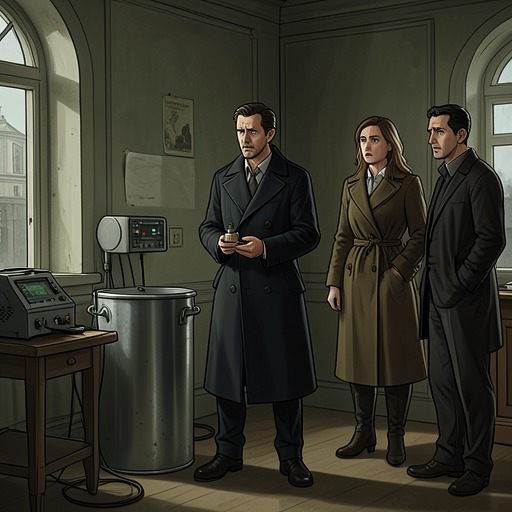
Manikova reached Gault after liquidating his wealth and leaving Eden alone in a custom-built interstellar transport. He had brought equipment, supplies, and the prototype replication unit used in his public demonstration. The colony’s separate groups could not readily produce all the things he carried, so he initially appeared useful. He provided food, seeds, and technology to one of the smaller clans; in return, they gave him a place to live and a base of operations.
Once established, Manikova set about making copies of himself. Creating a human body required large amounts of feedstock, particularly calcium and protein, as well as other materials; the process also generated considerable waste. In about nine months, Manikova exhausted the supplies he had brought, produced close to a hundred copies, and built two more replication units. He had started by abducting indigent and solitary people, but eventually began taking people whose absence their families and friends would notice. Suspicion fell on the newcomer, and the clan hosting him sent Security forces to his compound for questioning.
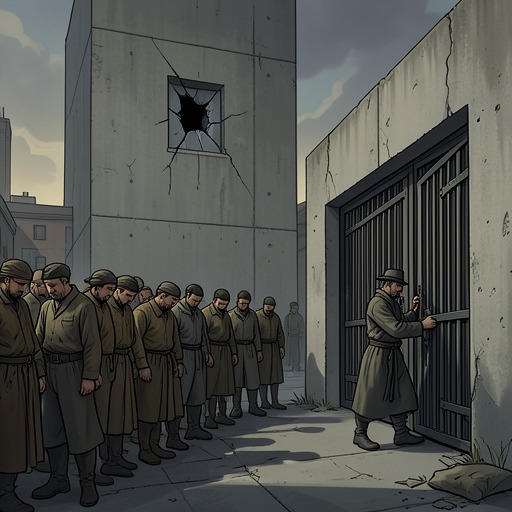
The encounter revealed that Manikova had kept his advanced military technology to himself. Gault’s divisions gave him time and room to answer the challenge with force. He put every member of his host clan through the replication process, armed the resulting copies, and sent them against a neighboring group. The other clans did not begin to consider a unified response for nearly a year. By then, Manikova and his copies formed an absolute majority of the planet’s human population. The remaining clans eventually joined forces, but too late to stop him; their chief effective act was sending a desperate message to Eden describing the conquest and asking for help.
Destruction and Political Afterlife
Gault’s appeal could not bring swift assistance. The message took seven years to reach Eden, and the authorities spent almost two more deciding what to do. The original settlers had been unpopular on their home world, and public opinion tended toward treating their fate as their own responsibility. Eden’s parliament ultimately judged that Manikova might threaten other worlds and that he had to be dealt with.
The planet’s later destruction made Gault more than the site of a political collapse. The Bullet struck three months after the destruction of Eden’s Justice, travelling at 0.97 times the speed of light. Its impact delivered energy equivalent to 200,000 fusion bombs to Gault’s ecosystem in roughly a picosecond. The devastation was irrecoverable. The attack demonstrates how little warning or practical defense a world has against an object arriving at relativistic speed; for Gault, the result was not a damaged colony awaiting relief but a planet that could not come back from the blow.
The Union regards the destruction of a habitable planet as the greatest crime in its history. Yet Farhome is not blamed in popular memory; Manikova is. Since Gault, many people in the Union consider being a multiple more odious than being a child stealer or a human head collector. The colony’s fate thus survives as both a planetary catastrophe and a political stigma attached to multiple human copies.
Significance as a Colonial Experiment
Gault’s history puts its founding ideal under pressure. Radical Liberty and Self Reliance could sustain separate households while conditions remained manageable, but it did not produce a shared means of confronting a danger that exploited their divisions. The same lack of coordination that left struggling neighbors unaided delayed resistance until Manikova had already become the majority. The colony’s failure was not simply that its settlers lacked resources or that its world was uninhabitable; its relatively hospitable setting and initial resources had allowed most groups to survive. The decisive weakness was their inability to act together in time.
The sequence also gives Gault a wider place in the Union’s colonial history: a private settlement founded in opposition to collective redistribution became the setting for a conquest powered by replication, then an example of a habitable world lost to overwhelming violence. Its story connects a local refusal of mutual obligation to consequences on a planetary and interstellar scale.