Farhome
Mickey7Farhome’s place in the history of Gault is defined by an extreme imbalance: a young, poor colony had few resources for a conventional expedition, yet its government chose a response powerful enough to destroy a planet. The weapon it called The Bullet ended Alan Manikova’s rule, but the catastrophe was remembered across the Union chiefly as Manikova’s responsibility, not Farhome’s.
A neighboring colony receives the warning
Farhome was Gault’s next-closest neighbor, a much younger, poorer, second-generation colony. It learned of the crisis through Gault’s last messages, sent by surviving clans after Manikova had turned the people of his host clan into copies of himself, armed them, and begun conquering the planet. The clans eventually joined forces, but too late to prevent Manikova from becoming an absolute majority of Gault’s human population; their desperate appeal asked Eden for help.
The message reached more than its intended audience. Eden’s government considered an expedition, but Farhome’s government was, if anything, more alarmed by what had happened. It lacked the ambition and resources to mount an operation like Eden’s. That disparity shaped its answer: rather than matching Eden’s expedition, Farhome chose a simpler and much cheaper means of striking Gault.
The Bullet
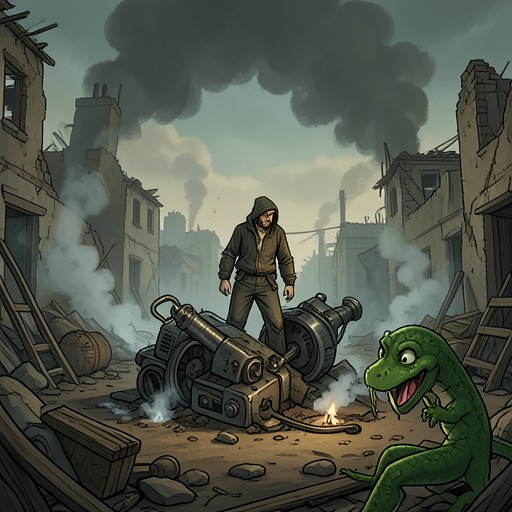
Farhome’s answer was The Bullet, an interstellar attack that relied on impact rather than deceleration. Eden’s Justice had been vulnerable while slowing down: Manikova’s nuclear-tipped missiles struck the ship as it decelerated toward Gault. The Bullet avoided that weakness by never attempting to slow down. Traveling at 0.97 times the speed of light, it hit Gault three months after the destruction of Eden’s Justice.
At that speed, the projectile did not need to be especially massive to deliver catastrophic force. Its impact transferred energy equivalent to two hundred thousand fusion bombs to Gault’s ecosystem in roughly a picosecond. The contrast with Farhome’s limited resources is stark: it could not afford a conventional expedition on Eden’s scale, but the weapon it chose made the planet itself the target and left no practical opportunity for defense.
Destruction and responsibility
Gault did not recover from the impact. The destruction of a habitable planet came to be regarded as the greatest crime in Union history, a measure of the scale of the loss as well as the attack’s lasting political significance. The episode also made clear how dangerous interstellar violence could be when speed turned a comparatively small object into a planetary weapon.
Despite delivering that force, Farhome was not blamed for Gault’s destruction. The Union’s judgment placed responsibility on Manikova, whose conquest had provoked the response; in its aftermath, being a multiple became more socially reviled than even such notorious crimes as child stealing or collecting human heads. Farhome therefore occupies a peculiar position in the account: its government chose the means that annihilated Gault, while the moral and political blame settled on the man whose rule had made the attack seem necessary.