Creeper Tunnels
Mickey7The Creeper Tunnels are an underground passage system beneath the ice near the human colony on Niflheim. Their known entrance is a steep, slanting tunnel cut through rock at the bottom of a crevasse; the tunnels matter not only as a route into the creepers’ territory, but as the place where a planned extermination gives way to contact. In the novel, the approach makes the choice stark: the same opening that can be entered by armed humans leads toward beings Mickey Barnes recognizes as sentient.
Setting and Access
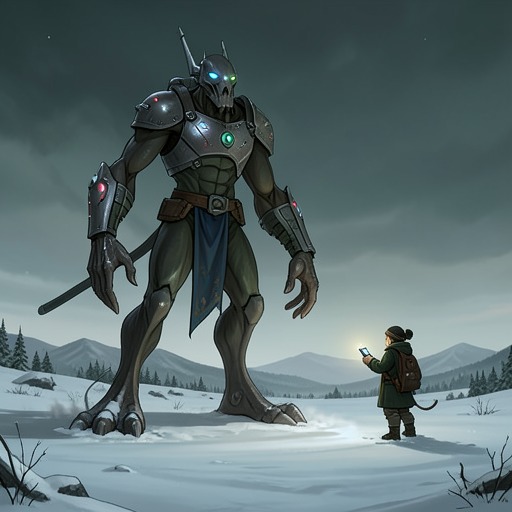
The approach begins in a crevasse whose floor is roughly six meters across, with ice walls rising about thirty meters on either side. A boulder jutting from one wall resembles a monkey’s head. Beyond it, Mickey Barnes spots the opening where he fell earlier; the recent snowfall has not concealed it. The entrance is a little over a meter wide, steep, slanting, and rock-walled. These details define what the narrative establishes about the tunnels: a constricted threshold reached through unstable ice, not a fully mapped underground landscape.
Mickey Barnes and Mickey8 are lowered into the crevasse, then walk toward the opening after Berto Gomez’s shuttle departs. Mickey Barnes is unsure whether they have found the precise place where he previously went down, but thinks that if not, they need only find another entrance to the tunnel system. The uncertainty makes access feel provisional: the route is identifiable, yet the surrounding ground is undermined and the entrance is only one possible way below.
That danger belongs to a broader reality of life on Niflheim. Mickey Barnes recalls that an Expendable may be sent to explore crevasses that could be unstable and contain carnivorous local fauna, work he had assumed might instead be done by remote machines. The tunnels therefore sit within a landscape where exploration itself can be lethal and where a human body is repeatedly put at risk because it can withstand conditions or perform tasks that machinery cannot.
The Tunnels and the Extermination Plan
At the entrance, the two Mickeys are carrying packs containing miniature bubble bombs. Each holds fifty thousand tiny antimatter nuggets, isolated inside magnetic monopole bubbles. Once released, the bubbles would drift through the air before eventually popping. The weapons are not ordinary tools for clearing a passage: Mickey Barnes calls them war crimes, and warns that if Midgard learns the colonists used them against sentient beings, the colony could face the kind of devastation associated with Gault.
The location sharpens the moral and practical stakes of that warning. The plan would take the humans from the open crevasse into a tunnel system occupied by the creepers, using an extraordinarily destructive weapon against beings whose territory the colony is approaching. The danger is not abstract: antimatter interacting with normal matter can produce gamma rays or streams of subatomic particles moving at a substantial fraction of the speed of light. The bombs thus threaten more than the intended targets; their presence makes the tunnels a threshold to a potentially catastrophic act.
Mickey8 believes they should proceed, while Mickey Barnes argues that they should not. His objection is specific: the creepers are sentient, and deploying these weapons against them would have severe consequences if discovered. The entrance is where their disagreement becomes unavoidable. It is no longer merely a question of whether a dangerous descent can be managed; it is a question of what the humans are prepared to do once they reach the inhabitants below.
Encounter and Communication
The planned violence does not define the tunnels’ decisive outcome. After a creeper’s head settles onto the tunnel floor and its mandibles slowly close, Mickey8 identifies himself as a Prime and asks whether they can talk. Mickey Barnes’s narration then confirms that they do. The brief transition—from the visible threat of the creeper’s jaws to an exchange—makes the underground setting the site of first communication rather than the scene of an attack carried through to completion.
This encounter changes the meaning of the route. The tunnels had been approached as a dangerous space to enter and potentially clear with antimatter; they become a place where the humans can address the creepers directly. That change does not establish that the tunnels are safe, that the two populations fully understand one another, or that every danger has passed. What it does establish is that the beings living there can be met as participants in communication, not simply treated as hostile local fauna.
The broader consequences extend back to the colony. In a later conversation, Hieronymus Marshall says he hopes the creepers will keep to their tunnels and away from the dome, and argues that the colonists must return to ensuring the colony’s survival. He also points out that producing two devices has dangerously reduced the remaining antimatter supply, with no foreseeable prospect of replacing it and the colony’s power plant dependent on that fuel. The tunnels are therefore connected both to the possibility of coexistence and to the material costs of the humans’ attempt to destroy the creatures within them.
Continued Significance
Later, Mickey Barnes leads Nasha toward a hillside and down a gully, explaining that they are close to an entrance to the creeper tunnel system. Nasha notices that the area looks like creeper country and asks why they have come; Mickey Barnes says he needs to check on something, without specifying what. This return to the vicinity of the tunnels shows that contact has not erased the importance of the underground world. It remains a place to which the humans must orient themselves, even after the immediate extermination plan has given way to communication.
The tunnels’ narrative significance lies in this reversal and in the limits of what is known about them. The text gives a precise, memorable approach—an ice crevasse, a monkey-headed boulder, and a narrow rock passage—but does not provide a comprehensive map of the passages below. Instead, it makes the entrance carry the conflict: human survival and dwindling resources press toward an armed solution, while the recognition of creeper sentience demands a different relation. The route beneath the ice becomes the boundary at which an assumed enemy can answer back.