Roanoke
Mickey7Roanoke is a harsh, tidally locked planet where a colony’s struggle to survive became a catastrophe of ecological conflict and failed recognition. Nearly two centuries before the events on Niflheim, its settlers confronted a native population whose intelligence did not resemble the technological signs they expected. By the time they understood that Roanoke’s life was not merely hostile but strategically adaptive, the settlement had been overtaken from within as well as attacked from outside.
Planetary Setting and the Beachhead
Roanoke lies about fifty light-years spinward from Niflheim, and its colonization was the last occasion, in the account given, when native life seriously opposed a human landfall. The world is an old red-dwarf planet, tidally locked with almost no axial tilt and a thirty-one-day orbital period. Its geography leaves little room for human habitation: one pole rarely falls below eighty degrees Celsius, while snow made of carbon dioxide falls at the other. Between them stretches a perpetual-twilight belt about a thousand kilometers wide, the planet’s more or less habitable strip.
That narrow band is also the setting of an ancient ecological struggle. Roanoke may have supported life for roughly seven billion years, and organisms there have spent that time competing for a foothold in the dry, wind-scoured belt. The colony arrived carrying millions of liters of liquid water, a resource whose abundance made the settlement an attractive target in a place where life was under constant pressure. The settlers’ arrival did not create Roanoke’s conflict; it inserted a new, concentrated store of resources into it.
The Colony Under Attack
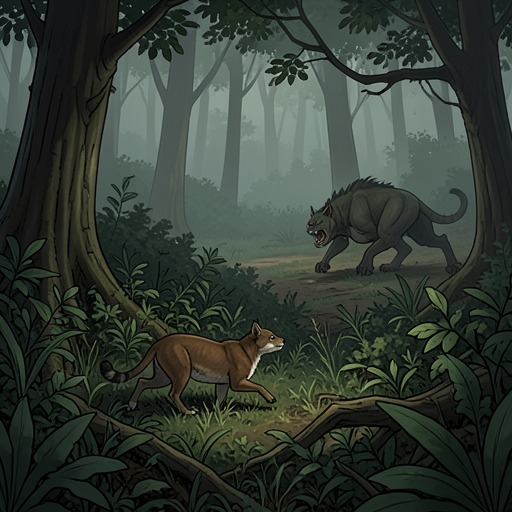
The settlers could not keep people alive outside the main dome for more than an hour. Losses came in ones and twos, week after week. Among the dangers were tiny organisms carried on the wind that burrowed into exposed skin, causing rashes, pus-filled blisters, sepsis, and death. Other creatures resembled sand-burrowing starfish, with fangs that could pierce armor and venom that killed within minutes. Insect-like animals, some half a human’s size, could shoot concentrated sulfuric acid from glands in their heads. The local fauna seemed almost designed to defeat the colony’s defenses.
As casualties mounted, the settlers began making additional copies of their Expendable, despite the taboo against doing so, simply to keep their berths filled. They eventually sealed the colony and tried to investigate the threat through research and sterilization. That retreat did not secure them: something was reproducing inside the dome, and six sterilization protocols failed to prevent its return. The colony’s central processor continued producing copies until its supply of amino acids ran out. A system intended to replace people lost to the exterior threat thus became part of the final image of the settlement: a population made up entirely of copies, sustained until the material needed to make more was exhausted.
Native Intelligence and the Failure to Recognize It
The colonists did not identify Roanoke’s inhabitants as intelligent because the locals did not use tools in the familiar technological sense. They emitted no electromagnetic signals and had no power plants, roads, cars, cities, or agriculture, as far as the settlers could tell. Their capabilities lay elsewhere: they were exceptionally skilled genetic engineers. Combined with extreme territoriality and xenophobia, that expertise let them confront the colony in ways its inhabitants initially misread as a succession of natural hazards.
One clue came too late. Biology had released a phage designed to kill one of the microorganisms devastating the settlers; a resistant strain appeared six hours later. A dying Expendable, Jerrol-two-hundred-and-something, recorded the realization that the attacks might be deliberate. The colony’s records do not provide a successful response to that insight: by then, the settlers were already being overwhelmed. Roanoke’s collapse therefore turns on more than environmental danger. The humans’ categories for recognizing intelligence were too narrow, and the absence of familiar technology concealed an adversary capable of biological adaptation.
Roanoke as a Warning
The account of Roanoke follows Mickey Barnes as he considers whether the giant creeper he encountered on Niflheim might be intelligent and whether an earlier Expendable could have recognized a similar truth on Roanoke but failed to report it. The possibility makes disclosure a question of responsibility: if a settlement dies because its people overlook native intelligence, silence or misclassification can have consequences beyond the individual who first encounters it. Mickey Barnes fears that Niflheim might fail for that reason, not simply because the planet is dangerous.
Roanoke also gives that fear an institutional weight. Hieronymus Marshall warns that if the Niflheim colony falls, its survivors could face a fate like the last sick Expendable on Roanoke, surrounded by copies of Mickey Barnes. The reference connects the earlier colony’s collapse to the present danger of both ecological failure and multiplying copies. Later, when Mickey Barnes weighs what to tell Command about life beneath Niflheim’s snow, the memory of Dugan being pulled under and the precedent of Roanoke press against his hesitation.
The comparison is not that Roanoke and Niflheim are identical. Rather, Roanoke makes the limits of human interpretation part of the survival problem: settlers can build domes, deploy biological countermeasures, and reproduce workers, yet those measures cannot compensate for failing to understand the living world they have entered. Its story turns the planet from a remote historical disaster into a test of whether the new colony can recognize native intelligence before fear and misjudgment harden into another irreversible failure.