Mickey Barnes's enlistment as the Drakkar's Expendable
Mickey7Mickey Barnes's enlistment as the Drakkar's Expendable begins not as a heroic call to adventure but as a narrowing of alternatives. Deep in debt to Darius Blank, and unable to see a reasonable way out of Blank's reach, Mickey accepts the one berth nobody else wants. Years later, facing the disassembler field interface on Niflheim, he remembers the thumb pressed onto Gwen Johansen's reader pad and still judges the decision right: the perilous promise of being repeatedly restored had become preferable to the life closing around him.
Debt and the narrowing of choices
The chain leading to the application runs through a gambling debt. Mickey has doubled down repeatedly, and by the time Berto Gomez wins the tournament, Mickey owes so much that even a paying job would have left him submerged for a long time. The creditor is Darius Blank. Mickey distinguishes the threat of debt collection from the sensational stories told in vids: he does not expect Blank to kill him, because a dead debtor cannot repay anything. Instead, he imagines that Blank might garnish his subsidy or make him work as a valet. These possibilities seem unpleasant but survivable, a modest future measured in staying alive and perhaps getting out of the apartment.
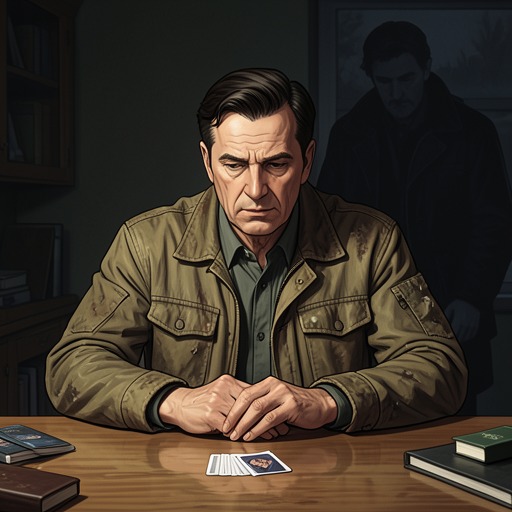
That expectation makes the turn at home all the sharper. Mickey returns from the coffee shop, rides the lift tube to his floor, and falls face-first just as his apartment door swings shut behind him. His legs have stopped working; when someone addresses him, his mouth can produce only a moan. A device pressed to the back of his neck is later identified as a neural inducer, tuned to act directly on his pain centers. It does no physical damage, but Mickey describes the experience as a torment that ordinary comparisons barely approach. He remains alive, paralyzed and sobbing, and only gradually recovers the ability to move. The encounter changes the scale of the choice before him: the imagined inconvenience of debt has given way to direct, incapacitating violence.
The one berth left open
That night, after cleaning himself up and crying, Mickey logs onto the Drakkar recruitment page. It lists the sections and positions already selected, and nearly every slot is filled. The single exception is the position of Expendable. When he asks Berto what the role is, Berto makes clear that it is the berth a recruit should avoid. Mickey answers that it is the only one still open and that he wants it.
Berto's response holds two truths together. He would like Mickey to come on the one-way trip and would welcome a friend aboard, but he also recognizes that this particular job is not a safe way to accompany him. His silence and careful attempt to dissuade Mickey convey the seriousness of the choice without changing it. Their friendship has limits: Berto can warn him and wish for his company, but he cannot make the available alternatives less bleak. Mickey schedules an interview for the following afternoon.
Accepting the Expendable role
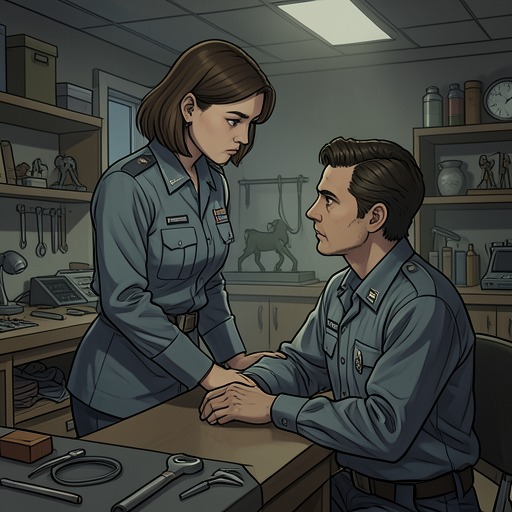
Twelve hours later, Gwen Johansen lists the terrible things that could happen during Mickey's tenure as an Expendable. Rather than turning him away, the warnings strike him as less frightening than what he has just endured. The decision is not made because he misunderstands that the job entails danger; the anticipated dangers have lost their power to deter him after the assault. The contrast also recasts the recruitment offer of what Mickey calls half-assed immortality. Its promise is limited and bound to a role in which death is an expected occupational risk, but, in that moment, even this compromised form of survival looks preferable.
The choice becomes harder to reverse once Mickey has boosted up to the Drakkar. The training is intended to teach him not to fear death, yet he regards the assault in his apartment as the more effective preparation. That is not a claim that the recruitment process has made him invulnerable; it is a measure of how violently his expectations have shifted in one afternoon. He has moved from hoping Blank will leave enough of his subsidy to live on to accepting a post built around the possibility of dying.
Retrospective significance
The framing gives the enlistment its force. Mickey recalls the decision while kneeling on the decking, inches from a disassembler field interface, with the prospect of being converted into slurry for the hungry colonists of Niflheim. From that later position, the question is whether pressing his thumb to the reader pad nine years earlier was the right call. His answer remains affirmative. The memory therefore does not erase the coercion that led him to apply: debt, Blank's violence, and the absence of a better route all precede his choice. Instead, it establishes that a decision made under pressure can still be affirmed by the person who made it.
The enlistment also fixes the contradiction at the center of Mickey's new life. He seeks a berth because it offers a way out of an immediate trap, while accepting a job whose dangers are serious enough for Berto to urge caution and Gwen to enumerate them. The departure is one-way, and the role's promise of continued service depends on Mickey's unusual relationship to death. His choice is at once an escape from Blank's control and an entrance into another system of risk. The affirmative judgment he gives it years later makes that beginning more than a desperate application: it is a threshold he remembers crossing without pretending it was safe.