Mickey disappears in and returns from the underground tunnels
Mickey7Mickey Barnes’s disappearance beneath the ice ends not with confirmation of his death but with his return to the dome—and with knowledge that transforms a presumed loss into a threat to the colony. The tunnels he crossed appear deliberately structured, and the creatures connected to them are more capable and more dangerous than the colonists had understood. His return therefore becomes a test of what he will tell Hieronymus Marshall, not merely proof that he survived.
Disappearance and Conflicting Reports
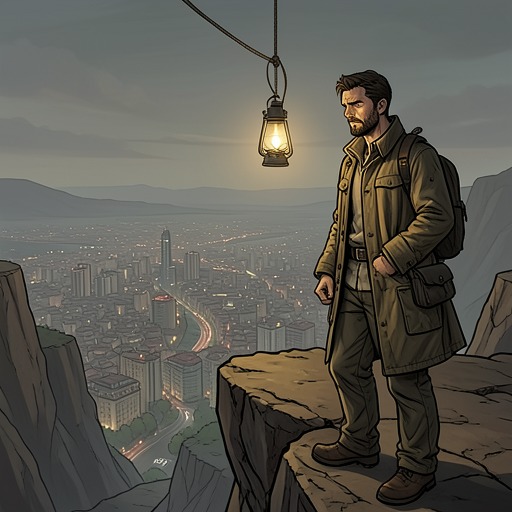
The account of Mickey’s presumed death changes as Berto Gomez revises his report. His initial version says the creepers killed Mickey; a later amendment attributes the presumed death to a fall. In the most recent account, Berto says Mickey fell through the ice into a tunnel or cave system and was still alive and conscious when Berto left him there. Berto estimates that the place may have been as much as a hundred meters beneath the surface. He believes Mickey died there, but Mickey’s return to the dome disproves that conclusion.
The sequence matters because it places Mickey’s disappearance inside a widening gap between what happened and what the colony has been told. Mickey explains that Berto reported him lost and that, by the time he made it back, Mickey8 had already been produced in the tank. His reappearance thus intersects with the duplication crisis: the report of his loss and the creation of another instance have already set events in motion before he can return. The account does not dwell on the mechanics of his escape; its emphasis is on the consequences of being left below and on the knowledge he brings back.
The Tunnels and the Colony’s Assumptions
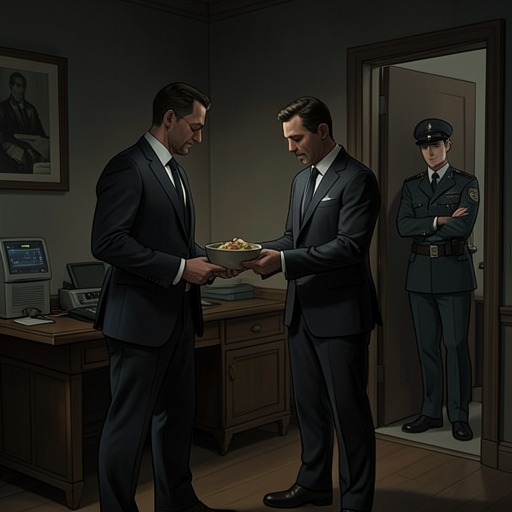
Marshall questions Mickey about the tunnels because their existence contradicts the colony’s orbital surveys. Those surveys had indicated that the area was geologically stable, without volcanism, fault lines, mountains, or soft rock that might explain an extensive cave system. Mickey agrees that the caves seemed anomalous. Asked whether they looked natural or artificial, he reports that they appeared deliberately structured rather than formed by ordinary geology.
That answer changes the subject of the interview. Marshall is not simply trying to establish how Mickey survived; he wants to know what exists beneath the surface and whether the tunnels indicate purposeful construction. Mickey understands the stakes before he answers. He considers the possibility that Marshall would kill the creatures if he could devise a way to do so, and this expectation makes disclosure dangerous. He also thinks of Roanoke, connecting the present question to the possibility that another human group might once have confronted a similar choice. The comparison is a moment of reflection, not an explanation of what happened on Roanoke.
What Mickey Reveals
When Marshall asks whether anything living was down there, Mickey pauses over what to disclose. His thoughts return to the giant creeper that pushed him up the tunnel and set him free in the garden. He also recalls visions of a caterpillar with a Cheshire grin, Dugan being pulled beneath the snow, and Roanoke. These memories gather around the question of whether the beings below are simply threats or something the colony has failed to understand. Mickey then tells Marshall everything rather than withholding the encounter.
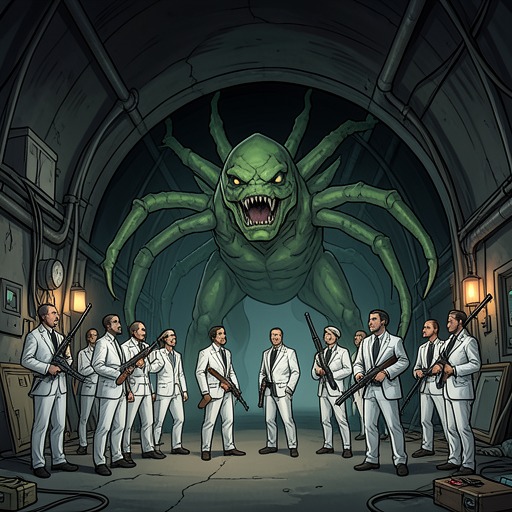
The disclosure establishes the scale of what Mickey has seen, but the book presents some of that knowledge through later conversation. When Nasha asks what happened after Berto abandoned him, Mickey says that the creatures he encountered were not the whole of what lived out there: some creepers were large enough to eat a flitter and still have room for dessert. Nasha adds that they have military technology, and Mickey confirms that they apparently do. The report broadens the implications of his return from survival to security: the underground life is not only present, but includes beings of immense size and evidence of technological capability.
Consequences and Significance
Mickey’s return forces the colony to confront two failures of knowledge at once. Its survey-based picture of the terrain cannot account for the extensive tunnels, and its initial understanding of the creepers cannot account for their scale, intelligence, or apparent military technology. Yet Mickey’s warning reaches Marshall through a conversation shaped by distrust: Mickey anticipates a violent response and must decide whether the danger of silence outweighs the danger of telling the truth. His eventual disclosure does not erase that conflict; it makes the stakes explicit.
The event also turns abandonment into witness. Berto’s changing reports preserve the uncertainty surrounding Mickey’s presumed death, while Mickey’s own account supplies information those reports cannot: the tunnels seemed structured, a giant creeper helped him reach the surface, and other creatures may pose a far greater threat. His survival is therefore more than a reversal of the colony’s death assumption. It carries back evidence that challenges the colonists’ map of their world and compels them to reckon with what lies beyond the assumptions that made the underground seem impossible.