First contact and truce between humans and creepers
Mickey7The first contact between humans and creepers reveals that the apparent conflict rests on a profound misunderstanding: the two species do not share the same ideas of individual life or aggression. When Mickey8 establishes communication with a creeper and the conversation leads to a truce, the immediate prospect of extermination gives way to a fragile arrangement whose terms neither side can be certain it fully understands.
The First Conversation
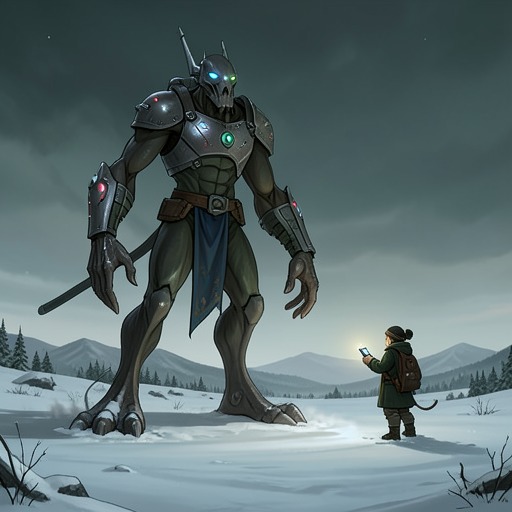
Mickey8 takes a leap of faith rather than relying on a more cautious approach. He identifies himself as Prime; the creeper says that it, too, is Prime and proposes that they talk. The exchange establishes a point of recognition between beings who have so far encountered one another through violence and observation. As the conversation begins, the creeper’s head settles onto the tunnel floor and its mandibles slowly close, inner pair first and outer pair afterward. The physical gesture accompanies a change in the encounter: the creature is no longer only a threat to be fought, but a participant in communication.
The possibility of speech does not mean that the two sides immediately share a language in any full sense. The creepers have learned what they know by snooping on Mickey’s communications, and their grasp of the words is surprisingly good. But, as Mickey later explains to Cat Chen and Marshall, a word cannot easily convey a concept that the other species does not possess. Contact begins, therefore, not with mutual understanding already achieved, but with the difficult work of discovering where understanding breaks down.
Two Different Ideas of Life and Aggression
Mickey’s account of the encounter challenges Marshall’s assumption that the colony and the creepers are at war. The creepers, he says, appear to be a communal intelligence with little concept of individual life. They do not treat the deaths of their own as humans treat the deaths of people, and they do not understand why humans care about those the creepers have taken. From the creepers’ perspective, the killing of some of their smaller forms, which Mickey translates as ancillaries, has not necessarily registered as an act of aggression. Those smaller beings are parts of a whole rather than intelligent individuals in their own right.
The misunderstanding runs in both directions. The creepers have assumed that individual humans are likewise parts of a collective, so they have not understood the human significance of taking or killing a person. Mickey says he tried to correct this assumption, but that the missing concepts made translation difficult. The creepers’ apology suggests some recognition of harm, but it does not establish that they now grasp the human meaning of what happened.
The Truce Under Threat
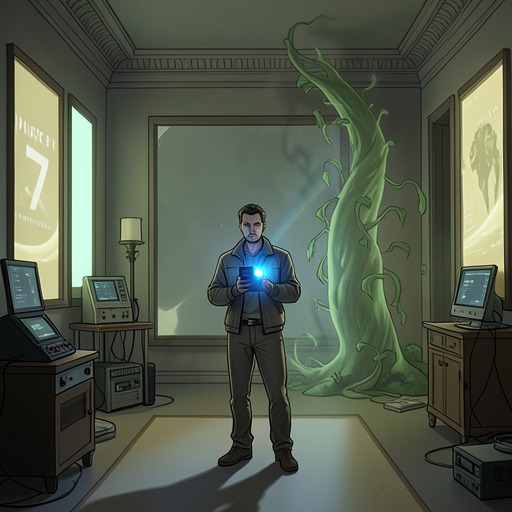
The conversation’s political consequences become clear when Mickey returns to the human leadership. Marshall points to deaths on both sides, including five of his people and two deaths of Mickey, as proof that the colony is at war. Mickey rejects that conclusion: the creepers have not understood their actions in human terms, and the two sides have, so far, exchanged information without agreeing on what counts as an attack. The disagreement is not abstract. Marshall is prepared to treat the creepers as an enemy to be eliminated, while Mickey warns that doing so would amount to genocide.
Marshall accuses Mickey of failing to do his job because he did not kill the creepers, and calls him afraid to die. Mickey allows that fear may have played a part, but insists that he also refused to carry out a killing that would leave him responsible for genocide. He argues that the colony has another intelligent species on the planet and that Marshall has already handed it an antimatter weapon. Under those circumstances, he presents himself as the colony’s only diplomat and asks whether killing him serves anyone’s interests. Marshall stares at him, visibly shaking, then leaves without answering. Cat and Lucas, who have shouldered their weapons, remain to watch him go. The exchange leaves Mickey alive and his diplomatic role intact, but it does not convert Marshall’s resistance into trust.
Terms and Uncertainty
The creepers’ stated condition for leaving the humans alone is that the colonists stay out of the tunnels and do not build in the foothills south of the dome. When Nasha later asks whether the creepers will really leave the colony in peace, Mickey cannot give her certainty. He is unsure how much either side understood, whether the creepers know what the dome means, or whether their promise rules out their seizing and killing an occasional human.
That uncertainty defines the truce’s significance as much as its promise does. First contact interrupts a cycle in which each side can interpret the other’s actions as evidence for war, and it opens a route toward coexistence through communication. But the agreement is not a guarantee of safety: it depends on boundaries and concepts that may not have been translated successfully. The decisive change is that the colony now has grounds to negotiate rather than treating extermination as its only option.