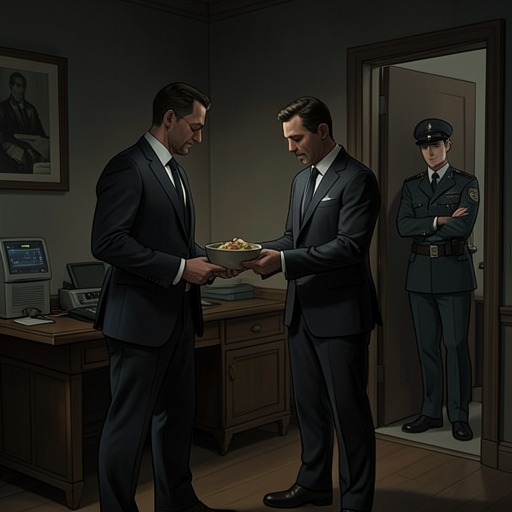
The Mickey7–Mickey8 duplication crisis
Mickey7The Mickey7–Mickey8 duplication crisis turns Mickey Barnes’s survival into a contest over which version of him is allowed to continue. Mickey7 has returned from the tunnels without dying, but the colony’s regeneration system has already produced Mickey8. Their coexistence violates the Union’s taboo against multiple copies, and the colony’s rationing and limited accommodations make the duplication an immediate practical threat as well as a crisis of identity. The two men first treat the problem as a choice between them; only when that choice reaches the bio-cycler does Mickey8 refuse to let it be settled by a death.
Return and Discovery
After emerging from the tunnel, Mickey7 considers whether Berto Gomez might already have reported him killed and how soon the colony would have re-instantiated him. He has not seen that process from the outside and does not know how quickly it would happen. Rather than leave Berto a message, he decides to wait: he has a strange feeling that his present, living status should remain private for a while. That hesitation becomes the crisis’s first act of concealment, before he knows there is another Mickey to conceal.
The return journey takes about an hour through knee-deep fresh snow. Near the dome, Mickey7 passes the colony’s security perimeter, a hundred meters out, with sensor towers, automated burner turrets, and man traps. The weather is unusually mild: just above freezing after nearly a week of colder temperatures, with the wind gone and a pink, cloudless sky. These concrete signs of an ordinary morning frame the discovery that follows. Mickey7 enters the slums, climbs four floors of metal stairs, and reaches his room near the hub, a double berth set among small, low-status racks.
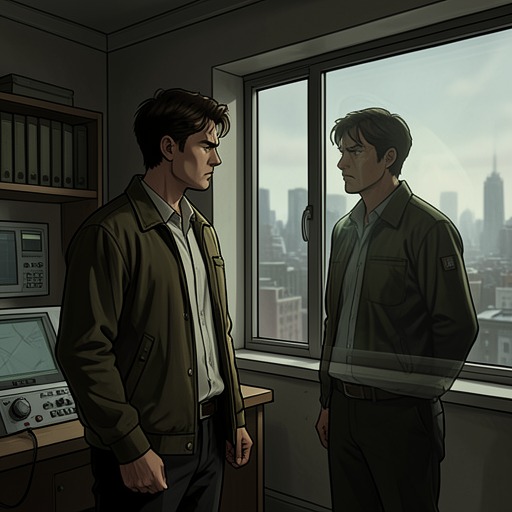
His door is already unlocked. Inside, a man lies in his bed beneath his blanket, his hair plastered to his forehead and his face streaked with what looks like dried snot. When the man wakes and sees Mickey7, he realizes that he is Mickey8. The duplication is not a suspicion or a future possibility: two visibly separate men now occupy the same room, each recognizing the other as himself. Mickey7’s earlier uncertainty about whether he had been reported dead gives way to the more immediate fact that a new Mickey has been made while the previous one remains alive.
One Identity, Two Lives
Mickey7’s first response is to insist that Mickey8 should not have come out of the tank, because Mickey7 is not actually dead. If Command discovers that they are a multiple, both will face consequences. The essential contradiction is plain to them: the system has treated Mickey7 as dead and produced a successor, but Mickey7’s survival means that the successor is not simply a replacement who can take over an empty life.
Their problem is sharpened by the colony’s material limits. At landfall, rations were set at 1,400 kilocalories per person per day, with adjustments for lean body mass and work schedule; the allowance has since been cut twice because even the hydroponics tanks struggle to grow crops. The colonists are gaunt, and an extra Expendable means one more person requiring food. Mickey8 rejects the idea that he should simply enter the bio-cycler, pointing out that the accident is not wholly Mickey7’s fault but is none of his. The question of blame cannot resolve a conflict in which there is only one registered identity and, as they see it, no compromise that lets both of them remain.
Mickey7 considers taking the issue to Hieronymus Marshall, but expects Command to respond harshly under the colony’s resource constraints. The bio-cycler makes that threat physical. Located on the dome’s lowest level, it reduces waste, plant matter, animal remains, and eventually human corpses to component atoms, then reassembles material into specified products. It supplies protein paste, vitamin slurry, and fertilizer; a desperate colony can survive on its output for a long time. For Mickey7, the walk toward it feels like climbing to a gallows. The colony’s recycling infrastructure, normally a condition of survival, becomes the machinery through which one of the two copies may be disposed of.
The Decision and Its Reversal
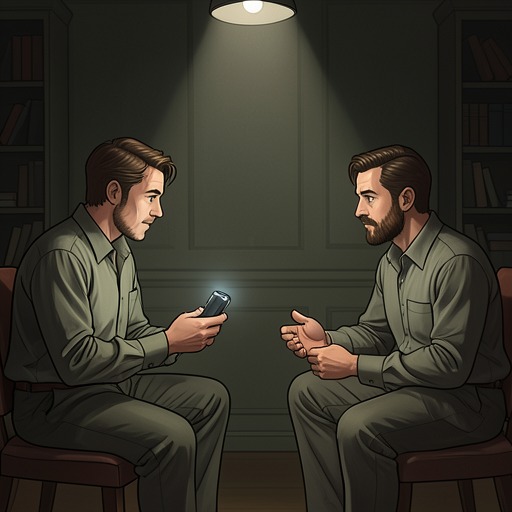
Unable to settle the matter by argument, the two Mickeys resort to rock-paper-scissors. They raise their hands and count down together. Mickey7 tries to predict Mickey8’s choice, imagining that both will select Rock, then that both will choose Paper, then that Mickey8 may anticipate Paper and choose Scissors. His attempt to outthink his own duplicate leaves his fist clenched. Mickey8 holds out a flat hand: Paper, which defeats Mickey7’s Rock. The game turns their abstract dispute into an apparent result, but it does not make the result acceptable.
At the bio-cycler, Mickey7 gets down on his hands and knees beside the corpse hole and prepares to put his face near the interface. He feels the field against his cheeks and nose. Mickey8 then pulls him back, helps him to his feet, and says he cannot stand there and watch Mickey7 do this. The reversal matters because Mickey8 had been defending his own right not to be sacrificed; he now refuses to let the losing game decide that Mickey7 must die. His intervention does not remove the practical conflict, but it breaks the immediate sequence from disagreement to disposal. For the moment, the two copies choose not to make the cycler the final arbiter of which one counts as Mickey.
Secrecy and the Unresolved Crisis
Back upstairs, Mickey8 jokes about drowning Mickey7 in a toilet and feeding his remains through the cycler piece by piece. Mickey7 does not take the joke as a solution. They still have only one berth, one ration card, and one registered identity, and discovery by Command could send one of them down the corpse hole. Mickey8 calls their situation unusual; Mickey7 doubts that unusual circumstances will make Hieronymus Marshall sympathetic when the colony is short of resources.
Mickey8 asks whether they can tell Nasha. Mickey7 considers her a person they can trust: she has been with him since he was Mickey3 and had been willing to risk her life trying to pull him from the hole. Yet telling her could expose her to the consequences if the matter reaches Hieronymus Marshall. Mickey7 therefore proposes keeping the duplication between the two of them for now, and Mickey8 agrees. His remark that one of them will probably die soon anyway reflects the dangerous conditions of the colony, not a resolution to their dispute.
The decision buys secrecy, not security. The crisis ends this stage with two living Mickeys sharing an identity the colony recognizes as singular, while the ration card, berth, taboo, and threat of Command remain unchanged. Its central tension is also a problem of continuity: Mickey8 resembles Mickey7 and carries the status of his regenerated copy, but Mickey7 does not regard him as a continuation of himself. The system can reproduce a body and its recorded identity; it cannot make the two present lives interchangeable. By refusing an immediate sacrifice and concealing the duplication, the two men preserve both lives for the moment while leaving the question of how they can coexist unanswered.