The Battle of Gault
Mickey7The Battle of Gault was the Union’s first and, so far, only interstellar military expedition, and its roughly twelve-second duration exposed the gap between Eden’s plan for a controlled intervention and the reality of confronting Alan Manikova. Eden sent a heavily armed colony ship to assess his intentions and, if necessary, destroy his position; instead, Manikova struck while the ship was still decelerating toward Gault. The battle established Gault as a byword for the consequences of arriving late and unprepared, a meaning that would later shape arguments over whether another colony might be made “the next Gault.”
Causes and the decision to intervene
The crisis began when Gault’s colonists sent a message describing what had happened to them and begging their home world for help. The signal took seven years to reach Eden, and Eden’s authorities then spent almost two years deciding whether to act. The colonists who had departed to found Gault had been unpopular before their departure; the intervening years did little to improve their reputation, and public feeling leaned toward leaving them to their fate. Parliament nevertheless judged that Manikova might eventually threaten other worlds and should be dealt with. That decision made the expedition not simply a rescue mission but an attempt to assess and contain a possible danger to the wider Union.
The practical problem was how to conduct an invasion across seven light-years. An ordinary ground invasion was out of the question, and even wealthy Eden would strain its budget assembling and fueling a vessel comparable to a colony ship. Military hardware was heavy, even without the terraforming equipment and fetuses a colonization mission would carry. Eden therefore chose a slightly up-armored colony ship, Eden’s Justice, rather than a purpose-built fleet. It left Eden’s system four years after Gault’s message arrived, carrying a crew of two hundred, six orbital bombardment craft, and a vast stock of fusion bombs.
The approach and the battle
Eden’s plan was to enter orbit around Gault, make contact with Manikova, and determine his intentions toward Eden and the Union. If that assessment showed an unacceptable threat, the expedition was prepared to glass the planet. The sequence depended on reaching the system with enough freedom to establish contact and make a deliberate choice. The ship’s conspicuous arrival made that premise fragile: a starship’s deceleration torch could be seen from a light-year away, and there was no practical way to conceal it.
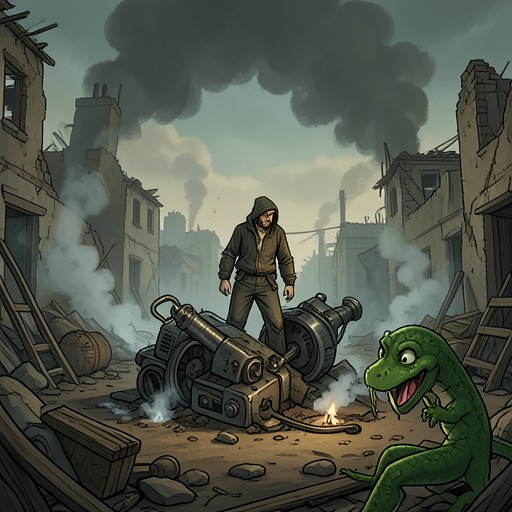
By the time Eden’s Justice reached Gault, Manikova had had almost eighteen years to consolidate his control of the system, make further copies of himself, and entrench his position. Nor was he an opponent inclined to wait for an approaching force to set the terms of engagement. As Eden’s Justice decelerated, its own torch blinded it to what was coming. A dozen or so nuclear-tipped missiles, fired from a base Manikova had built on Gault’s second moon, slammed into the ship. Its commander never managed to fire back. The encounter lasted on the order of twelve seconds: the expedition’s first exchange was also its decisive failure to respond.
The battle’s brevity was not a sign that the stakes were small. Eden had sent a crewed vessel carrying bombardment craft and enough fusion bombs to threaten the planet; Manikova’s missile base demonstrated that he could strike the expedition before it could establish its intended position or initiate contact. The plan’s careful sequence—arrive, communicate, assess, then attack if necessary—collapsed at the point of arrival. Its weapons and numerical resources could not compensate for the time Manikova had spent preparing, or for the ship’s inability to hide its approach.
Aftermath and later significance
Eden was not the only world to receive Gault’s message. Farhome, Gault’s next-closest neighbor, was a much younger and poorer second-generation colony. Its government was at least as alarmed as Eden’s, but lacked the resources and ambition to mount an expedition on the same scale. Farhome’s response was instead described as simpler, more direct, and much cheaper: it called the response The Bullet. The contrast underlined how the failed expedition changed the problem facing other worlds. A large, visible force had not secured the advantage Eden wanted; the response that followed from a less powerful neighbor took a different form.
Gault’s name later carried the memory of what could happen when a colony confronted a threat with catastrophic force and insufficient control over the encounter. During a later dispute about using an antimatter weapon against the sentient creepers on Niflheim, Mickey warned that Midgard might make the colony the next Gault if it learned what had been done. In that argument, Gault was not merely the site of a historical battle but a precedent for how other worlds might judge a colony’s use of destructive weapons. The reference draws on the battle’s enduring political lesson: a military response can provoke consequences beyond the immediate target, and the power to strike does not guarantee control over what follows.
The Battle of Gault also stands in sharp contrast to the slower, deliberate approach Eden had intended. Its stated purpose had been to make contact and judge Manikova’s intentions before deciding whether to destroy his position; the actual battle allowed no such interval for judgment. The ship’s visible deceleration, Manikova’s preparation on the second moon, and the commander’s inability to return fire turned the planned intervention into an ambush. The event’s defining measure is therefore not the size of the force Eden assembled but the twelve seconds in which its assumptions about initiative, warning, and choice failed.