Confirmation of creeper military technology
Mickey7Confirmation of creeper military technology is the turning point at which the Niflheim colony’s apparent wildlife threat becomes an acknowledged conflict with a technologically hybrid native force. Examination of a specimen brought back from a creeper hunt confirms that the creatures are not fully biological; Hieronymus Marshall declares the colony on a war footing, while the later struggle over what that means exposes a deeper mismatch between human and creeper ideas of life, aggression, and war.
From dangerous fauna to a military threat
The discovery changes the meaning of dangers the colonists had already encountered. Creepers had attacked the main lock and damaged its decking, but those actions had not by themselves established what the creatures were. Marshall tells Mickey Barnes and Mickey8 that examination of the hunting party’s specimen has confirmed the suspicion: the beings called creepers are some kind of hybrid military technology. The finding is specific but incomplete. It establishes that they are not wholly biological, without explaining who or what made them, or how their hybrid nature works.
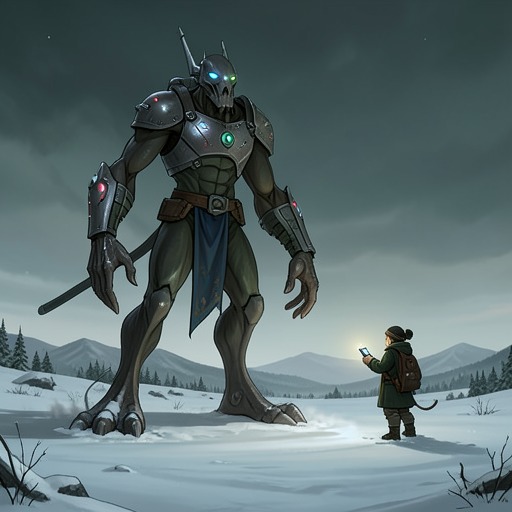
The book’s earlier encounter with a giant creeper sharpens the contrast that makes the confirmation so unsettling. Its segmented body, hard claws, feeding legs, and round, toothed maw resemble those of the smaller creatures, but its mandibles differ, and it is immense beside the roughly meter-long animals the colonists know. The giant carries Mickey through the tunnels and sets him down in a chamber before withdrawing. These observations complicate the colony’s simple category of local fauna, but they are not themselves the military confirmation; that comes later, through examination of the specimen returned from the hunt.
The colony goes on a war footing
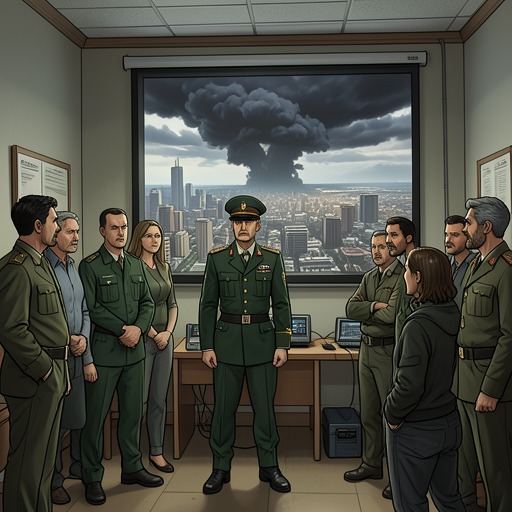
Marshall’s announcement has an immediate institutional consequence: he says the colony is now on a war footing. He also says that Nasha, one of the two qualified combat pilots, would otherwise have been removed already, but that the prospect of combat against hostile native sentients makes her skills necessary. The finding therefore affects not only how the colonists classify the creatures but also how Marshall weighs discipline and personnel against the colony’s defensive needs.
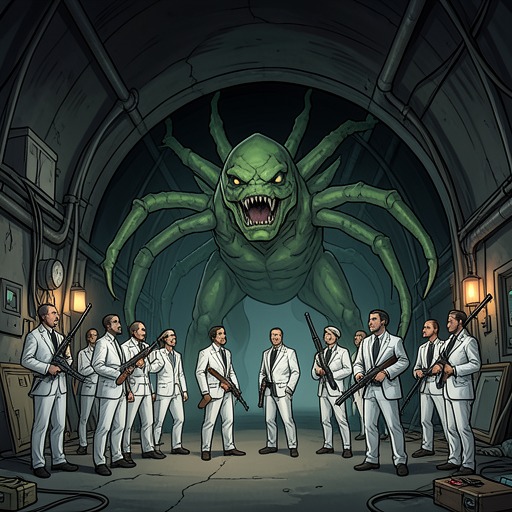
A subsequent image reinforces the scale of the danger. Mickey receives a still frame of a deep cavern whose every square meter is covered in creepers—the smaller kind associated with Dugan’s death and the breach of the main lock. The view does not establish that every creature in the cavern is military equipment, but it makes plain that the confirmed threat is not confined to one specimen or one attack. The colony faces a population of creatures occupying an extensive tunnel environment, while the humans remain dependent on a vulnerable settlement above it.
Competing definitions of war
The military finding does not mean that both sides understand the conflict in the same way. When Marshall argues that the creepers have killed five people and Mickey twice, Mickey counters that the creatures appear to be a communal intelligence with little concept of individual life. In his account, the smaller beings are ancillaries—parts of a larger whole, rather than independent intelligent individuals. The creepers may therefore interpret human actions, including the dissection of several ancillaries, as an exchange of information rather than aggression; they may likewise fail to understand why humans mourn individuals they have taken.
This difference makes the confirmation more than a change in threat assessment. Marshall’s war footing is a human response to deaths, attacks, and evidence of military technology; Mickey’s explanation suggests that those signs do not prove the creepers share a human concept of war. The discovery heightens the danger precisely as it fails to settle the question of intent. A hybrid military organism can be a grave threat without its communal intelligence assigning the same meanings to violence that the colonists do.
Material stakes and aftermath
The colony’s ability to respond is constrained by the systems that keep it alive. Its Biological recycler can turn waste and corpses into protein paste, vitamin slurry, and fertilizer by breaking material down into atoms and reassembling it; the antimatter-powered ship engine supplies the energy that process requires. These technologies sustain a precarious beachhead, but they do not remove the colony’s dependence on its remaining fuel. Later, Marshall warns that producing two devices has dangerously reduced the antimatter stores, with no foreseeable means of replenishing them and the power plant essential to the survival of everyone in the settlement. The military crisis thus unfolds alongside a severe infrastructure constraint: defensive action can consume resources on which daily survival depends.
The confirmation begins a sequence of escalation, but it is not the story’s final account of the creepers. Later encounters and Mickey’s effort to communicate with them make coexistence possible, showing that the initial human classification of the creatures as hostile does not settle the relationship. The discovery remains decisive because it explains why the colony prepares for war; its limits become equally important because military capability alone cannot reveal how the other intelligence understands contact.