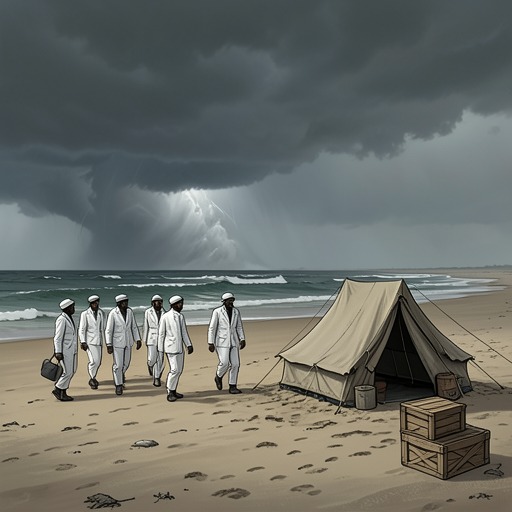
Niflheim's Frozen, Nearly Uninhabitable Condition
Mickey7Niflheim’s frozen, nearly uninhabitable condition defines the colony’s central paradox: from orbit the planet looks like an expanse of ice, yet its water and oxygen-nitrogen atmosphere make settlement seem possible. That possibility is narrow. Growing crops outside the dome is expected to be a serious long-term challenge, and local microbiota interferes with cultivation inside it. The colony’s prospects therefore rest not on a welcoming landscape, but on whether its enclosed systems can keep producing food and power under pressure.
The Snowball Seen from Orbit
The first view offers none of the reassuring signs the arriving colonists might have imagined. Still several million kilometers away, the planet appears smooth, white, and featureless, more like a ball than a world with visible continents or oceans. The colonists watch as their changing viewpoint gives them no new detail; the apparent cloud cover resolves into ice. Nasha identifies the planet as a snowball, turning an indistinct white surface into a concrete warning about the place awaiting them.
The scene balances that alarm with a practical argument for attempting the landing. Mickey Barnes points to the abundance of water and the oxygen-nitrogen atmosphere, comparing Niflheim’s early conditions to a period before life took off on Old Earth. The comparison is not proof that the colony will flourish; it is a reason to believe that the planet contains basic ingredients for survival. Nasha kisses his cheek but answers with the hope that they have not crossed the distance only to die. Their exchange makes the distinction between a world that can support life in principle and one that will welcome human settlement in practice.
Agriculture Under Constraint
The difficulty does not end with the planet’s icy exterior. Growing anything outside the dome is expected to be a serious long-term undertaking, while something in Niflheim’s local microbiota is already interfering with plants cultivated inside. The colony’s agricultural problem is thus twofold: the exposed environment is inhospitable, and enclosure does not eliminate biological uncertainty. The available evidence presents cultivation as a continuing obstacle rather than a solved problem, and the warning that the Agriculture Section needs to get its work in order connects that obstacle to everyday pressure over food.
That pressure changes the meaning of the colony’s food. Mickey Barnes drinks a mug of processed food while Cat Chen has a meal that makes the disparity between their provisions conspicuous. He points out that she is eating well in front of him; her hesitant laughter suggests that the remark is not wholly a joke. The exchange gives the food problem a domestic scale: agricultural difficulty is not simply a future technical concern but a condition felt in what people can eat and in how they speak to one another.
Recycling and Power
The Biological recycler provides a fallback when ordinary food production cannot meet need. It accepts waste ranging from plant remains and bones to hair, fingernails, and eventually corpses, and returns protein paste, vitamin slurry, and fertilizer. A desperate colony can subsist on the paste for a long time, though nobody wants to make it a normal diet. In a world where growing crops is uncertain, the recycler turns discarded matter into food inputs and nutrients; it is not an escape from scarcity so much as a way to keep scarcity from becoming immediately fatal.
Its operation depends on the colony’s power supply. Material dropped through the corpse hole is broken down into component atoms and reassembled in a specified order, a process that consumes an enormous amount of energy. The power plant is an antimatter-driven starship engine, so energy initially appears to be the resource the colony has in abundance. That apparent security has a limit: after two devices are produced, the remaining antimatter stores have taken a dangerous hit, and there is no prospect of replenishing them in the foreseeable future. If the power plant shuts down, the consequences threaten everyone. The planet’s cold is therefore only one part of the survival problem; food recycling and other essential operations also depend on fuel that cannot readily be replaced.
A Settlement with No Easy Margin
Niflheim’s condition makes colonization a calculation of coupled risks rather than a simple judgment that the planet is habitable or not. Water and atmospheric composition support the case for trying, while ice, difficult cultivation, and interference from local microbiota undermine confidence that the colony can feed itself. The recycler can stretch available resources, but its energy demand links food security to the antimatter reserve. Each system compensates for a weakness in another, so a shortage or failure can spread beyond the point where it begins.
The contrast with other colony histories reinforces the uncertainty without making Niflheim’s particular hazards interchangeable with theirs. Roanoke’s colonists failed to recognize intelligent local life until it was too late, while the first exploratory party on the jungle world Bergen’s World did not last a day despite armor and heavy weapons. Those examples show why apparently manageable conditions cannot guarantee a successful landing; they do not establish that Niflheim faces the same threats. Here, the evidence centers on an icy world, precarious food production, and infrastructure dependent on finite fuel. The snowball is both the colony’s most obvious obstacle and the setting for a more consequential test: whether its people can keep the systems of survival working long enough to make the planet livable.