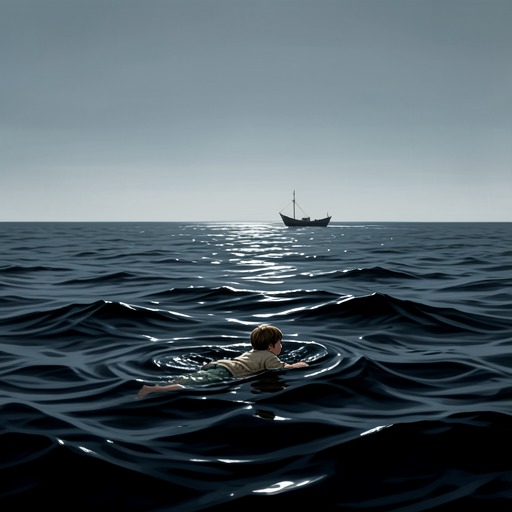
Castaway
Moby-DickCastaway names the condition produced when a sailor is cut off from ship, crew, and settled life and left to the sea’s uncertain mercy. In Moby-Dick, it is not merely a nautical accident but a recurring human predicament: a person is suddenly reduced to an exposed body, while the institutions and companions that ordinarily make survival possible become distant, distracted, or themselves destroyed. Pip’s abandonment gives the condition its most psychologically transformative form; Ishmael’s final survival gives it its narrative function; and the many falls, drownings, wrecks, and disappearances surrounding them show how precarious every sailor’s belonging always was.
Definition and Maritime Condition
A castaway is first a sailor deprived of the ship as both workplace and social world. The Pequod’s boats pursue whales while selected ship-keepers remain aboard, and the division of labor creates situations in which one person can be left behind when the hunt suddenly changes direction. Pip becomes the clearest example. After he jumps from a boat a second time, he fails to breast out the whale-line; when the whale runs, he is left behind on the open sea while Stubb’s boat continues after the fish.
The physical setting makes abandonment radically different from an ordinary fall overboard. The sea is calm, bright, and apparently harmless, yet its level surface offers no shelter and no human scale. Pip’s head bobs alone in an ocean extending to the horizon, and within three minutes a mile of water separates him from Stubb and the boat. The danger lies not only in drowning but in isolation: the castaway remains visible for a moment while becoming practically unreachable, a body still present but already removed from communal action.
Pip’s Abandonment and Transformation
Pip’s condition is made more bitter by the fact that it follows an explicit warning. Stubb had ordered him to stick to the boat and had stated that the economic value of a whale outweighed Pip’s value in the eyes of the fishery. When Pip jumps again, Stubb does not intend, at least consciously, to abandon him; he assumes that two boats behind him will quickly find and recover the boy. Instead, those boats turn toward whales without seeing Pip, while Stubb and his crew remain absorbed in the hunt. The episode therefore exposes a structural cruelty rather than a simple act of individual malice: commercial purpose, divided attention, and the conventions of whaling combine to make a human life temporarily secondary to the chase.
The calm sea intensifies the scene’s moral disturbance. Pip is not swallowed immediately by a storm or destroyed by a visible monster; he is left in a beautiful, expansive environment that becomes unbearable because it contains no responsive companion. His solitude concentrates the self in the middle of an immense world, turning the ocean into an image of existence stripped of ordinary assurances. The ship eventually rescues him, but rescue does not restore him to his former condition. From that hour, his shipmates regard him as an idiot, while the narration presents his altered mind as having descended into strange depths where the primal world and the hidden abundance of Wisdom become visible.
Pip’s apparent madness thus reverses the usual hierarchy between sanity and delusion. The crew interprets his speech as irrational because it exceeds ordinary mortal reason, but the narration imagines that he has encountered a larger, divine order in which human distinctions lose their certainty. His abandonment becomes an extreme passage from social identity into visionary exposure. The castaway is not simply returned; he returns as someone whose contact with the sea has displaced the common world and made its judgments appear narrow.
Other Forms of Abandonment and Catastrophe
The book repeatedly places sailors in conditions resembling castawayhood before the final wreck. During a squall, a boat carrying members of the Pequod’s crew is swamped, separated from the ship, and surrounded by darkness, mist, and a rising sea. The oars no longer propel the boat and serve only as life-preservers. Starbuck manages to ignite a lantern, which Queequeg holds aloft as a small sign of hope in the storm. The boat’s occupants are not formally abandoned, but their inability to hail the other boats and their uncertainty about the ship place them in the same existential space: alive, yet temporarily outside the reach of organized rescue.
Tashtego’s fall into the sperm whale’s head presents another version of isolation, this time within the very object being harvested. While the Pequod’s crew bail fragrant sperm oil from the whale’s enormous head, Tashtego drops head-first into the deep cistern and disappears below the surface. Daggoo immediately attempts to reach him, but the rescue is endangered when one of the hooks suspending the head tears loose and the remaining hook bears the entire strain. Tashtego is therefore trapped inside a precarious mass whose movement threatens everyone around it. His predicament reveals how whaling repeatedly turns the laboring sailor into a body enclosed by, and endangered through, the creature he is supposed to master.
The Pequod also records a direct fall from the ship’s mast. A sailor who has climbed to the foremast to look for the White Whale suddenly plunges into the sea. The life-buoy dropped after him has shrunk from prolonged exposure to the sun; it slowly fills with water, and its iron-bound body follows him downward instead of supporting him. He becomes the first man of the Pequod to mount the mast in search of the White Whale’s own ground and then disappear into the deep. The crew interprets the death through the language of omens, treating it as the fulfillment of earlier supernatural warnings rather than as a failure of equipment or procedure.
Shipwreck and Ishmael’s Survival
At the climax, castawayhood expands from an individual accident into the fate of nearly the entire ship. The White Whale strikes the Pequod’s starboard bow, and the ship’s timbers reel as water pours through the breach. The whale’s attack transforms the vessel into a second hearse, while the sailors’ tools remain mechanically fixed in their hands. The ship, once the center of labor, command, and collective purpose, becomes the scene of collective exclusion from life. As the Pequod sinks, the flag is nailed more firmly to the subsiding spar, and a sky-hawk becomes entangled in it and descends with the vessel, joining the ship’s destruction to an image of captive heaven.
After the ship vanishes, the sea closes over the wreck and leaves no stable human world behind. Ishmael alone remains to tell what happened. He has been drawn toward the vortex created by the sinking ship, circling its contracting center until the coffin life-buoy shoots upward from the sea. The coffin, originally made for Queequeg, becomes the object that preserves Ishmael’s life after the Pequod has failed. Its function is paradoxical: an emblem of death becomes a buoyant substitute for the lost ship and carries the survivor through the aftermath of collective destruction.
Ishmael floats on the coffin for almost one whole day and night. Sharks pass without harming him, and sea-hawks glide above with their beaks effectively sheathed, so that the natural world does not complete the violence begun by the wreck. On the second day, the Rachel approaches and rescues him while searching for its own missing sailors. The ship finds not the children it seeks but another orphan, making Ishmael’s rescue part of the novel’s larger pattern of incomplete recoveries and displaced grief.
Narrative and Thematic Significance
Castawayhood gives the novel a recurring image of life outside protection. Pip is left behind because the whale hunt continues; the storm-bound boat is separated from the ship by weather; the masthead sailor receives a failed life-buoy; Tashtego is isolated inside the whale’s head; and Ishmael survives only after the Pequod has disappeared. These episodes differ in cause, but together they show that the sea can suspend a person between belonging and disappearance in an instant.
The condition also exposes the limits of collective responsibility. Stubb’s failure to recover Pip is softened by his assumption that other boats will intervene, yet that assumption proves fatal until the ship happens to find the boy. The crew’s response to the masthead death turns a material failure into an omen, while the Pequod’s final disaster overwhelms every distinction between responsibility, fate, and chance. Castawayhood is consequently both a physical state and a crisis of interpretation: survivors must decide whether abandonment resulted from negligence, economic priorities, hostile nature, destiny, or some combination that no single explanation can contain.
Most importantly, the castaway becomes the condition from which narration itself emerges. Ishmael can speak only because he has passed through the wreck as an isolated body, supported by a coffin and later recovered by a searching ship. His survival does not cancel the catastrophe; it makes him its witness. The castaway is therefore not outside the story but the figure through whom the destroyed story reaches the reader: separated from the community that lived it, yet carrying its memory forward.