Religious fasting
Moby-DickReligious fasting in Moby-Dick is not merely a private dietary observance but a bodily discipline through which belief becomes visible, difficult, and socially consequential. Its fullest treatment occurs in Queequeg’s Ramadan, or “Fasting and Humiliation,” when the devout harpooneer withdraws into an all-day rite of abstinence and immobility. Through Ishmael’s alarm, argument, and eventual respect, the practice becomes a test of whether religious difference must produce condemnation or can instead lead to recognition among shipmates.
Definition and Religious Context
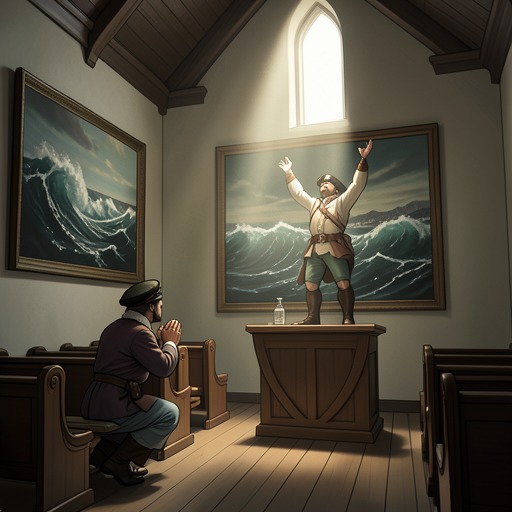
Religious fasting appears in a world where prayer and ritual repeatedly organize experience. Father Mapple kneels in the pulpit with folded hands and closed eyes, praying as though he were at the bottom of the sea; afterward he directs the congregation toward the Book of Jonah, whose central lesson joins sin, punishment, repentance, prayer, deliverance, and joy. Against this Christian scene, Queequeg’s Ramadan is neither dismissed by the narrative as simple superstition nor presented as an abstract theological system. Ishmael identifies it as a demanding practice belonging to Queequeg’s relation with Yojo, and he insists that Presbyterian Christians should not assume themselves superior to pagans, since all people are, in different ways, “cracked about the head.”
The comparison is sharpened by Ishmael’s earlier willingness to participate in Queequeg’s worship. Although he was raised within the Presbyterian Church, he reasons that worship consists in doing the will of God and treating a fellow human being as one would wish to be treated. Because Queequeg is his fellow man, Ishmael concludes that he must join him in his form of devotion. He helps arrange the idol, offers burnt biscuit, salams before it, and kisses its nose. This shared ritual follows their exchange of smoke and their declaration of bosom friendship, making religious accommodation part of the relationship through which the two men become companions.
Queequeg’s Ramadan
Queequeg’s observance lasts through the daylight hours, and Ishmael deliberately avoids disturbing him because he respects religious obligations even when their outward forms seem comical. When evening arrives, however, Queequeg does not answer from his locked room. Ishmael becomes frightened, looks through the keyhole, and takes the presence of Queequeg’s harpoon shaft against the wall as evidence that he must still be inside. With the landlady’s resistance delaying him, Ishmael finally bursts the door open.
The scene converts anxiety into astonishment. Queequeg sits in the middle of the room, squatting on his hams and holding Yojo on top of his head. He is entirely cool and self-contained, resembling a carved image more than an ordinary man. He neither moves nor speaks when Ishmael tries to persuade him to take a chair. Ishmael wonders whether this rigid posture is part of Ramadan and imagines that Queequeg may remain there until the fast ends, even though the practice seems to him physically senseless and nearly insane.
The observance continues through the night. Queequeg remains in the cold room, awake and motionless, while Ishmael goes below to supper and listens to sailors’ stories. When Ishmael returns near eleven o’clock, Queequeg has not shifted an inch. Ishmael urges him to rise, eat, and avoid starving himself, but receives no answer. Yet his irritation is accompanied by genuine concern: before going to bed, he throws his bearskin jacket over Queequeg because Queequeg is wearing only his ordinary round jacket. Ishmael then finds it difficult to sleep, troubled by the thought of his companion sitting alone in the cold and darkness.
At daybreak the rite ends. Queequeg is still squatting as though fixed to the floor, but when the first sunlight enters the room he rises with stiff, grating joints and a cheerful expression. He limps toward Ishmael, presses his forehead against his friend’s, and announces that his Ramadan is over. The gesture repeats the sign through which the two men earlier affirmed their friendship, linking religious completion to social reunion.
Ishmael’s Objection and Accommodation
Once Queequeg has completed the fast, Ishmael undertakes an extended critique. He argues that Lents, Ramadans, and prolonged squatting in cold rooms are harmful to health, useless to the soul, and opposed to hygiene and common sense. His reasoning treats fasting as a bodily process with psychological consequences: if fasting makes the body collapse, then the spirit collapses with it, and thoughts produced by hunger must be only half-fed. He even connects gloomy ideas about the afterlife with digestive disorder, turning theological controversy into comic physiological argument.
The exchange does not establish Ishmael’s doctrine as victorious. His position is shaped by affection as much as by rational confidence: Queequeg’s observance pains him precisely because he regards Queequeg as sensible and sagacious in other matters. Religious difference therefore produces a conflict within Ishmael between judgment and loyalty. He objects when devotion becomes torment, but his conduct during the fast—waiting, investigating, covering Queequeg against the cold, and remaining emotionally distressed—shows that respect for the person precedes agreement with the practice.
This episode also complicates any simple opposition between Christian and pagan belief. Ishmael’s Presbyterian background does not prevent him from joining Queequeg’s worship, while Father Mapple’s sermon demonstrates that Christian religion likewise uses intense bodily and emotional images: Jonah sounds the depths of the sea, and the congregation’s hymn rises above a storm. The novel places these traditions beside one another rather than granting one an uncomplicated monopoly on seriousness.
Ritual, Community, and the Sea
Elsewhere aboard the Pequod, ritual repeatedly gathers the crew and gives collective form to dangerous action. Captain Ahab summons the men around the capstan, has the harpoons produced, arranges the mates with their lances, and makes the crew drink in a revived custom of his fisherman fathers. The ceremony temporarily binds shipmates, officers, and harpooneers into a single circle, even as it channels fellowship toward the pursuit of the White Whale. Religious and quasi-religious forms thus do not remain separate from maritime labor or violence; they help authorize and organize them.
The whaling enterprise itself is repeatedly elevated into a sacred or legendary fraternity. Ishmael traces its honor through Perseus, St. George, Hercules, Jonah, and Vishnoo, presenting the whaleman’s vocation as connected with heroes, prophets, demigods, and divine incarnation. In this comparative religious imagination, the whale becomes an object of rescue, combat, knowledge, and sanctification. Fasting belongs to the same larger pattern in which bodies, weapons, flames, coffins, prayers, and sea voyages acquire ritual meaning.
Even death is given ceremonial structure. When Queequeg expects to die, he prepares his coffin with the iron of his harpoon, a boat paddle, biscuits, fresh water, woody earth, sail-cloth, and Yojo. He lies inside it, crosses his arms over his breast, and calmly tests its comfort before declaring that it will do. The coffin is at once a final bed, a religious object, and a practical maritime artifact. In the later course of the story, it becomes the life-buoy on which Ishmael survives, turning Queequeg’s preparation for death into an instrument of another man’s rescue.
Religious practice also appears in Ahab’s encounter with fire. Facing the white flames at the masthead, he recalls having worshipped fire as a Persian and now defines its proper worship as defiance. His language transforms reverence into resistance: the ritual posture remains, but its object is no longer obedience. This contrast clarifies the special quality of Queequeg’s Ramadan. Queequeg’s fast creates a temporary separation from ordinary life and then returns him cheerfully to companionship; Ahab’s rites intensify his solitary opposition and bind the crew to a destructive purpose.
Narrative Significance
Religious fasting gives Moby-Dick one of its clearest demonstrations that belief is encountered through bodies before it is understood through doctrines. Queequeg’s silent posture, Yojo balanced on his head, empty stomach, cold room, stiff joints, and cheerful return make faith visible as endurance. Ishmael’s response refuses both easy mockery and complete theological acceptance. He criticizes the observance while protecting the observer, and the distinction becomes a practical ethic of friendship.
The episode also establishes a recurring pattern in the book: ritual can separate a person from ordinary time, create a sacred interval, and then reintegrate that person into a community. Queequeg’s Ramadan begins as an inscrutable private discipline, becomes a source of alarm for Ishmael, and ends with the renewal of their bodily sign of fellowship. Other ceremonies aboard the Pequod produce different results—collective drinking, prophetic preaching, heroic genealogy, fire-defiance, or preparation for death—but all reveal how the crew attempts to impose meaning on an unstable sea.
For Ishmael, the lasting lesson is not that every religious practice is equally sensible. It is that judgment of a practice must not erase regard for the person who performs it. His friendship with Queequeg is strengthened not by doctrinal agreement but by the willingness to remain beside an unfamiliar devotion, to care for the fasting body, and finally to accept the returning friend. Religious fasting therefore becomes a compact model of the novel’s broader concern with plural belief, embodied ritual, and the fragile forms of fellowship that can survive amid the sea’s uncertainty.