Insanity
Moby-DickInsanity in Moby-Dick is a volatile condition that moves between bodily suffering, psychological fracture, obsessive intelligence, and visionary insight. The narrative refuses to treat madness as merely the opposite of reason: Captain Ahab’s delirium becomes an instrument of extraordinary purpose, while Pip’s mind, apparently broken by abandonment in the open ocean, is represented as having entered depths that ordinary sanity cannot perceive. Insanity therefore exposes the instability of the categories by which the Pequod’s crew judge themselves and one another.
Ahab’s Delirium and Its Physical Origin
Captain Ahab’s first known crisis is connected to the loss of his leg in an encounter with Moby Dick, but the narrative distinguishes the immediate bodily shock from the later formation of his lasting madness. Captain Peleg explains that Ahab had been “a little out of his mind for a spell” on the passage home, attributing this condition to the sharp shooting pains in his bleeding stump. He also describes Ahab as having become moody, desperate, and sometimes savage since the injury, while insisting that these changes might pass and that a moody good captain could still be preferable to a laughing bad one. This account establishes a tension between compassion and alarm: Ahab’s condition has a visible physical cause, yet his wounded body does not fully explain the darkness gathering around him.
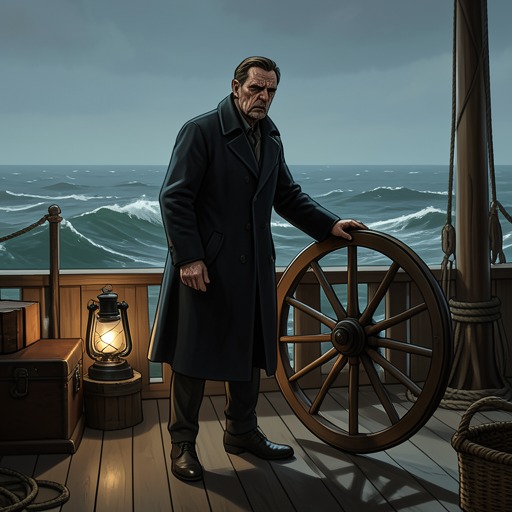
The fuller narrative locates the decisive transformation during the long homeward voyage. At the moment of the attack, Ahab’s fury is described as immediate and bodily; the wound initially produces agony rather than a complete philosophy of revenge. Only after the collision, when Ahab and anguish lie together for months in one hammock while the ship rounds the winter storms of Cape Horn, do his torn body and gashed soul bleed into one another. The result is delirium. Although he has lost a leg, he retains immense physical strength, intensified by his fevered state, and his mates must lace him fast in his hammock while he raves through the gales in a strait-jacket.
From Broad Madness to Monomania
Ahab’s apparent recovery does not end his insanity. As the ship reaches calmer latitudes and crosses the tropics, his visible delirium seems to remain behind with the Cape Horn swells. He emerges from his dark confinement, resumes a collected front, and gives calm orders again; his mates thank God that the madness has passed. Yet the narrative insists that the change is only a transformation of form. Human madness may become subtler rather than disappear, and Ahab’s full lunacy contracts into a narrow, unfathomably deep monomania.
This contraction does not diminish Ahab’s intelligence. Instead, his natural intellect becomes the living instrument of his special lunacy. The madness does not destroy his strength; it concentrates it upon a single object until he possesses vastly greater potency toward that end than he had ever brought to any reasonable purpose. Ahab’s insanity is thus terrifying precisely because it is organized. His judgment, energy, authority, and imagination remain active, but they are directed toward one consuming mark rather than moderated by competing obligations or ordinary limits.
That mark is Moby Dick. Ahab transfers to the white whale the accumulated malignity, rage, torment, and evil that he feels in life and in the human condition. The whale becomes a visible and practically assailable personification of forces that would otherwise remain intangible. Ahab’s revenge is therefore more than anger at an animal that mutilated him: it is an attempt to make the whole burden of suffering answerable to a single enemy. The psychological displacement gives his madness its enormous scope. He turns an inward, unmasterable conflict into an external pursuit, and the very clarity of that pursuit makes his insanity appear like purpose.
The Crew’s Perception of Madness
The Pequod’s crew experiences Ahab’s insanity through changes in atmosphere, gesture, and bodily presence before it can understand his motives. When Ahab advances upon Stubb with an overbearing terror in his aspect, Stubb involuntarily retreats. The encounter leaves him physically and spiritually unsettled: he wonders whether to return Ahab’s blow or kneel and pray for him, although prayer has never been his practice. Ahab’s anger has crossed the ordinary boundaries of command and insult, producing in Stubb not simple resentment but a confused mixture of fear, reverence, and disorientation.
Stubb then searches the ship for signs of the hidden condition. He recalls that Ahab sleeps scarcely more than three hours in twenty-four, and that Dough-Boy finds his hammock clothes rumpled, his sheets at the foot, his coverlet knotted, and his pillow frighteningly hot. Stubb imagines that Ahab carries a kind of inward torment, perhaps a conscience, and notices that Dough-Boy suspects Ahab goes into the after hold every night. These details make insanity legible through disrupted sleep, overheated bedding, secret movement, and riddling behavior rather than through a clinical diagnosis. Ahab’s mind is treated as a concealed pressure that surfaces in the material life of the ship.
Stubb’s own reaction also shows how uncertain the boundary between observer and sufferer can become. After meeting Ahab, he feels turned “wrong side out,” cannot stand properly on his legs, and wonders whether he has been dreaming. He finally decides to suppress the experience and return to his hammock, hoping daylight will clarify it. The scene does not establish that Stubb is mad, but it shows Ahab’s condition radiating outward as an affective disturbance. Ahab’s face, voice, and violence make the normally comic and resilient Stubb lose confidence in his own perceptions.
Pip’s Abandonment and Visionary Madness
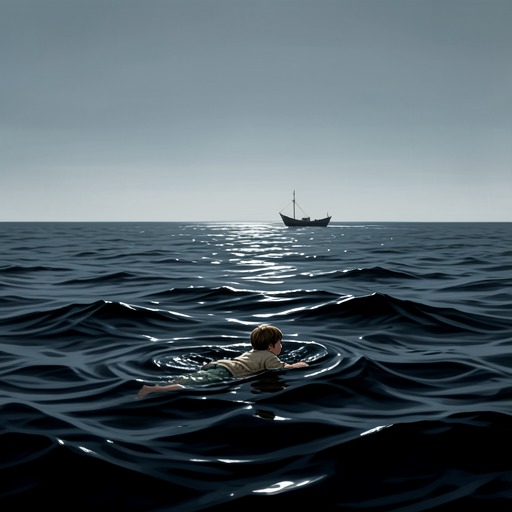
Pip’s insanity arises from a different but equally decisive rupture: abandonment in the open sea. During a whale chase, he jumps from the boat a second time. Stubb has warned him to remain aboard and has said that the ship cannot afford to lose whales for the sake of a sailor whose value is measured against the price of a whale. When the whale runs, Pip is left behind, and Stubb’s boat continues after the animal. The other boats, instead of noticing him, turn toward whales of their own. In three minutes, a mile of empty ocean separates Pip from Stubb.
The sea first reduces Pip to an isolated body. His head bobs in the calm water, and the narrator compares him to a castaway surrounded by a blue, level immensity. The physical danger is intensified by the loneliness of the open ocean: even experienced sailors who bathe at sea cling closely to their ship, whereas Pip is cut off from every stabilizing human presence. The ship eventually rescues him by chance, but the rescue does not restore what the sea has taken. From that hour he goes about the deck as an idiot, or as one whom the crew calls mad.
Yet Pip’s apparent mental destruction is also described as a form of revelation. The sea keeps his finite body afloat while drowning, or carrying downward, the infinite part of his soul. In the depths he sees strange forms of a primal world and encounters Wisdom as a miser-merman guarding hoarded knowledge. He perceives the coral organisms that raise immense shapes from the waters and sees God’s foot upon the treadle of the cosmic loom. Because he speaks of this vision, his shipmates call him mad. The narrative reverses their judgment: what appears insane from the standpoint of mortal reason may be a contact with a divine or cosmic order that reason cannot contain.
Insanity, Knowledge, and the Limits of Reason
Ahab and Pip occupy opposite positions within the novel’s treatment of insanity. Ahab’s mind narrows from broad delirium into a terrible concentration; Pip’s mind expands beyond ordinary human proportion after the sea isolates him from the social world. Ahab converts suffering into a target, while Pip receives suffering as an opening onto immensities that cannot be translated into practical language. One form of madness produces command, pursuit, and violence; the other produces passivity, wonder, and speech that the crew dismisses as incoherence.
The contrast also complicates the meaning of sanity. The crew’s everyday judgment treats Ahab’s sleeplessness, secretive habits, and explosive authority as signs of danger, while it treats Pip’s visionary speech as idiocy. But the narrative itself does not simply endorse the crew’s categories. Ahab is irrational in his monomania yet retains an intact, powerful intellect; Pip is socially unintelligible yet may have perceived truths inaccessible to ordinary consciousness. Insanity becomes a border condition where bodily fact, emotional injury, metaphysical speculation, and communal labeling meet.
The novel further suggests that madness is not always removed by recovery or confirmed by diagnosis. Ahab can appear calm while remaining inwardly raving, and Pip can be called an idiot while speaking of the structure of creation. The decisive question is not only whether a character has departed from common reason, but what common reason has excluded. In Ahab’s case, pain and rage are forced into a single destructive image; in Pip’s, the terror of abandonment exposes a universe too vast for the shipmates’ language. Insanity consequently functions as both a danger and a revelation: it can magnify obsession into fatal power, but it can also reveal how narrow ordinary sanity may be.