Epidemic
Moby-DickEpidemic is the immediate condition that prevents ordinary contact between the Pequod and the Jeroboam, turning a customary maritime exchange into a scene of quarantine and contested authority. It is not described through medical diagnosis or treatment; instead, its force appears in the precautions it imposes, the fear it generates, and the opportunity it gives Gabriel to convert illness into spiritual and political power.
Outbreak Aboard the Jeroboam
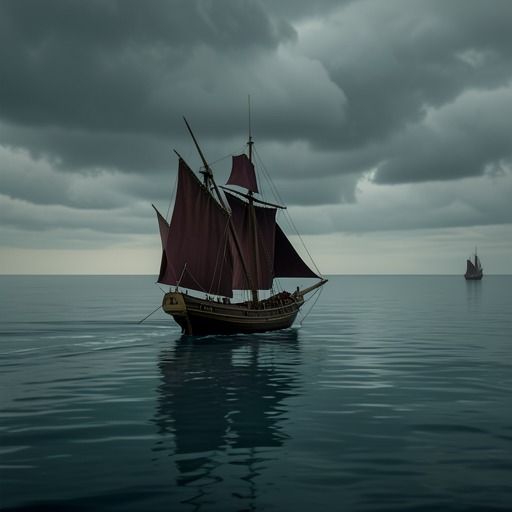
The Pequod encounters the Jeroboam of Nantucket while the latter is passing to windward. After the Jeroboam responds to the Pequod’s private signal, she comes abeam and lowers a boat, but Captain Mayhew refuses to approach the Pequod directly because a malignant epidemic has broken out aboard his ship. Mayhew and the boat’s crew remain untainted, and open sea and air separate the two vessels, yet he adheres conscientiously to what the narration calls the timid quarantine of the land. The epidemic therefore governs conduct beyond the infected ship itself: it prevents the visiting captain from boarding even when physical contact seems avoidable, and it dictates the distance at which the two crews communicate.
The quarantine is nevertheless partial rather than absolute. The Jeroboam’s boat keeps several yards from the Pequod while both vessels move through a freshening sea, maintaining a conversation by rowing to preserve its position. Waves repeatedly interrupt the exchange, adding a physical barrier to the medical one. The epidemic thus makes communication possible only through controlled separation, showing how maritime sociability survives under conditions of risk by replacing direct hospitality with distance, signals, and carefully managed contact.
Gabriel and the Politics of Disease
The epidemic has a second and more disturbing effect because Gabriel, a former prophet among the Neskyeuna Shakers who claims to be the archangel Gabriel, declares that the plague is under his personal command. His earlier insanity had already given him extraordinary influence over the Jeroboam’s crew. He had announced himself as the deliverer of the isles of the sea and vicar-general of all Oceanica, and his earnest delirium caused most of the sailors to surround him with an atmosphere of sacredness. Fear made that sacredness socially effective: the crew would not allow Captain Mayhew to put him ashore, and they threatened collectively to leave the ship if Gabriel were removed.
Once the epidemic breaks out, Gabriel’s authority expands. He claims that the plague will not be stopped except according to his pleasure, while the sailors cringe before him and sometimes pay him personal homage as though he were a god. The disease becomes, in his hands, more than a biological danger. It is represented as a sign of supernatural jurisdiction, and the crew’s fear allows an unstable individual to displace the captain and mates as the ship’s effective power. The crisis exposes how quickly formal command can be weakened when an organization confronts an incomprehensible threat and seeks an explanation in prophecy.
When Captain Ahab invites Mayhew to come aboard, Gabriel rises and warns him to think of fevers, yellow and bilious, and to beware the horrible plague. His intervention interrupts the attempted approach and confirms that quarantine is enforced not only by the captain’s conscience but also by Gabriel’s intimidation. Mayhew’s caution is institutional and ethical; Gabriel’s is apocalyptic and coercive. Both, however, keep the two ships apart.
Fear, Authority, and Maritime Risk
The Jeroboam episode places epidemic alongside the other hazards that structure life at sea. The book repeatedly presents danger through bodily exposure, uncertain warning, and collective interpretation: the Essex is stove in and sunk by a Sperm whale; a storm swamps a boat and leaves its crew clinging to improvised life-preservers; Tashtego falls head-first into a whale’s suspended head; and a sailor disappears from the mast-head when the life-buoy fails to save him. In each case, physical risk exceeds the crew’s control, but the disaster is also shaped by the explanations imposed upon it. The epidemic is distinctive because it does not merely threaten bodies; it reorganizes social relations before any visible catastrophe occurs.
The Jeroboam’s sailors respond to illness through submission to Gabriel, while Captain Mayhew responds through quarantine. These reactions reveal two competing forms of risk management. One relies on distance, restraint, and practical responsibility; the other converts uncertainty into a prophetic narrative and transfers decision-making to a charismatic figure. The epidemic therefore becomes a test of whether danger will be governed through disciplined collective procedure or through fear of a self-appointed interpreter.
Isolation and the Global Voyage
The epidemic also intensifies the Pequod’s isolation. The whaling ship ordinarily moves through a global network that the narrator credits with exploration, commerce, missionary travel, and political transformation. Whaling is described as a peaceful influence that opened remote seas, connected harbors, and helped establish intercourse between distant peoples. Yet the whale-ship’s mobility does not eliminate separation; it produces a floating society that may spend long periods without seeing land or meeting anyone except other seamen.
That isolation makes encounters with other ships especially important, but the epidemic places even this maritime fellowship under quarantine. The Pequod and the Jeroboam can recognize one another through their private signals and converse across the water, but cannot safely enact the customary physical meeting. At the same time, the Pequod continues toward the Javan sea, the Philippine Islands, the Japan whaling grounds, and ultimately the Pacific hunting line as Captain Ahab seeks the waters frequented by Moby Dick. The disease encounter is consequently absorbed into a larger voyage whose commercial and imperial reach coexists with extreme vulnerability.
Narrative Significance
Epidemic functions in the narrative as both a material danger and a social amplifier. Its concrete consequence is the refusal of direct contact between the Jeroboam and the Pequod, but its deeper consequence is the redistribution of authority aboard the infected ship. Gabriel’s claim to command the plague demonstrates how illness can be mythologized, how panic can make delusion persuasive, and how a crew may protect a threatening figure when fear has become stronger than formal discipline.
The episode also complicates the book’s broader account of disaster. Some dangers arrive as spectacular blows—the Sperm whale that destroys the Essex or the White Whale that smashes the Pequod’s bow—while the epidemic works through apprehension, avoidance, and suspended contact. Its violence is partly invisible, and its effects are mediated by quarantine and belief. In this form, disease becomes a compact image of the shipboard world itself: a closed community exposed to forces it cannot master, compelled to decide whom to trust, and always liable to mistake terror’s explanation for truth.