Mutiny
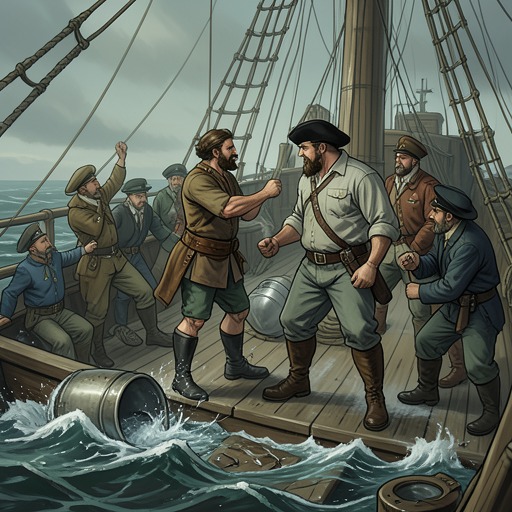
Moby-DickMutiny is the point at which a whaling ship’s formal authority loses the consent that ordinarily makes discipline workable. Its clearest enacted form appears in the Town-Ho episode, where the Lakeman Steelkilt and his fellow sailors resist the chief mate Radney after an insulting order, defend themselves against armed punishment, and convert a private quarrel into a collective refusal. Read beside the Pequod’s command structure, the episode shows that maritime order depends not only on rank and force but also on restraint, fairness, and the crew’s willingness to recognize an order as legitimate.
Institutional Background
The whaling ship is a tightly organized but economically unusual community. Its officers and sailors do not generally receive fixed wages; all hands share in the voyage’s profits through lays proportioned to their duties. The arrangement makes everyone dependent on common luck, vigilance, intrepidity, and hard work, and the long Southern voyage and its dangers can produce a less rigorous discipline than that of merchant vessels. Yet the external forms of the quarter-deck remain highly punctilious. The harpooneer’s special status illustrates this structure: in the older Dutch fishery, the Specksnyder, or chief harpooneer, shared command with the captain over whale-hunting, while in later practice the office was reduced but remained professionally important because the success of a voyage depended so heavily on the harpooneers.
This mixture of shared economic interest and rigid hierarchy creates the conditions in which mutiny becomes both dangerous and intelligible. The ship’s company works together, but authority is visibly concentrated in the captain and officers; the men depend upon one another, yet they are also subject to orders backed by confinement, weapons, and the threat of flogging. The Pequod makes the same tension unusually stark. Captain Ahab exacts implicit, instantaneous obedience rather than ceremonial homage, but the ordinary usages of the quarter-deck give his authority an external form through which his private will can become an irresistible dictatorship. At meals, even officers who may behave boldly on deck become humble before him in the cabin, showing how institutional ritual turns command into a social and psychological force.
The Immediate Conflict
The Town-Ho mutiny begins with exhaustion and humiliation. After laboring at the pumps, Steelkilt is ordered to sweep the deck, although he regards that task as belonging to three lads who have not been assigned to the pumps and have done little work. He refuses in an ordinary tone and explains why, but Radney, already irritated by his own exertions, repeats the command in a domineering and outrageous manner. The mate then advances with an uplifted cooper’s club hammer, turning a disputed order into an unmistakable threat of physical assault.
Steelkilt initially tries to contain the conflict. He remains seated, then retreats slowly around the windlass while Radney follows him with the hammer. His refusal is repeated, but he does not immediately attack. The scene therefore distinguishes resistance from spontaneous violence: Steelkilt’s first objective is not to overthrow the ship but to prevent an officer from striking him and to preserve the dignity of the men’s work. When Radney’s threats continue, Steelkilt stops retreating and prepares to defend himself. The conflict shifts from obedience versus disobedience to bodily self-preservation and collective honor.
The violence quickly escapes the boundaries of the original dispute. Steelkilt is surrounded by the junior mates and harpooneers, while two Canallers and other sailors rush to pull him toward the forecastle. A general struggle follows. The captain, standing outside the main danger, moves about with a whale-pike and orders his officers to manhandle Steelkilt. The resisting sailors reach the forecastle deck and barricade themselves behind several large casks placed in line with the windlass. A quarrel that began over a shovel has become a confrontation between an armed command and an organized body of men.
Collective Resistance and Containment
The captain answers the barricade with two pistols and demands that the sailors come out. Steelkilt climbs onto the barricade and openly defies the threat, warning that his death will signal a murderous mutiny by all hands. The warning gives the resistance its decisive political force: the issue is no longer Steelkilt’s individual punishment but whether the captain can use violence against one sailor without provoking the whole crew. The captain fears that the threat may be true and briefly moderates his action, though he still orders the men back to duty.
Steelkilt and his companions refuse to resume work unless the captain promises not to flog them. The captain refuses to make that promise and instead orders them below, threatening to keep them confined. Most of the men initially resist even this order, but Steelkilt eventually leads them into the forecastle, where they disappear into the dark space like animals withdrawing into a cave. The captain and his supporters then close and padlock the scuttle, imprisoning ten men while roughly twenty others remain neutral. The ship’s response thus contains the mutiny through physical separation rather than reconciliation: authority survives, but the underlying grievance is not resolved.
During the night, the officers maintain an alert watch around the forecastle and fore hatchway, fearing that the confined sailors may break through the bulkhead. The men who remain at their duty continue laboring at the pumps, whose iron clanking carries through the darkness. This detail reveals the material pressure beneath the conflict: the ship is still in peril, and even a mutiny unfolds within the demands of collective survival. The crew can challenge the officers, but abandoning the ship’s essential work would endanger everyone, including the rebels.
Punishment, Passive Resistance, and Revenge
The next phase exposes the limits of coercive containment. When the captain orders three men to be tied up, Radney appears with his head bandaged from the earlier struggle. Though he can barely speak, he claims that he is willing to do what the captain dared not attempt, takes the rope, and approaches Steelkilt’s restrained companion. Steelkilt calls him a coward. Radney acknowledges the charge and strikes anyway. The three men are cut down afterward, and all hands return to work, but their obedience is visibly sullen rather than reconciled.
That evening, two sailors who had supported the authorities flee from the forecastle and beg protection at the cabin door, declaring that they dare not remain with the crew. Their fear shows that the conflict has altered loyalties throughout the ship. They are placed in the ship’s run at their own request, while the rest of the sailors do not renew the mutiny. Instead, largely at Steelkilt’s instigation, they agree to obey orders until the vessel reaches port and then desert together. Their resistance changes from open rebellion to disciplined passive action.
The sailors also agree not to sing out for whales if any are discovered. This decision attacks the voyage at its economic and professional foundation without requiring an immediate assault on the officers. The Town-Ho’s leak and other dangers do not prevent its captain from wanting to lower the boats, and Radney remains ready to enter a whaleboat despite his bandaged mouth. By withholding the warning that makes a whale hunt possible, the men turn their labor and knowledge into leverage. Steelkilt, meanwhile, keeps silent about his personal plan for revenge. He serves in Radney’s watch and observes that the mate, against the captain’s advice, insists on resuming command at night, thereby placing himself in the conditions Steelkilt intends to exploit.
Authority, Consent, and Significance
The mutiny’s larger significance lies in its contrast with the Pequod’s more complete subordination of the crew. When Ahab summons the entire ship’s company, the men assemble with curious and apprehensive faces beneath the atmosphere of an approaching storm. He converts the gathering into a ritual of collective action by making the crew respond to the sight of a whale, ordering the harpooneers to display their weapons, and surrounding himself with officers, irons, and sailors. The ceremony makes obedience appear communal, but its emotional center is Ahab’s will.
The difference between the Town-Ho and the Pequod is not that one ship has authority and the other lacks it. Both depend upon rank, custom, weapons, and the practical need to keep the vessel functioning. The difference is the visible point at which authority meets resistance. Steelkilt’s men retain enough collective confidence to demand protection from flogging and to withhold their labor’s most valuable service. Ahab’s crew, by contrast, is drawn into his purpose through ritual, fear, shared excitement, and the overwhelming authority of the captain’s office. Even Starbuck, who recognizes the danger of Ahab’s command and once considers whether he should remove him, ultimately remains bound by obedience.
Mutiny therefore reveals the unstable boundary between discipline and domination. A ship’s rules can coordinate dangerous work, but the same rules can become instruments of private power when an officer uses them to insult, punish, or compel. In the Town-Ho episode, resistance is contained without being morally erased: the sailors’ open revolt subsides, yet their planned desertion and refusal to signal for whales preserve the grievance in another form. The episode makes clear that obedience restored by force is not the same as loyalty, and that a vessel may remain operational while its social order has already been fractured.