Shipwreck
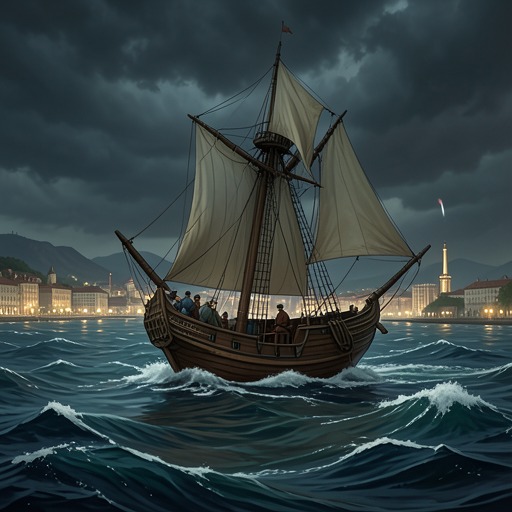
Moby-DickShipwreck is one of the governing conditions of Moby-Dick. It names the literal destruction of vessels, but also the larger exposure produced when human plans meet an ocean that cannot be mastered. The book presents wreck through documented maritime testimony, immediate scenes of storm and collision, and retrospective reflection; across these forms, ships that appear to organize distance, labor, commerce, and empire are repeatedly shown to be fragile structures. The decisive pattern is not simply that vessels sink, but that confidence in human control collapses with them.
Definition and Narrative Scope
Shipwreck appears as both an anticipated hazard and a completed disaster. Ishmael’s account places whaling within a world of violent weather, immense animals, tangled lines, submerged obstacles, and long isolation from land. The danger is inseparable from the enterprise itself: whaling sends crews into waters where the object of pursuit can become an attacking force, and where rescue may depend on a passing ship rather than on any stable shore-based system.
The narrative also treats wreck as a historical and global condition. Whaling is defended as a major peaceful influence that explored uncharted seas, opened harbors, carried missionaries, supplied isolated settlements, and helped connect distant regions. The same ships that serve as pioneers of commerce and cultural contact therefore carry the risks of imperial expansion and extraction. Their mobility enlarges the world while exposing their crews to the world’s remoteness.
Recorded Precedents and Maritime Risk
The sinking of the Essex establishes shipwreck as a documented consequence of whale-hunting rather than a fabulous exaggeration. In 1820, the Nantucket ship Essex, commanded by Captain Pollard, pursued a shoal of Sperm Whales in the Pacific. After several whales had been wounded, a very large whale broke from the shoal and drove directly at the vessel. Its forehead stove in the hull, and the ship settled and fell over in less than ten minutes. No surviving plank was afterward seen.
The disaster extends beyond the initial collision. Part of the crew reached land in boats after severe exposure, while Captain Pollard later sailed again and suffered a second total shipwreck on unknown rocks and breakers. He then abandoned the sea. Ishmael strengthens the account by presenting it as independently supported: he had seen Owen Chace, the Essex’s chief mate, read Chace’s narrative, and spoken with Chace’s son near the scene of the catastrophe. Shipwreck thus enters the book through testimony, memory, and corroboration, not merely through the narrator’s imaginative rhetoric.
The Essex evidence also complicates the boundary between animal instinct and deliberate action. Chace’s account describes the whale as making two attacks whose direction maximized the force of impact, and as seeming to act with resentment after members of its shoal had been struck. Whether or not the whale possesses human intention, the testimony alters the sailors’ understanding of the event: the catastrophe is experienced not as random contact but as an organized counterattack. The wreck becomes a crisis of interpretation as well as a loss of ship and life.
Storm, Near-Wreck, and Collective Survival
A separate maritime crisis follows the loss of a whaling boat in a violent squall. Wind, waves, spray, darkness, and mist isolate the boat from the Pequod, while the rising sea makes bailing impossible and renders the oars useless as propellers. Starbuck manages to ignite a lamp after repeated failures and places it on a waif pole, which Queequeg holds aloft. The small flame becomes a practical signal and a stark image of hope maintained inside overwhelming danger.
At dawn, the crew still despairs of finding the ship. Queequeg hears the muffled creaking of ropes and yards before the others can see anything, and a huge vague shape eventually emerges from the mist. The Pequod bears down upon the abandoned boat at close range; the boat disappears beneath the bows and later resurfaces astern. The crew swims toward it, is battered against it by the sea, and is finally taken aboard safely. Because the other boats have already returned and the ship has continued cruising for signs of the missing men, the episode ends in rescue rather than wreck, but only after the crew has been made to experience the practical and psychological condition of castaways.
The Pequod and the Whale’s Destruction
The final wreck fulfills the danger repeatedly established by the earlier examples. During the chase, the White Whale entangles the lines attached to him, drawing Ahab’s, Stubb’s, and Flask’s boats into collision. The boats are dashed together, their crews thrown into the water, and their fragments revolve in a boiling maelstrom. The whale then rises beneath Ahab’s boat, hurls it into the air, and leaves the men struggling from beneath the overturned hull.
The destruction proceeds from boats to ship. Nearly all the seamen aboard the Pequod become motionless spectators, still holding hammers, planks, lances, and harpoons as the White Whale advances. His forehead strikes the starboard bow, and the ship’s timbers reel while water pours through the breach. The impact transforms the vessel into what Ahab calls a second hearse: the ship that carried the pursuit becomes the structure of burial.
Ahab’s death is bound to the same material system of line and weapon that has enabled the chase. After the White Whale is harpooned, the line runs foul; when Ahab bends to clear it, a flying turn catches him around the neck and shoots him from the boat. Immediately afterward, the Pequod fades into the water. The remaining crew, still fixed to their elevated lookouts, disappears with the sinking vessel, while the whirlpool draws the boat, oars, lance poles, and every floating fragment into its circular motion.
The final image joins human labor, national identity, animal life, and wreckage in one emblematic descent. Tashtego remains at the mainmast as the ship goes down, hammering Ahab’s flag to the spar. A sky-hawk is caught between hammer and wood; the bird, the flag, the sailor, and the ship descend together. Shipwreck here is not a clean separation between victor and defeated. It gathers the pursuing human order, its symbols, its tools, and a fragment of the living heavens into the same sinking movement.
Consequences and Significance
The book’s shipwrecks expose the limits of technological and institutional confidence. The whale-ship can carry years of water, weapons, and supplies; it can cross nearly the whole known cruising world without sighting land; it can function as a mobile outpost of commerce and exploration. Yet its provisions and navigational reach do not make it invulnerable. A whale can stove in a hull, a storm can erase the ship from sight, and a line intended to connect hunter and prey can become the instrument of a captain’s death.
Shipwreck also gives form to the novel’s argument about knowledge. The Essex disaster is reconstructed from personal observation and written testimony, while the Pequod’s destruction is witnessed by Ishmael as a survivor whose account depends on fragments, absence, and aftermath. What can be known is uneven: wreckage may vanish, a ship may appear only as a fading shape, and the decisive motives of a whale remain uncertain. The narrative therefore preserves disaster without pretending to master it.
Finally, wreck turns the ocean into more than a route between places. The sea sustains global commerce, exploration, missionary movement, and the whaling economy, but it also refuses the stable boundaries that those networks require. Its creatures, storms, depths, and distances continually return the ship to its condition as a temporary human construction. In Moby-Dick, shipwreck is the ultimate reversal of maritime ambition: the vessel that claims passage through the world is finally absorbed by the element through which it moves.