Quarantine
Moby-DickQuarantine is presented as a temporary maritime barrier against contagion, separating the Pequod from the Jeroboam while allowing limited communication across the water. Its decisive significance lies in the tension between rational prevention and the irrational power that disease-fear acquires aboard a ship: Captain Mayhew observes quarantine to protect the Pequod's company, while Gabriel turns the epidemic into an instrument of personal authority.
The Encounter Between the Ships
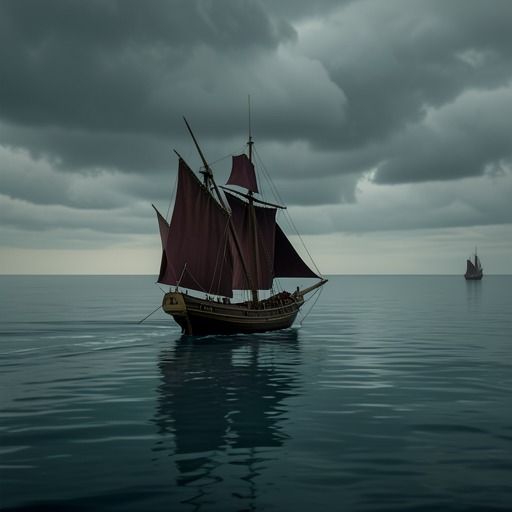
The Pequod identifies the approaching vessel as the Jeroboam of Nantucket through the American Whale Fleet's system of private signals. The Jeroboam comes abeam under the Pequod's lee and lowers a boat, but Captain Mayhew refuses to come into direct contact after revealing that a malignant epidemic has broken out aboard his ship. Although Mayhew and the boat's crew remain untainted, he considers the danger serious enough to maintain separation, even with only a short distance of clean sea and air between the vessels.
Quarantine therefore does not end exchange; it changes its form. The Jeroboam's boat keeps several yards away and rows parallel to the Pequod as the ships move through freshening weather. Waves sometimes drive the boat ahead, after which its crew skilfully regain position, and conversation continues despite these interruptions. The scene makes distance itself into a social and medical instrument: the two crews can speak, signal, and observe one another, but they cannot safely share a deck.
Protection and the Limits of Command
Captain Mayhew's refusal is described as a conscientious adherence to the cautious quarantine associated with land-based practice. His conduct contrasts with the aggressive openness of Captain Ahab, who declares that he fears the epidemic and invites Mayhew aboard. The invitation treats courage and contact as interchangeable, whereas Mayhew's conduct treats restraint as a responsibility to the healthy crew.
The episode also reveals that quarantine cannot be understood only as an official order imposed by a captain. On the Jeroboam, Gabriel claims that the plague is under his sole command and declares that it will end only according to his pleasure. Because the crew already regards him with fear and reverence, the epidemic becomes embedded in an informal power structure that competes with the ship's formal hierarchy. A medical emergency thus exposes the difference between nominal command and effective authority.
Gabriel and the Politics of Contagion
Gabriel's influence predates the outbreak. Originally associated with the Neskyeuna Shakers, he had once acted as a prophet, descended through a trap-door in secret meetings, and announced the opening of the seventh vial. After joining the Jeroboam as a green hand, he declared himself the archangel Gabriel, ordered Captain Mayhew to jump overboard, and proclaimed himself deliverer of the isles of the sea and vicar-general of Oceanica.
When Captain Mayhew considered putting him ashore, Gabriel threatened the ship and all hands with perdition. The crew collectively opposed his removal, saying that not one man would remain if Gabriel were sent away. Their intervention forced the captain to abandon the plan and left Gabriel with complete freedom aboard the ship. Once the epidemic appeared, this freedom gave his pronouncements greater force: sailors cringed or fawned before him, sometimes offering personal homage as though he were a god. Quarantine consequently becomes more than a barrier between ships; within the infected vessel, it helps produce an exceptional political space in which a fanatic can claim dominion over life and death.
Maritime Knowledge and Global Movement
The quarantine episode occurs within a world organized by the whale-ship's movement across oceans. The Pequod's pursuit carries it through the Javan sea, past the Philippine Islands, toward Japan, and eventually toward the Season-on-the-Line in the Pacific. Such travel makes ships both instruments of connection and vectors of danger. The same whale-ship that opens routes between distant regions can also be compelled to close itself against another vessel.
This double function belongs to the wider historical importance attributed to whaling. The whale-ship is credited with exploring uncharted seas, entering harbors before naval and commercial powers, carrying missionaries, and connecting remote communities. Yet circulation also carries disease, and the encounter with the Jeroboam shows that oceanic mobility requires practices of interruption as well as exchange. Quarantine is the negative counterpart of the whale-ship's expansive geography: it preserves the possibility of continued travel by temporarily refusing physical intimacy.
Narrative Significance
Quarantine sharpens the novel's recurring conflict between method and uncertainty. Elsewhere, Ahab studies charts, currents, feeding grounds, and seasonal migrations in the hope of converting the ocean into a calculable field for finding Moby Dick. The Pequod's route similarly depends on instruments, dead reckoning, and maritime knowledge, even though those systems remain vulnerable to contingency. Against this confidence in navigation, quarantine introduces an invisible threat that cannot be located by ordinary charts: disease travels through contact, air, and the uncertain condition of bodies.
The episode also turns separation into an ethical question. Mayhew's refusal protects the Pequod's crew, but Ahab's challenge shows how easily prudence can be recoded as fear or weakness. Gabriel's fanaticism intensifies the danger by claiming to control the epidemic while exploiting the crew's terror. Quarantine therefore stands between two forms of power: a limited, precautionary authority that accepts uncertainty, and an absolute authority that transforms uncertainty into prophecy. Its importance lies in showing that at sea, survival depends not only on courage and navigation but also on the disciplined recognition of what cannot safely be approached.