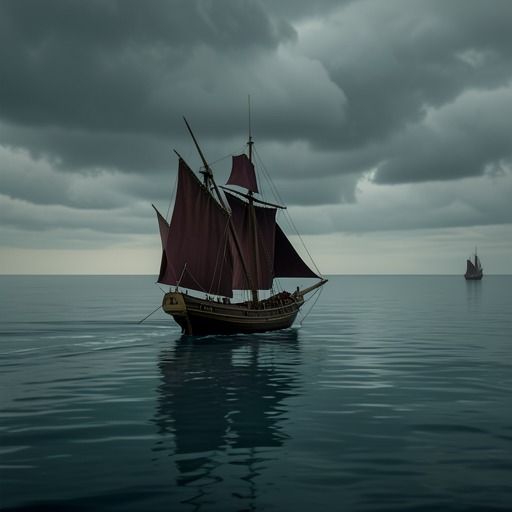
Japanese Sea
Moby-DickThe Japanese seas are among the most important operational spaces in the Pequod's global hunt for Moby Dick. They function simultaneously as a known Sperm whale cruising ground, a passage linking the China waters with the Pacific, and a testing ground for Captain Ahab's faith in charts, instruments, currents, and calculation. Yet the region also exposes the limits of that knowledge: its apparently measurable routes and seasons remain subject to migration, weather, and the unknowable movements of the White Whale.
Geographic Setting and Maritime Route
The Japanese seas lie within the far eastern reaches of the Pequod's circumnavigating voyage. As the ship approaches the Straits of Sunda, Captain Ahab intends to pass into the Javan sea, cruise northward across waters frequented by Sperm whales, sweep along the Philippine Islands, and reach the far coast of Japan in time for the great whaling season there. This route is not a detour but part of a deliberate plan to cover nearly all the known Sperm whale grounds before the ship descends upon the Line in the Pacific.
The region therefore occupies a connective position between the China waters and the Pacific. The waters around Formosa and the Bashee Isles form one of the tropical outlets from the China waters into the Pacific, and Ahab studies the eastern coasts of the Japanese islands, including Niphon, Matsmai, and Sikoke, as he reconstructs his courses. The Japanese seas are presented not as an isolated backdrop but as a node in a maritime network through which ships, labor, commodities, navigational knowledge, and imperial ambitions circulate.
Whaling Grounds and Ahab's Pursuit
Ahab's interest in the Japanese seas is governed by the migratory behavior attributed to the Sperm whale. The whales are said to travel along remarkably exact oceanic paths, or veins, whose width remains within the visual sweep from a whale-ship's mast-heads. At particular seasons and along these paths, migrating whales may be confidently sought. Such regularity allows Ahab to treat the ocean as a field of probabilities that can be converted, at least in his imagination, into near-certainty.
Earlier sightings of Moby Dick in the Japanese region have made it especially significant. Volcano Bay on the Japanese Coast is identified as one of the places where the White Whale had previously been seen, though the narrative cautions that such grounds may be only temporary stopping places rather than permanent abodes. The fact that Moby Dick had appeared there in a former year does not guarantee that the Pequod will find him there again. Ahab's method thus depends on a contradiction: he acknowledges the variability of whale movement while continually pressing that variability toward the certainty required by his monomaniac thought.
The Japanese seas are consequently one of the intermediate hunting spaces through which Ahab refuses to suspend his pursuit. The Pequod leaves Nantucket at the beginning of the Season-on-the-Line, too early to double Cape Horn and reach the equatorial Pacific in time for that season. Ahab uses the intervening year for a miscellaneous hunt, hoping that Moby Dick might appear in distant waters such as the Persian Gulf, Bengal Bay, China Seas, or the Japanese seas before the ship reaches the whale's most familiar seasonal ground. The Japanese region is therefore both an immediate objective and a stage in the longer approach to the decisive encounter expected on the Line.
Charts, Instruments, and the Limits of Knowledge
The Japanese seas become a particularly vivid setting for the conflict between cartographic mastery and oceanic uncertainty. Almost every night, Ahab spreads charts of all four oceans in his cabin, erases earlier pencil marks, and substitutes new courses. He consults old logbooks recording the seasons and places in which Sperm whales were captured or seen, using currents, the drift of the whale's food, and known hunting seasons to calculate where a solitary animal might be encountered.
When the Pequod draws near Formosa and the Bashee Isles, Ahab is found with a general chart of the oriental archipelagoes and another chart representing the long eastern coasts of the Japanese islands. His snow-white ivory leg is braced against the table while he traces his former courses with a jack-knife, turning the region into a surface of repeated projections and revisions. The map offers order, but the repeated alterations also reveal that Ahab's order is never finished: every new line records both knowledge and the failure of previous knowledge to settle his search.
The limits of navigation become explicit in the Japanese seas when Ahab takes a solar observation. Beneath him, the Parsee watches the same sun while Ahab uses his quadrant to calculate the ship's latitude. The instrument can tell him where he is, but it cannot tell him where he will be, where Moby Dick is, or what is occurring beyond the horizon. Ahab therefore smashes the quadrant and rejects its authority, deciding to rely instead on the level ship's compass and the dead reckoning of log and line. The episode transforms the Japanese seas from a successfully measured location into the scene of a rebellion against scientific mediation.
That rejection does not free Ahab from instruments; it merely shifts his dependence. Soon afterward, remembering his oath concerning the level log and line, he orders the neglected log to be heaved. The Pequod's long-abandoned reel has been warped by sun and wind and rotted by rain and spray, a material reminder that every navigational system decays when left unused. Ahab's attempt to replace the quadrant with another method thus repeats the larger pattern of his voyage: he destroys one form of guidance while demanding certainty from another.
Natural Radiance and Narrative Significance
The Japanese seas are described through an intensity of summer light that makes the region appear almost metaphysical. The sun is presented as a blazing focus upon the glassy ocean; the sky seems lacquered, the clouds vanish, and the horizon floats in an unrelieved radiance likened to the splendors of God's throne. The colored glasses of Ahab's quadrant are necessary because the solar fire is too vivid to face directly. The beauty of the setting is inseparable from danger: illumination does not yield understanding, and brightness can scorch as readily as it reveals.
This radiant sea sharpens the novel's recurring contrast between visible order and hidden reality. Ahab can determine his latitude beneath the Japanese sun, but geographical position does not disclose destiny, the White Whale's location, or the future. The region's navigable surfaces therefore become a critical-cartographic paradox: charts, seasons, veins, and instruments make the ocean legible enough to traverse, yet none can master the living forces that move through it.
The Japanese seas also embody the global reach of whaling. The whale-ship's routes are connected elsewhere in the narrative with the opening of remote harbors, the movement of commerce, missionary travel, and the expansion of European and American influence. In this setting, the Pequod's passage toward Japan joins a history in which whaling vessels act as pioneers of exploration and exchange. But the same route is also organized around extraction and pursuit. The region's importance arises from its whales, its currents, its seasonal knowledge, and its position in a worldwide economic network, while Ahab narrows all of that expansive geography to the single living target of Moby Dick.