Kro
Moby-DickThe Crozetts are a remote oceanic region encountered during the Pequod’s north-easterly passage, a place where routes, species, and scales of perception converge. They appear as a working whaling ground rather than a civilized settlement: the surrounding sea carries the traffic of Right Whalemen, spreads fields of brit, gathers immense herds of Sperm Whale, and exposes the Pequod’s crew to the predatory violence and inscrutable abundance of the open ocean.
Setting and Maritime Position
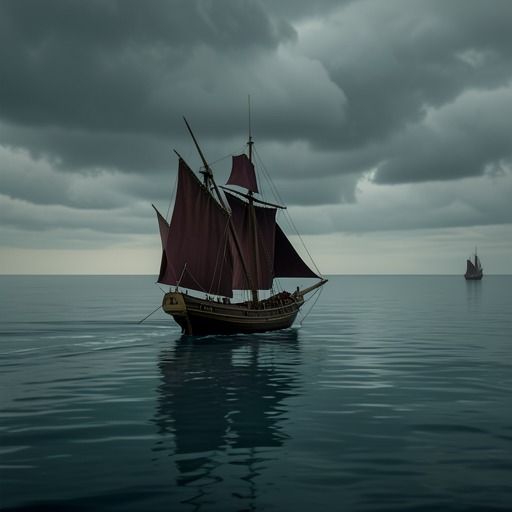
The Crozetts first enter the narrative as a distant cruising ground off the Cape, associated particularly with Right Whalemen. From a mast-head, Ishmael observes another whaler, the Goney, or Albatross, slowly approaching after nearly four years at sea. The ship’s bleached hull, reddened rust, frost-like rigging, and ragged look-outs make the region appear not as a picturesque landmark but as part of a severe world of prolonged absence, labor, and exposure. The Crozetts therefore mark a zone where the ordinary signs of human habitation have been replaced by the visible wear of oceanic travel.
The region also lies within the Pequod’s larger global itinerary. After steering north-eastward from the Crozetts, the ship passes through vast meadows of brit and continues toward Java; later, Ahab’s projected route again takes the ship through the area before carrying it toward the Javan Sea, the Philippine Islands, the Japanese whaling grounds, and finally the Pacific Line. The Crozetts are thus one node in a circular strategy intended to sweep across nearly all known Sperm Whale cruising grounds before Ahab makes his anticipated attempt against Moby Dick.
Whaling Grounds and Food Webs
The waters north-east of the Crozetts are described as being filled with brit, a minute yellow substance on which Right Whale feeds. It extends for leagues like ripe golden wheat, transforming the sea into a moving pasture. Right Whale pass through it with open jaws, their fringed mouth structures filtering the brit from the water as they advance in slow parallel motion. The image of marine feeding is agricultural without becoming terrestrial: the whales act like mowers, but their field is a boundless sea and their passage leaves long blue swaths in the yellow surface.
This abundance supports a dense and violent ecology. Near the same oceanic region, the Pequod moves through calm waters where a mysterious jet appears intermittently at night, before a strange spectre is sighted from the mast-head. The sea can look serene, silvery, and almost secretive while concealing large and dangerous forms beneath its surface. The Crozetts consequently stand for a habitat whose beauty does not cancel predation; it conceals it. The surrounding ocean contains creatures that glide unseen, brilliantly colored sharks that remain remorseless, and a universal cannibalism in which marine life continually feeds upon marine life.
Whale Herds and Animal Agency
The Crozetts belong to a transformed whaling geography in which Sperm Whale are increasingly encountered not in small detached companies but in immense caravans. Intensive hunting has altered the distribution visible to human observers: long periods without a single spout may be followed by the sudden appearance of thousands. This alternation between absence and overwhelming presence makes the cruising ground resistant to simple calculation. A region may seem empty for weeks or months and then reveal itself as crowded with life on a scale that exceeds the ship’s expectations.
The great herds are not merely a backdrop for human pursuit. They display forms of collective movement, protection, breeding, and attachment that complicate the hunters’ classifications. In one scene, a young whale remains connected to its dam by a natural umbilical line, which may become entangled with a hempen whale-line and trap the calf during the chase. At the center of the surrounding danger, the whales nevertheless engage in peaceful social and reproductive behavior. Their calm intimacy contrasts sharply with the boats’ attacks at the outer edges of the herd and with the agony of wounded animals moving through the revolving circles.
The region also evokes the defensive geography of whale-bone whales. Hunted from familiar middle-sea grounds, they may retreat toward Polar citadels among ice fields and floes, where human pursuit becomes difficult or impossible. The Crozetts thus participate in a larger map of displacement: hunting does not simply make whales vanish, but drives them toward remoter and more protected spaces, while simultaneously making their appearances more sporadic and spectacular.
Human Commerce and Global Oceanic Networks
Although the Crozetts are remote, they are connected to a global system created and extended by whaling. The narrative presents whaling as a powerful peaceful influence whose ships explored uncharted seas, opened contact with formerly inaccessible harbors, and preceded military, commercial, and missionary movements. The whale-ship is credited with helping open routes toward the Pacific coast of South America, Australia, Polynesia, and Japan. The Crozetts therefore belong to a maritime network linking distant oceans rather than to an isolated wilderness outside history.
That network is also material and economic. American whalers are described as operating a fleet of more than seven hundred vessels, employing eighteen thousand men, consuming millions of dollars annually, and bringing a harvest of millions into American harbors. The Crozetts are one of the working spaces through which that extensive industry moves. Their importance lies not in a port, market, or permanent settlement, but in their position within a mobile infrastructure of ships, crews, knowledge, provisions, and animal pursuit.
Narrative and Ecological Significance
In the narrative structure, the Crozetts serve as a threshold between observation and danger. From their waters, Ishmael looks down upon the worn Albatross, studies the feeding of Right Whale, and witnesses the sudden appearance of vast Sperm Whale herds. The same region can produce a nearly pastoral spectacle of golden brit and a terrifying vision of wounded animals, sharks, and hidden marine violence. Its apparent serenity is therefore inseparable from uncertainty.
The Crozetts also sharpen the contrast between human maps and the ocean’s own movements. Ahab can plot a route through recognized cruising grounds, but whales aggregate, disperse, migrate, and retreat according to conditions that remain only partly knowable. The region becomes a practical demonstration of incomplete knowledge: it is charted enough to be named and revisited, yet too immense and changeable to be mastered. Through the Crozetts, the book presents the sea as both a resource frontier and a living system whose animals continually exceed the categories, schedules, and ambitions imposed upon them.