Daxianghu
Moby-DickThe Atlantic Ocean is the first great expanse into which the Pequod and its crew disappear, and it functions simultaneously as a working environment, a historical corridor, and an image of existential uncertainty. It carries the vessel away from land into the loneliness of open water, links whaling to imperial and commercial history, and becomes the dark oceanic counterpart to the regions of peace imagined within the human soul.
Setting and Departure
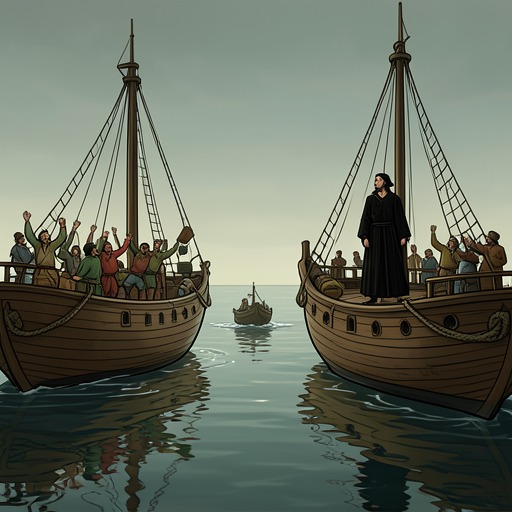
The Atlantic first appears as the space separating the Pequod from the shore and from the people who have sent the ship onward. When Captain Bildad and Captain Peleg leave, the ship and the boat diverge in a cold, damp night breeze. The two hulls roll wildly, a screaming gull passes overhead, and the crew gives three heavy-hearted cheers before plunging blindly into the lone Atlantic. The departure therefore carries both ceremony and foreboding: the crew is not merely beginning a voyage but entering a realm figured as isolated, unstable, and governed by forces that resemble fate.
The Atlantic is also the setting in which Ishmael and Queequeg become fully committed to whaling. Ishmael addresses landsmen who regard the profession as unpoetic, disreputable, bloody, and unclean, and argues that their judgment misunderstands the work and its place in civilization. The ocean is thus introduced not as an empty wilderness outside history but as the operating ground of a major international industry whose labor, risks, and products reach far beyond the ship itself.
A Global Whaling Corridor
Whaling gives the Atlantic an economic and geopolitical scale. American whalers are described as commanding a fleet of more than seven hundred vessels, manned by eighteen thousand men, consuming four million dollars annually, and sending ships valued at twenty million dollars to sea while importing a yearly harvest of seven million dollars into American harbors. These figures make the ocean a measurable infrastructure of capital, labor, supply, and return, even though the sailors experience it as limitless water.
The Atlantic also belongs to a longer history of state power. The Dutch once had admirals of their whaling fleets; Louis XVI financed whaling ships from Dunkirk and invited families from Nantucket; and Britain paid more than one million pounds in bounties to whalemen between 1750 and 1788. Such examples place the ocean between private enterprise and national policy. Whaling is presented as an industry capable of serving monarchies, maritime states, and expanding commercial societies at once.
The whale-ship’s influence extends beyond the Atlantic itself. The narrative credits whalers with opening unexplored seas and archipelagoes, guiding later European and American warships into harbors, and mediating early encounters between foreign powers and peoples described as previously unfamiliar to them. After the fishery rounded Cape Horn, whalemen helped break the Spanish Crown’s restrictive control over commerce with Pacific colonies; the account even connects their movements with the eventual liberation of Peru, Chile, and Bolivia. The Atlantic is therefore the western gateway of a maritime process that reaches into the Pacific and participates in the transformation of imperial space.
Passage Toward Other Oceans
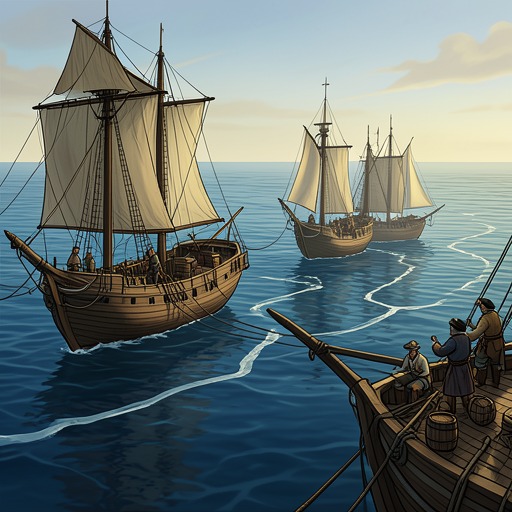
The Pequod’s Atlantic passage is only one segment of a planned circumglobal circuit. After crossing several cruising grounds, including waters off the Azores, the Cape de Verdes, the Plate near the mouth of the Rio de la Plata, and the Carrol Ground south of Saint Helena, the ship continues toward the Indian Ocean and the Java Sea. Captain Ahab intends to pass through the Sunda Strait, cruise northward by the Philippine Islands, reach the Japanese whaling grounds, and eventually descend upon the Line in the Pacific, where he expects to encounter Moby Dick.
This route shows how the Atlantic is connected to an articulated map of whale grounds rather than treated as an isolated setting. The Pequod carries its own provisions, weapons, and crew instead of ordinary commercial cargo, and it can remain at sea for years without touching land. Its water tanks and stored necessities allow it to cross distances in which the crew may see no people except other floating sailors. The whale-ship consequently makes the Atlantic part of a mobile world whose primary geography is made by currents, sightings, seasons, and prey rather than by ports alone.
The ocean’s charted routes coexist with sudden uncertainty. The Pequod may pass through established grounds for weeks without seeing a single spout, then encounter enormous herds of Sperm Whales gathered in numbers that seem like whole nations. In the Atlantic and beyond it, the map promises knowledge while the whales preserve the power of surprise. The ship’s movement is planned, but the decisive encounter remains contingent upon what the sea conceals or reveals.
Living Sea and Human Vulnerability
The Atlantic is not merely a stage for human action. It is inhabited by whales, sharks, squid, and other creatures whose relations form a violent and interdependent marine world. The narrative describes the sea as a place where dangerous animals move beneath beautiful surfaces and where universal predation has continued since the beginning of the world. The ocean’s loveliness therefore cannot be separated from its concealed threats; its calm appearance may cover creatures and forces that remain unseen until they act.
In the Atlantic, the hunting of whales exposes the reciprocal vulnerability of humans and animals. A wounded whale can break away carrying part of a harpoon line, and its agony can turn it into a force of uncontrolled destruction. Elsewhere, the peaceful intimacy of whales within a vast herd appears amid the violence of the chase, suggesting that the animals’ lives exceed the purposes imposed on them by hunters. The Atlantic contains both the machinery of extraction and forms of animal sociality that resist being reduced to quarry.
The same sea that supports the hunt can become an immediate threat to the ship. When a captured Sperm Whale is brought alongside, sharks gather around the carcass in such numbers that the surrounding water appears like a huge cheese filled with maggots. The crew must remain alert because leaving the carcass unattended could result in little more than a skeleton by morning. The scene makes the Atlantic an ecosystem of competing appetites in which the whale, the sharks, and the human hunters occupy shifting positions within a chain of consumption.
Symbolic and Narrative Significance
The Atlantic carries a persistent symbolic tension between freedom and destruction. The sea is described as the dark side of the earth, covering two thirds of the globe and containing deserts of grief that sunlight cannot conceal. Against this immensity, the human mind may still contain a peaceful inner island, but that island is surrounded by the horrors of partly known life. The Atlantic thus becomes an image of inward existence: calm may persist at the center, yet it is encircled by danger, sorrow, and uncertainty.
At the same time, the ocean enables the narrative to join personal adventure with global history. The Pequod’s departure, the economic power of American whaling, the opening of distant coasts, the movement of missionaries and merchants, and the weakening of imperial barriers all belong to one maritime system. The Atlantic is where this system becomes visible as movement: ships leave shore, carry labor and knowledge outward, and return with products that illuminate and enrich distant societies even as the labor itself remains physically perilous.
The Atlantic finally resists every attempt to make it fully legible. It can be crossed, measured, provisioned, and entered into a worldwide plan, but its whales gather unpredictably, its weather and currents exceed command, and its depths conceal lives that human knowledge only partially reaches. For the Pequod, the Atlantic is therefore both an avenue toward Moby Dick and the first proof that no route, map, or purpose can abolish the sea’s power to turn human intention into exposure.