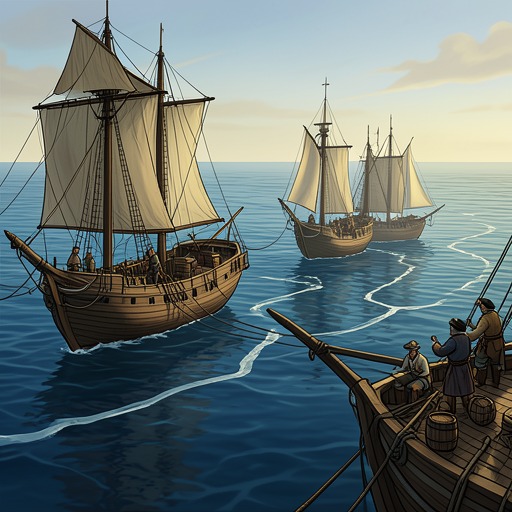
Taiwang Sea
Moby-DickThe Pacific, also called the South Sea or Great South Sea, is the decisive oceanic setting of the voyage and one of the central imaginative spaces of Moby-Dick. Ishmael sets out from New Bedford with Cape Horn and the Pacific as his destination, imagining the whaling voyage as an opening into a wonder-world. For Captain Ahab, however, the ocean gradually becomes more narrowly defined: its vastness is not an invitation to discovery but the field in which he intends to locate and confront Moby Dick.
Definition and Setting
The Pacific is presented as a vast South Sea reached after the Pequod rounds Cape Horn and passes the Bashee isles. Ishmael describes its waters as extending a thousand leagues eastward and as possessing a “sweet mystery,” with waves that seem to speak of a hidden soul beneath the surface. Its scale joins rather than merely separates the world: the ocean connects the Indian Ocean and Atlantic as their arms, washes both newly established Californian towns and ancient Asiatic shores, and surrounds the globe with coral islands, archipelagoes, and the difficult-to-enter waters of Japan.
This setting is neither empty nor uniform. It contains known cruising grounds, feeding grounds, migrating routes, islands, straits, and uncharted spaces, while also carrying the accumulated traces of drowned lives and dreams. The Pacific therefore operates simultaneously as geography, route, ecological environment, and metaphysical image. Its apparent serenity conceals movement, danger, and an immeasurable depth of human and nonhuman histories.
A Global Whaling Network
The Pacific is reached through the commercial and exploratory infrastructure of whaling. Ishmael argues that whaling ships pioneered routes into remote seas and archipelagoes, entered harbors that European and American warships later used, and helped interpret between foreign powers and peoples previously treated as inaccessible. In this account, the whale-ship is not a marginal vessel but a mobile institution of exploration, commerce, communication, and imperial expansion.
The ocean also figures in the historical transformation of distant regions. Ishmael credits whalemen with helping break the Spanish crown’s restrictive policy toward its Pacific colonies and associates their activity with the later liberation of Peru, Chili, and Bolivia. He likewise presents the whale-ship as the true mother of Australia’s modern colony, recalling that its crews sometimes supplied early settlers with biscuit when they were threatened by starvation. Across Polynesia, whaling ships opened routes for missionaries and merchants, while their presence near Japan suggests the possibility that even that “double-bolted land” might eventually become hospitable.
The Pacific is consequently a space where labor, capital, navigation, and imperial power circulate together. The whale-ship carries no ordinary cargo for foreign wharves; it carries itself, its crew, weapons, provisions, and water, allowing it to remain at sea for years and sometimes to cross immense distances without sighting land. Its isolation produces a floating society, yet its voyages make the ocean a medium of worldwide connection.
Ahab’s Charted Pursuit
Captain Ahab treats the Pacific as the culminating zone of a calculated hunt. In his cabin he repeatedly studies charts of all four oceans, marks and erases courses, and consults old logbooks recording where Sperm whales have been seen or captured. His method depends on the seasonal recurrence of whales, the distribution of their food, ocean currents, and the narrow “veins” along which migrating whales travel with remarkable precision.
The ocean’s vastness therefore does not discourage Ahab. He attempts to convert it into a system of probabilities approaching certainty, positioning the Pequod between feeding grounds and along anticipated migratory paths. His planned route carries the ship through the Javan sea, past the Philippine Islands, toward the far coast of Japan, and eventually down to the Line in the Pacific. Although he expects to search almost all the known Sperm whale grounds, he reserves his strongest expectation for the Pacific waters where Moby Dick is most frequently known to haunt and where the season should make an encounter most likely.
This cartographic effort reveals both knowledge and obsession. Ahab’s expertise gives him genuine command of tides, seasons, and whale behavior, but the charts also become projections of his monomania. The Pacific remains too large to be possessed; Ahab can only pursue it through routes, timings, and surmises. The more precisely he maps the ocean, the more visibly his private revenge attempts to impose a single purpose upon an immeasurable world.
The Pacific and the Whale Economy
The Pacific is also tied to the material value extracted from marine life. Whaling helped create the commercial routes that opened the South Sea’s Sperm whale grounds to English and American vessels. The history of Enderby & Sons illustrates this process: the Amelia rounded Cape Horn in 1778 and lowered a whale-boat in the South Sea, after which other ships followed and the Pacific grounds became accessible to an expanding international fishery.
The ocean’s resources include not only whale oil and sperm but also rarer substances such as ambergris. When Stubb discovers ambergris, the narrative pauses to explain its commercial importance, its soft waxy texture, its fragrance, and its uses in perfumery, candles, hair powders, cosmetics, cooking, and the flavoring of wine. A substance formed in the sea thus enters distant systems of luxury, religion, medicine, and trade, linking the Pacific and other oceans to consumers far beyond the whaling ship.
Yet the language of prosperity coexists with the violence of extraction. Ishmael defends whaling as a noble and globally consequential vocation, citing its fleets, capital, crews, and peaceful influence, but the same enterprise depends upon the killing and processing of whales. The Pacific consequently embodies the contradiction between the dignity claimed for whaling and the material economy that makes that claim possible.
Mystery, Danger, and Narrative Significance
For Ishmael, the Pacific briefly fulfills a youthful longing. After reaching it, he feels that a long supplication has been answered and greets the ocean with gratitude. Its breadth, depth, and mixture of ancient and newly founded shores make it a “tide-beating heart of earth,” an image that turns geography into a vision of planetary unity. The ocean gathers continents, histories, peoples, and souls into one moving field.
Captain Ahab experiences the same setting differently. Standing beside the Pequod’s rigging, he notices the scents of the Bashee isles and the salt breath of the newly entered sea, but his attention is fixed upon the hated White Whale. In the Pacific, the ocean’s spiritual mystery is overwhelmed by pursuit: even in sleep, Ahab cries that the White Whale is spouting thick blood. The setting that offers Ishmael meditation gives Ahab a final object for vengeance.
The Pacific therefore holds together the book’s largest contrasts. It is a route of commerce and a region of isolation, a source of scientific knowledge and a reminder of incomplete knowledge, a space mapped by human calculation and governed by currents, seasons, and migrating animals. Its immensity makes global connection possible while exposing the limits of any individual will. As the Pequod approaches the waters where Moby Dick is expected, the Pacific becomes both the world’s encompassing sea and the confined theater of Captain Ahab’s destructive purpose.