Whale Hunter Church
Moby-DickWhaleman's Chapel in New Bedford is both a Christian sanctuary and a memorial space for the hazardous world of whaling. Visited by Ishmael before his voyage, it gathers sailors, sailors' wives, and widows beneath a storm-beaten roof, where the dead and missing of the sea become part of a shared religious imagination. Its sermons and symbols do more than console: they connect the immediate risks of a Nantucket voyage with biblical prophecy, classical legend, global maritime history, and the moral contradictions of the whaling enterprise.
Setting and Memorial Function
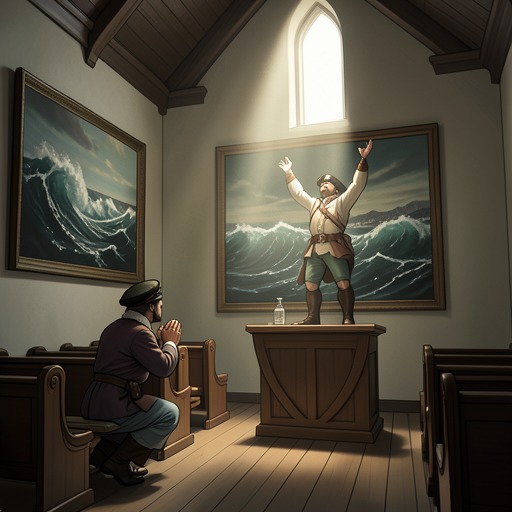
Whaleman's Chapel stands in New Bedford, a port from which fishermen commonly depart for the Indian Ocean or Pacific. Few moody whalemen preparing for such voyages fail to visit it on Sunday, and Ishmael makes the visit during foul weather, walking through sleet and mist in a bearskin jacket. Inside, he finds a small, scattered congregation of sailors and sailors' wives and widows. The storm outside and the muffled silence within establish the chapel as a threshold between land and ocean, departure and return, ordinary life and maritime danger.
The worshippers sit apart from one another as though each grief were an isolated island. Their attention is fixed on marble tablets set into the wall beside the pulpit, commemorating whalemen lost at sea. One tablet remembers John Talbot, lost overboard at eighteen near the Isle of Desolation off Patagonia on November 1, 1836, and erected by his sister. These memorials make distant waters present within the chapel and place Ishmael's prospective voyage under the shadow of recorded deaths. The building therefore functions not merely as a church but as a communal archive of disappearance.
Father Mapple and Maritime Worship
The chapel's minister, Father Mapple, embodies the union of seafaring experience and religious authority. Once a sailor and harpooneer, he has devoted many years to the ministry, and his old age retains the vitality of a second flowering youth. His maritime past remains visible in his tarpaulin hat, pilot cloth jacket, and robust bearing as he enters through the sleet. After removing his wet outer clothing, he approaches the pulpit in a decent suit, carrying the physical discipline of the sea into the forms of Christian worship.
Father Mapple reorganizes the congregation with commands adapted from shipboard maneuvering, directing the worshippers to shift from starboard and larboard toward midships. The chapel thus becomes temporarily ship-like, while the congregation becomes a company of shipmates. His prayer intensifies the transformation: kneeling in the pulpit's bows, he seems to pray at the bottom of the sea. The image makes the sanctuary a vessel exposed to the same spiritual depths and mortal uncertainties as the ships outside.
His hymn begins in solemn tones resembling the bell of a ship foundering in fog, then rises into exultant joy. Nearly everyone joins in singing, and the hymn swells above the howling storm. The ritual does not erase danger; it gives danger a collective language and a sacred frame. The chapel's soundscape therefore moves from isolation and mourning toward temporary communal strength without denying the violence of the sea.
Jonah and the Whale Tradition
Father Mapple bases his sermon on the closing verse of the first chapter of Jonah, in which God prepares a great fish to swallow Jonah. He presents the short biblical book as a compact strand in the immense cable of Scripture, yet one capable of sounding the deepest regions of the soul. His nautical language translates Jonah's descent into the fish into an experience recognizable to whalemen: floods surge overhead, the congregation sounds toward the kelpy bottom, and seaweed and slime surround the prophet.
The sermon identifies two related lessons. For sinful people, Jonah's story includes deliberate disobedience, awakened fear, swift punishment, repentance, prayer, deliverance, and joy. For Father Mapple himself, as a pilot of the living God, it concerns the difficulty of obeying a command that contradicts the self. The chapel consequently turns a narrative of maritime engulfment into an argument about moral submission: obedience requires a person to disobey personal inclination.
The pulpit also enlarges the cultural ancestry of whaling. Perseus is presented as the first whaleman because he harpoons the sea monster threatening Andromeda; St. George's dragon is interpreted as a whale rather than merely a land reptile; Hercules is tentatively claimed because a whale swallows and disgorges him; Jonah is included as a prophet associated with the same creature; and Vishnoo becomes a whaleman when he takes whale form to recover the sacred Vedas from the depths. Through these comparisons, the chapel's sermon places biblical, classical, and Hindu traditions within a single imaginative fraternity of encounters with the great monster of the deep.
From Chapel Sermon to Global Whaling
The religious defense of whaling voiced in the chapel extends into a historical defense of the vocation itself. Whaling is described as an ancient and honorable enterprise, one linked to heroes, prophets, and demigods rather than reduced to an unpoetic or disreputable trade. The same argument insists that the whale-ship has explored uncharted seas, opened routes into remote harbors, aided missionaries and merchants, and helped establish contact between distant peoples. Whaling is thereby represented as a force that has shaped global movement as well as supplied commodities.
This maritime history includes the whale fishery's passage around Cape Horn, its challenge to the Spanish crown's restrictive colonial policy, and its alleged contribution to the liberation of Peru, Chili, and Bolivia. The whale-ship is also credited with helping make Australia accessible to the wider world and with saving early settlers from starvation when its vessels anchored and supplied them with biscuit. The chapel's religious language thus sits beside an imperial and commercial narrative in which whalemen appear as pioneers, intermediaries, and agents of political change.
The same worldview governs the Pequod's route. Captain Ahab plans to pass through the Sunda Strait into the Javan sea, cruise northward through waters frequented by Sperm whales, continue by the Philippine Islands toward Japan, and eventually descend upon the Equatorial fishing ground in the Pacific, where he expects to confront Moby Dick. The whale-ship carries its own crew, weapons, provisions, and years of water rather than ordinary cargo, allowing it to cross immense spaces while scarcely seeing land. In this sense, the chapel's elevation of whaling reflects a shipboard civilization that imagines itself as an oceanic ark.
Sacred Space and the Limits of Interpretation
Whaleman's Chapel offers a setting in which danger, doctrine, legend, and practical seafaring knowledge are continually translated into one another. Its memorial tablets make loss concrete; its storm-filled service makes the congregation feel enclosed within the sea; and its pulpit converts Jonah's engulfment into a lesson about fear, repentance, and obedience. Yet the wider whaling argument also exposes a tension: the vocation is praised as heroic, exploratory, and historically productive even though it depends on killing whales and remains surrounded by death.
That tension is not resolved by the chapel. Instead, it gives the maritime world a ritual language capable of holding grief, ambition, superstition, moral seriousness, and imperial confidence together. Later, when sailors hear human-seeming cries near rocky islets and debate whether they are mermaids, drowned men, or distressed seals, the ocean again unsettles the boundary between religious omen and natural explanation. The chapel remains significant because it prepares readers for precisely this unstable world, where the sea is at once physical environment, sacred theater, archive of the dead, and source of stories that exceed any single tradition.