Niniveh
Moby-DickNineveh is the unreachable destination at the center of Father Mapple’s retelling of Jonah: the city to which the prophet was commanded to carry an unwelcome truth, and the place whose anticipated hostility helped provoke his flight. Its importance lies less in physical description than in its role as a moral horizon. Nineveh names the public world before which a speaker must stand, even when obedience is frightening and self-preservation seems easier.
Biblical Destination and Moral Setting
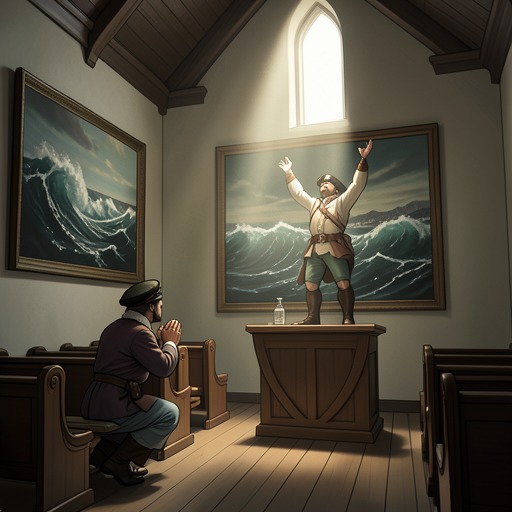
In Father Mapple’s sermon, Jonah is described as an anointed pilot-prophet commanded by God to sound unwelcome truths in the ears of a wicked Nineveh. Appalled by the hostility that his mission would raise, Jonah fled from his duty and sought to escape both his mission and his God by taking ship at Joppa. Nineveh therefore functions as the point from which disobedience begins: the prophet does not merely wander aimlessly, but turns away from a specific city and an assigned public task.
The city is presented through the contrast between its wickedness and the truth Jonah must proclaim to it. The sermon does not elaborate Nineveh’s streets, buildings, rulers, or inhabitants; instead, it makes the city an ethical audience. Its significance comes from the resistance that truth encounters there, and from the demand that the prophet address falsehood directly rather than seek a safer route.
Jonah’s Flight and Return
Jonah’s attempted escape carries him away from Nineveh toward Tarshish, but the flight cannot reach its intended end. Father Mapple insists that God is everywhere and that Tarshish was never reached. Jonah is swallowed by a great fish, plunged into the depths, and brought to repentance; after God hears his cry, the fish returns toward the air and earth and vomits him onto dry land. Only then does the word of the Lord come to him a second time, and Jonah, bruised and beaten, performs the command he had resisted.
The sequence makes Nineveh the fixed measure of Jonah’s failure and restoration. The prophet’s deliverance is not complete when he escapes the sea. It becomes meaningful only when he returns to the duty represented by the city. In this structure, Nineveh is both the place Jonah refused and the destination that gives his repentance practical form.
Truth Spoken to Falsehood
Father Mapple identifies the second and more demanding lesson of Jonah’s story as the obligation to preach truth directly to falsehood. Nineveh is the implied scene of that confrontation. Jonah’s task is not simply to survive punishment or to offer private prayer; he must resume the difficult public office from which fear had driven him.
The sermon extends this lesson from Jonah to every speaker who claims a divine or moral commission. It condemns the person who allows worldly charm to draw him away from duty, who tries to please rather than appall, or who values a good name more than goodness. Against those evasions, Nineveh represents the hostile audience that makes integrity costly. The city’s narrative function is consequently double: it is the object of prophetic speech and the test by which the prophet’s fidelity is measured.
Place in the Novel’s Maritime Imaginary
Nineveh belongs to the book’s larger habit of translating religious narratives into maritime terms. Jonah’s mission, flight from Joppa, descent into the whale, and return to dry land are all recounted through the language of ships, pilots, seas, depths, and deliverance. The city is therefore connected to the ocean even though it is not described as a seaport setting within the sermon. Its distance is measured by the voyage Jonah attempts and by the sea that interrupts it.
The association between Nineveh and maritime legend is reinforced later when the narrator discusses the supposed honor and antiquity of whaling. Joppa, from which Jonah set sail, is also linked to the story of Perseus and Andromeda and to the ancient skeleton said to be the whale Perseus slew. The connection does not turn Nineveh into a whaling location, but it places Jonah’s city within a chain of stories in which prophetic, heroic, divine, and whale narratives overlap. Nineveh is thus remembered through a network of sea-borne myths rather than through local description.
Narrative and Thematic Significance
As a location, Nineveh is almost entirely recalled through another story, and its power comes from that indirect presentation. It is a destination withheld from direct scenic experience but made vivid by the fear it produces, the duty attached to it, and the consequences of refusing it. The city becomes an allegorical threshold between private safety and public truth.
Its moral force also illuminates the novel’s recurring concern with the dangers of evasion. Jonah’s escape fails because the world he tries to leave remains under divine command; the sea becomes the medium through which his avoidance is exposed and reversed. Nineveh consequently stands for the obligation that cannot be escaped by changing ships or pursuing a distant shore. The city’s decisive presence is the demand that a commissioned speaker face the hostile world and tell the truth there.