Manhattan (Manhattoes)
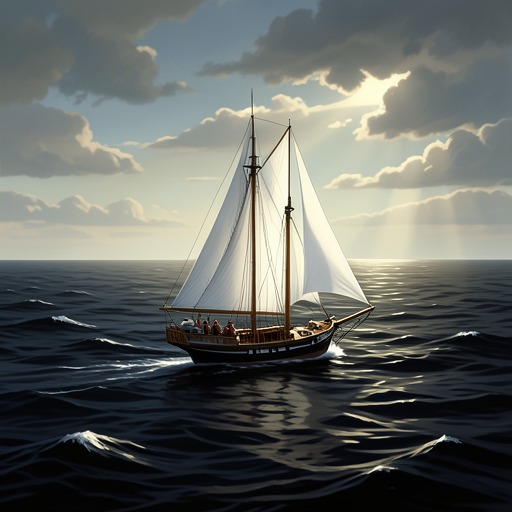
Moby-DickManhattan (Manhattoes) is introduced as a city encircled by wharves and animated by commerce, a land-based metropolis whose deepest identity is revealed at its waterfront. For Ishmael, it is also the place he leaves behind when he turns toward the sea: the city marks the beginning of his movement from depressive confinement into the expansive, dangerous world of whaling.
Port City and Waterfront Setting
Manhattan (Manhattoes) is described as an insular city belted by wharves, with commerce breaking around it like surf around islands. Its streets run waterward, culminating downtown at the Battery, where waves wash the great mole and breezes arrive from beyond the visible land. The geography makes the harbor more than a backdrop: the city appears organized by its contact with the ocean, as though urban life were continually being drawn toward the shoreline.
The waterfront gathers people who otherwise belong to the inland world. On a dreamy Sabbath afternoon, crowds stand along the piers, spiles, bulwarks, and rigging, gazing seaward. Some are landsmen confined during the week to counters, benches, and desks; others come from lanes, alleys, streets, and avenues. They converge at the extreme limit of land, seeking to approach the water as closely as possible without falling into it. This repeated movement toward the harbor gives Manhattan (Manhattoes) a collective orientation: the sea exerts a magnetic attraction even on those who do not sail.
Ishmael’s Point of Departure
Ishmael begins with a desire to escape the oppressive condition of life ashore. When he has little money and nothing particular to interest him on land, he turns to the sea as a way of regulating his spirits and driving away his spleen. The city therefore functions as the setting from which his inward restlessness becomes outward travel. Its waterfront crowds embody, on a public scale, the same fascination that sends him toward a ship.
After packing a few shirts into an old carpet-bag, Ishmael leaves the city and sets out toward Cape Horn and the Pacific. He reaches New Bedford on a Saturday night in December, intending eventually to sail in a Nantucket craft. The departure from Manhattan (Manhattoes) is thus not simply a change of residence; it is the first movement in a passage from the crowded, commercial shore into the unbounded geography of whaling.
Manhattan (Manhattoes) in the Whaling Network
Although Ishmael leaves Manhattan (Manhattoes) for New Bedford, the city belongs to the wider economic and navigational system that makes the voyage possible. Whaling is described as a major American enterprise involving a fleet of more than seven hundred vessels, eighteen thousand men, millions of dollars in annual expenditure, and substantial imports into American harbors. The urban harbor is consequently connected to ships, capital, labor, supplies, and maritime knowledge extending far beyond the coast.
The narrative presents the whale-ship as a pioneer of global contact. Whalemen explore uncharted seas and archipelagoes, enter harbors that later receive American and European warships, and establish routes between peoples, merchants, missionaries, and imperial powers. The whale fishery’s rounding of Cape Horn opens intercourse between Europe and the Spanish provinces of the Pacific, while whalemen are credited with helping produce the eventual liberation of Peru, Chile, and Bolivia. The whale-ship is likewise described as a formative force in Australia and Polynesia, sometimes supplying early settlements with provisions and carrying missionaries to their destinations. Manhattan (Manhattoes), as a major American port city, stands at the shoreward entrance to this world-spanning system.
From Urban Shore to Oceanic Space
The contrast between Manhattan (Manhattoes) and the ocean is central to the location’s significance. The city is densely populated, commercially enclosed, and marked by piers, streets, and fixed points; the ocean beyond it is open, shifting, and resistant to complete control. Yet the city’s crowds reveal that the division is unstable. Even those tied to desks and shops are repeatedly drawn to the water, suggesting that the sea is not an external space but a latent desire within urban society.
This tension becomes sharper once the voyage begins. Captain Ahab studies charts of the four oceans, traces courses through currents and eddies, and calculates the seasonal movements of the Sperm whale. The Pequod’s route eventually approaches the Sunda Strait, the Javan sea, the Philippine Islands, Japan, and the Pacific Line, aiming to cross nearly all known Sperm whale cruising grounds before reaching the waters where Moby Dick is most likely to appear. The contrast between the fixed urban waterfront and this immense itinerary shows how Manhattan (Manhattoes) opens onto a geography that cannot be contained by the shore.
Narrative and Historical Significance
As a setting, Manhattan (Manhattoes) is both threshold and image. It is the first visible form of the oceanic world: a city whose streets lead toward water, whose inhabitants gather to look beyond land, and whose commerce depends on maritime circulation. Ishmael’s departure gives the place a personal function, while the discussion of whaling enlarges it into a node in a global history of exploration, trade, colonial contact, and labor.
The city also establishes a recurring opposition between land-based security and oceanic uncertainty. Later, Ahab’s navigational instruments expose the limits of human knowledge: a quadrant can identify a ship’s position but cannot reveal where Moby Dick will be or where even a drop of water will lie on the following day. The abandoned log and line, later recalled after the quadrant has been destroyed, further suggest that maritime location is always provisional. Manhattan (Manhattoes) therefore represents the ordered shore from which human beings depart, but its own waterfront crowds already imply that the desire for the unknown begins on land.