Queequeg's coffin
Moby-DickQueequeg's coffin is one of the Pequod's most consequential objects: made in anticipation of Queequeg's death, it becomes an instrument of continued life when Ishmael survives the wreck upon it. Its changing functions join Queequeg's cultural identity, the ship's material practices, the crew's response to death, and the final reversal by which a vessel prepared for burial becomes the means of rescue.
Origin as a Burial Vessel
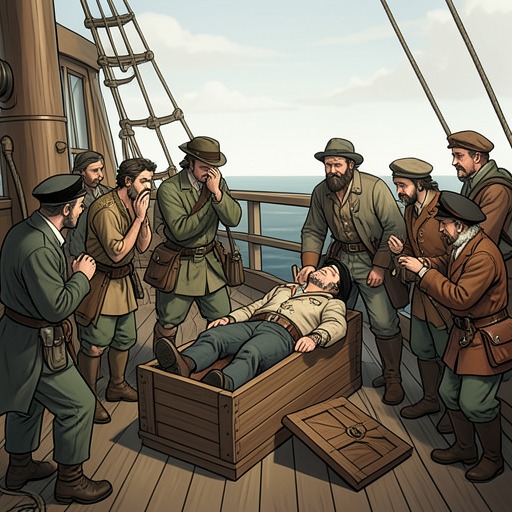
Queequeg's coffin is commissioned during his severe illness, when the crew believes that he is dying. Queequeg rejects the ordinary sea-custom of being buried in a hammock and exposed to the sharks. Instead, he asks for a dark canoe-shaped coffin resembling the little canoes in which the dead of Nantucket are laid, a form that also recalls the burial practice of his own people. In his account, embalmed warriors are stretched in canoes and floated toward starry archipelagoes because the stars are imagined as islands and the Milky Way as the breakers of seas that flow into the heavens. The coffin therefore carries a specific cultural and cosmological meaning rather than functioning as a generic container for a corpse.
The vessel is made from dark, coffin-colored lumber cut from the aboriginal groves of the Lackaday islands. The carpenter measures Queequeg's body with exactness, transfers the measurement to his bench, cuts notches to preserve the required length, and completes the box with a fitted lid. The crew initially tries to keep it away, but Queequeg demands that it be brought to him. His insistence makes the coffin an object of personal authority: although others treat it as an ominous sign, he determines its use and requires the ship to accommodate his wishes.
Queequeg's Final Preparation
Queequeg equips the coffin as a complete preparation for death. He removes the wooden stock from his harpoon and places the iron part inside, adds one of his boat's paddles, arranges biscuits around the sides, sets a flask of fresh water at the head, and puts a small bag of earth from the hold at the foot. A rolled piece of sail-cloth serves as a pillow. He then asks to be lifted into the coffin to test its comfort, summons his small god Yojo, crosses his arms over his breast with Yojo between them, and has the lid placed over him. The hinged head remains open enough for his composed face to be seen, and he pronounces the arrangement satisfactory.
This preparation combines burial, travel, sustenance, religion, and seafaring. The harpoon iron preserves Queequeg's identity as a whaleman; the paddle recalls the canoe that gives the coffin its form; the biscuits and water supply provisions for an imagined passage; the earth anchors the vessel to the material world; and Yojo accompanies him as a sacred object. The coffin is thus not merely a sign of death but a carefully furnished vehicle for an uncertain journey.
Queequeg's apparent acceptance of death is interrupted by his sudden recovery. After every preparation has been made and the coffin has proved a good fit, he declares that he has remembered an unfinished duty ashore and has therefore changed his mind about dying. He claims that a man's decision to live can defeat sickness, while only a whale, a gale, or another violent and uncontrollable force can kill him. His convalescence turns the coffin from a terminal object into a reminder of his self-described sovereignty over the boundary between life and death.
From Coffin to Sea-Chest
Once Queequeg regains his strength, the coffin remains aboard the Pequod rather than being discarded. He uses it as a sea-chest, emptying his canvas bag of clothing into it and arranging his belongings there. He also spends spare hours carving grotesque figures and drawings into the lid, apparently attempting to reproduce portions of the tattooing on his body. Those tattoos were made by a deceased prophet and seer of Queequeg's island and were said to form a complete theory of heaven and earth and a mystical treatise on attaining truth. The coffin's decorated surface therefore becomes an extension of the living body and of a knowledge that remains partly unreadable even to its bearer.
The change in function is more than a practical conversion. A container designed to preserve Queequeg after death becomes part of his daily life, storing clothing and receiving the marks of his history. Its material identity remains tied to death, but its use becomes domestic, mobile, and creative. The object follows the logic of the voyage itself: tools, bodies, religious signs, and provisions repeatedly move between ordinary use and ritual significance.
Recommissioned as a Life-Buoy
Near the end of the voyage, a sailor falls from the mast-head into the sea. The Pequod's existing life-buoy, a long slender cask, is dropped after him, but the cask has dried and shrunk from prolonged exposure to the sun; it fills with water and sinks instead of supporting the sailor. The lost buoy must be replaced, yet no sufficiently light cask can be found. Because the crew is absorbed in the approaching crisis and unwilling to spend effort on work not directly connected with its unknown end, the ship's stern is about to remain without a buoy when Queequeg hints at the coffin.
The suggestion shocks the officers because it reverses the object's established identity. Starbuck recognizes the strange practicality of a coffin as a life-buoy, while Stubb calls the idea queer and Flask observes that the carpenter can arrange it. Starbuck finally orders the coffin brought up and rigged, then tells the carpenter to nail down the lid. The object is consequently altered under pressure from an emergency: the ship converts a prepared burial vessel into safety equipment because no conventional substitute is available.
Ishmael's Survival and Meaning
The coffin's final purpose appears only after the Pequod has been destroyed. When the ship sinks, Ishmael is drawn toward the closing vortex. The suction subsides into a rotating pool, and he circles inward until the coffin, released by its buoyancy and the action of its spring, shoots up from the sea. It falls over and floats beside him, allowing him to remain buoyed up for almost a day and a night. The object made for Queequeg's death thus becomes the sole material support of Ishmael's life.
On the second day, the Rachel approaches and rescues Ishmael while searching for its own missing crew members. The coffin has passed through an entire sequence of reversals: a culturally meaningful burial canoe, a temporary bed for a man expected to die, a recovered man's sea-chest, emergency equipment at the stern, and finally the life-buoy that carries the narrator through the wreck's aftermath. Its endurance is also a structural answer to the novel's recurrent concern with unstable boundaries. Death becomes flotation, a private object becomes communal equipment, and the vessel associated with Queequeg becomes the means by which Ishmael alone survives to tell the story.
The object also gathers the novel's material and religious imagery into one form. The Pequod's journey repeatedly turns ordinary things into instruments of ritual or fate: prayers are offered as though at the bottom of the sea, Scripture makes a great fish into a figure of judgment and deliverance, and the crew's tools are enlisted in ceremonies of pursuit. Queequeg's coffin completes that pattern without losing its physical specificity. Its wood, hinge, carved lid, provisions, water, earth, harpoon iron, and buoyancy all matter. The final rescue is not an escape from material circumstances but a survival achieved through them: the coffin's practical construction, once intended to receive a dead body, makes possible the living narrator's return to the human world.