Chamberlain's 27 September 1938 broadcast
MunichNeville Chamberlain's 27 September 1938 broadcast was a public attempt to hold together two positions that the Sudeten crisis was pulling apart: the need to prepare for war and the determination to keep seeking peace. Speaking from 10 Downing Street to Britain and audiences abroad, he explained why the danger was immediate, defended the possibility of a negotiated transfer of territory, and questioned whether the British Empire could be committed to war on the issue alone. The broadcast was not simply reassurance; it made the boundaries of Chamberlain's resolve part of the crisis itself.
A crisis measured in deadlines
The address came amid a rapidly narrowing timetable. Chamberlain told the Cabinet that the Czechoslovak Government had agreed in principle to the orderly transfer of the Sudetenland to Germany, subject to a plebiscite, but that Adolf Hitler had announced he would not wait even a week and would invade on Saturday. Sir Horace Wilson had privately warned Hitler that Britain would be obliged to support France if France fulfilled its treaty obligations to Czechoslovakia. Chamberlain reported Hitler's defiant response: ‘It is Tuesday today, and by next Monday we shall all be at war.’ The deadline gave the broadcast its urgency: diplomatic arrangements had to be made while the possibility of war remained imminent.
The British response was itself under debate. Asked when partial mobilization could be operational by 1 October, the military answer was ‘Today.’ Advocates argued that limited mobilization could show Hitler that Britain was not bluffing and might make him reconsider. Chamberlain worried that a visible challenge could instead provoke a leader who could not tolerate losing face. The dilemma—whether a signal of readiness would deter or accelerate war—hung behind the public speech, even though Chamberlain ultimately left the proposed announcement of naval mobilization out of it.
A broadcast staged for a watching public
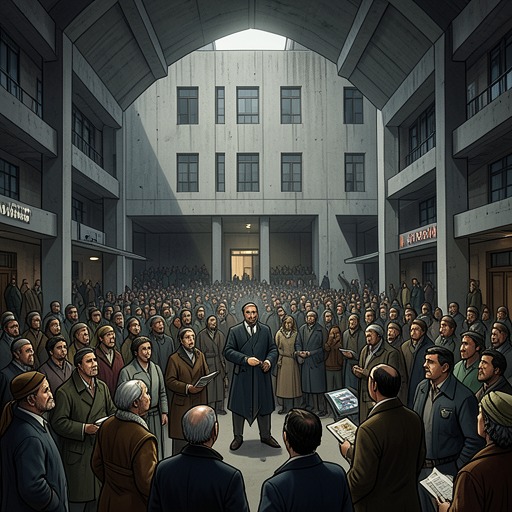
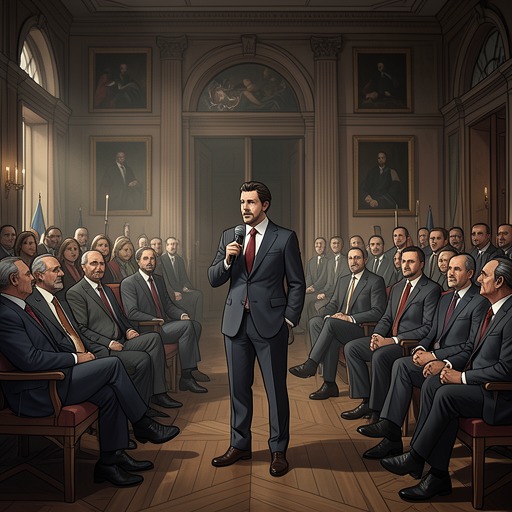
The address was prepared and delivered under visible strain. Big Ben struck eight as the announcer introduced the Prime Minister's speech from 10 Downing Street, explaining that it would be heard throughout the Empire, across the continent of America, and in many foreign countries. Chamberlain's hands shook; a page fell from his speech, and he bent stiffly to retrieve it. After asking for water, he spoke carefully into the microphone. The scene joined a private physical vulnerability to the reach of a public voice: a man visibly struggling to steady himself was speaking to audiences far beyond the room.
Chamberlain began by making the preparations for conflict tangible: ‘How horrible, fantastic, incredible it is that we should be digging trenches and trying on gas masks here because of a quarrel in a faraway country between people of whom we know nothing.’ He acknowledged that the Czechoslovak Government had been unable to accept the German memorandum, while insisting that the dispute had already been settled in principle. His phrasing gave listeners both the human unease of civilian war preparations and the diplomatic case for trying to complete the transfer by agreement.
Peace as an effort, and a limit
Chamberlain presented his personal encounters with Hitler as grounds for continued hope. He said that, if time were allowed, arrangements for transferring territory that the Czechoslovak Government had agreed to give Germany ought to be settled by agreement and under conditions that assured fair treatment for the population. He also invoked Hitler's stated claim that, once the Sudeten German question was settled, Germany's territorial claims in Europe would be at an end. The speech thus treated Hitler's assurance as a possible basis for settlement even as the invasion deadline made reliance on it perilous.
He promised not to abandon peace while any chance remained, and said he would make a third visit to Germany if he thought it would help. The appeal was paired with practical instructions: volunteers were still wanted for air-raid precautions, fire-brigade and police services, and Territorial units. Listeners were asked not to be alarmed if men were called up for anti-aircraft defences or ships, because these were precautionary measures. Yet the line announcing naval mobilization, which Legat expected to hear, did not appear; Chamberlain had cut it. The omission mattered. The speech acknowledged preparations without presenting the Navy's mobilization as a public step in the contest of resolve.
Its most consequential qualification concerned the grounds on which Britain might fight. Chamberlain said that sympathy for a small nation confronted by a powerful neighbour could not, in every circumstance, require the whole British Empire to enter a war on its account. If war came, he argued, it would have to concern larger issues. He then described the principle that could make resistance unavoidable: if a nation had resolved to dominate the world through fear of its force, liberty would be impossible under such domination. But war, he stressed, was fearful, and the issues had to be clear before people were asked to risk everything. The address therefore offered neither an unconditional guarantee to Czechoslovakia nor a simple withdrawal from the prospect of fighting; it placed the decision under a wider test of political principle and consequence.
Domestic constraints and the uncertain aftermath
That boundary reflected the political problem discussed around the Cabinet table. Chamberlain asked how the British public could be persuaded to endure a winter of war if Czechoslovakia collapsed before the end of October, particularly when Britain had already conceded that the Sudeten Germans should not have been transferred to a Czech-dominated state. Lord Halifax, Foreign Secretary, reported that the Dominions would not accept war over so narrow an issue, while America would not join and Ireland would remain neutral. A suggestion that the Soviet Union might assist met objections of geography and of making Joseph Stalin an ally in a campaign for international law. Lord Gort warned that a wider conflict could mean fighting Germany in Europe, Italy in the Mediterranean, and Japan in the Far East, placing the existence of the Empire in grave jeopardy. Sir Horace Wilson proposed telling the Czechoslovak Government to accept Hitler's terms before the deadline; Chamberlain's broadcast conveyed the reasoning behind that pressure without reducing the crisis to a purely military calculation.
The address ended by asking the public to await the next few days as calmly as possible. Chamberlain insisted that, while war had not begun, there was still hope of preventing it and that he would work for peace to the last moment. The green light went out; he exhaled and slumped back in his chair. Later, Lord Halifax opposed Sir Horace Wilson's proposed telegram, arguing that ordering the Czechoslovak Government to surrender territory under threat would amount to complete capitulation and that Britain could not guarantee German forces would stop at the Sudetenland. The contrast sharpened the problem the broadcast had exposed: the effort to avert war could itself require asking another country to yield under force.
The crisis continued to turn on signals, deadlines, and audiences. At seven minutes past two, Sir Nevile Henderson telephoned from Berlin with news that Benito Mussolini had asked Hitler to postpone mobilization for twenty-four hours so the situation could be reconsidered, and that Hitler had agreed. When Chamberlain later prepared to address the House of Commons, he asked about its mood; Lord Dunglass told him that support for his action was strong across the Party, even Winston Churchill was subdued, and the Labour whips had refused the BBC's request to broadcast the statement. These later developments did not resolve the tension in the radio address. They show instead how its public appeal for calm and its guarded account of Britain's obligations belonged to a crisis in which every pause, promise, and audience could affect the course of events.