Hotel Printania
NauseaHotel Printania is Antoine Roquentin’s lodging in Bouville, but its significance exceeds that of a fixed address. It is a point of return amid his disorienting experiences, a place from which he goes out to the library and to which his letters can be forwarded, and a practical marker of the departure he is preparing. Against that everyday stability, the hotel’s rooms and surroundings register how uncertain his sense of self and past have become.
Setting and Daily Life
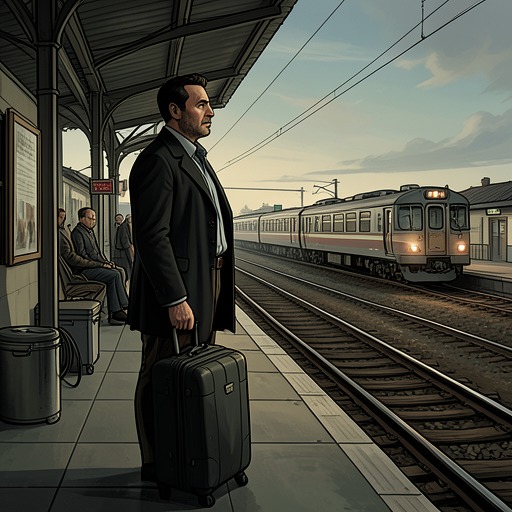
From his room at Hotel Printania, Roquentin looks toward the Rue des Mutiles and the construction site for the new station. The railway setting places the hotel beside a town in physical transition: trains arrive, people emerge from the old station, and the building’s view takes in the red-and-white flame of the Railwaymen's Rendezvous. Roquentin describes himself in this moment as solidly grounded in the world, in contrast to the strange feelings that had troubled him in the preceding weeks. The view does not resolve those experiences; it records a temporary return to ordinary confidence, set among construction, traffic, and arrivals.
The hotel is also part of Roquentin’s routine. On the morning of the failed paper-lifting episode, he leaves it at eight-fifteen to go to the library. He initially writes that nothing new has happened, but recognizes that this account conceals the incident: he wanted to pick up a sheet of paper lying on the ground and found that he could not. He tries to shake off the idea at the library and at the Cafe Mably, yet it stays with him as a dead weight and makes him feel no longer free. The hotel’s doorway thus marks the beginning of an experience he first dismisses as too slight to count as an event, even as it shapes the pages he writes afterward.
Letters and the Past
Hotel Printania becomes a destination in Anny’s correspondence. When a letter addressed to the hotel reaches Roquentin, its envelope revives his image of Anny: her smile, eyes, and familiar habit of coming to stand before him. The address is written in small letters, and the old concierge has covered the envelope with scrawled marks. The ordinary route by which a letter reaches a resident gives physical form to a more complicated return: the message connects Roquentin to someone he has not seen for six years, but it cannot restore the relationship as it once was.
Reading and carrying the letter sharpen the contrast between the past and the present. Roquentin recalls the intensity of his three years with Anny, when even their smallest griefs, unspoken thoughts, and passing sensations seemed to remain alive between them. After they parted, he felt emptied out; later, in Saigon, deciding to return to France, he experienced the remaining traces of places and faces as wiped away. In the present, he sits with the letter in a café and observes a waitress and a man, while the Hotel Printania’s evening tramway passes outside. The hotel’s address can deliver Anny’s words, but it cannot bridge the distance between the woman remembered and the person who wrote them.
Anny’s Return and Roquentin’s Solitude
After learning that Anny has arrived in Bouville to care for the ill M. Fasquelle, Roquentin looks forward to seeing her again. He wonders how they will meet after six years apart and hopes not to make her uncomfortable; he remembers that she dislikes being offered his hand. He also imagines that she might return with him to Bouville and stay at Hotel Printania, even for a single night. In his fantasy, that brief visit would change something: he would no longer be afraid. The hotel is therefore not just his residence but a space onto which he projects the possibility of recovering intimacy and overcoming solitude.
Their reunion does not fulfill that hope. When Anny asks him to speak about himself, Roquentin recalls that she has always put direct questions to him, combining genuine interest with a wish to get through preliminaries. He then loses the desire to explain his nausea, fear, or thoughts about existence, deciding that he would rather keep them to himself. Their encounter exposes the limits of what the old relationship can now contain: Anny’s request opens a conversation, but Roquentin withholds the experience that has most altered his life.
At their parting, Roquentin gives Anny his address on an envelope, using Hotel Printania so that his mail can be forwarded after he leaves Bouville. He knows she may not write and fears that this may be the last time he sees her; at the same time, he is overwhelmed by the prospect of returning to solitude. Anny kisses him lightly and says she wants to remember his lips for her spiritual exercises. The address remains useful, but the scene makes its emotional limit plain: it provides a route for possible future correspondence, not a promise of renewed closeness.
Departure and Narrative Significance
After watching Anny leave Paris by train, Roquentin plans to return to Bouville on the noon train the following day. He expects to spend two days packing, settling his bank accounts, and returning the books he borrowed from the library. Hotel Printania may charge him for two extra weeks because he did not give notice. These practical details make the hotel a concrete part of his departure rather than a symbol detached from daily life: leaving means settling obligations to the place where he has lived, even as he doubts that a change of city will change his inner condition.
That doubt gives the hotel its wider narrative force. Roquentin distinguishes Paris, divided by a river, from Bouville, beside the sea, yet sees both as cities built from sterile earth and hollow stones that hold odors and sounds. He is afraid of cities, but also believes one must remain within them rather than venture alone toward the vegetation gathering at their edges. Hotel Printania belongs to this human-built shelter: a room, an address, a view, and a set of obligations in a world Roquentin experiences as materially vivid and hard to master. Its recurrence links his routine to crisis, remembered love to present distance, and the unsettled decision to leave to the ordinary work of packing and paying.