Meknes
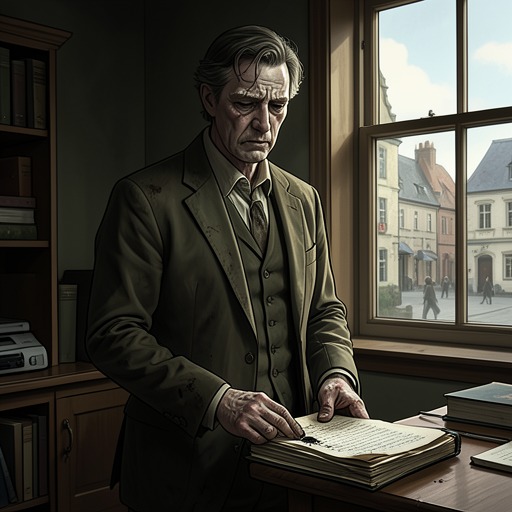
NauseaMeknes matters less as a recoverable landscape than as a fault line in Antoine Roquentin’s account of his past. It returns as the setting of an encounter with a hill tribesman and as one of the places where Roquentin and Anny once shared a life on the move. But when Roquentin tries to picture it, the scene breaks apart: the square disappears, details become doubtful, and memory’s remains threaten to become fiction.
The Recalled City
Roquentin tries to recover an incident in Meknes by asking what the hill tribesman was like, and where Anny stood beside him. Even that basic arrangement wavers: she may have been on his right or his left. His uncertainty is not merely about a minor detail. The recollection begins as a scene with people placed in space, then exposes how little of that scene he can confidently restore.
The square he used to visit every day proves still more elusive. Roquentin cannot see it; what survives is the vague sense that it was charming, bound up with the words “a charming square at Meknes.” When he tries to supply a tree in the distance and a short, dingy figure running toward him, he recognizes that he may be inventing these elements to support his case. He does retain some curtailed details: the Moroccan was big and weather-beaten, and Roquentin saw him only after the man had touched him. Yet these fragments cannot establish whether the rest is genuine memory or imaginative reconstruction.
Violence and the Problem of Adventure
Elsewhere, Roquentin recalls the incident in more decisive terms: a Moroccan jumped on him and tried to stab him with an enormous knife. Roquentin struck him just below the temple; the man shouted in Arabic, and a swarm of beggars chased Roquentin and his companion as far as Souk Attarin. This account gives the episode a concrete sequence and consequence, even as the reflective passages question how securely its details can be held.
That Meknes episode becomes central when Roquentin confronts his claim that he has never had adventures. He acknowledges that events and incidents happened to him, and that the attack was an event that happened to him. The distinction he is trying to make is not between a real event and an unreal one, but between an occurrence and a life that seems to possess rare, precious significance. Meknes can furnish danger, action, and escape without proving that his past had the special quality he once attributed to it.
Repetition, Travel, and the Erosion of Memory
Meknes returns not only as the site of danger but as part of Roquentin’s remembered itinerary. When Anny’s letter summons him to Paris, he thinks of how, in Meknes and Tangier, he would sometimes find a note on his bed asking him to come at once. He would run to her; she would open the door with raised eyebrows and a surprised look, then have nothing more to tell him, sometimes seeming irritated that he had come. The recollection makes their former closeness vivid through its small, repeated ritual, but it also shows how an invitation could lead to anticlimax rather than the encounter he expected.
The city’s presence in Roquentin’s mind is similarly unstable. A remembered sun and blue sky initially promise to bring back an earlier joy, and Meknes appears as a possible source of that sensation. But he recognizes the lure as something that has caught him many times: the square itself has vanished, leaving only a verbal label and scraps whose status he cannot settle. In his account, the name of Meknes can summon the feeling of a place without restoring the place; when he tries to fill its gaps, the apparent picture may be no more than invention.
This instability reaches beyond one city. Roquentin reflects that stories of travel can remain after their images have disappeared: he can tell anecdotes too well, yet their protagonists seem detached from him, and the countries in them are no longer places he knows through direct memory. Meknes therefore stands at a boundary between lived incident and narrated past. Its attack can be recounted as a sequence of actions, while the square where the incident began resists visualization; the memory preserves enough to be told, but not enough to guarantee that telling has recovered what happened.
A Place That Survives as a Story
Roquentin’s difficulty recalling Meknes belongs to a broader unease about travel memories and the stories made from them. He can still tell anecdotes, sometimes with confidence, but recognizes that their images may have disappeared: the traveler in the story no longer feels like himself, and the countries he names can seem no more familiar than places known only from books. The square at Meknes makes that gap tangible. Its name and the phrase describing it as charming endure, while its visible particulars do not; a tree and a running figure may be inventions supplied to make the account hold together.
The remembered attack and the missing square thus pull in opposite directions. The attack can be recited as an ordered sequence—an assailant with a knife, a blow, a cry, a chase—yet the place that should anchor the scene remains inaccessible to sight. Meknes is both the setting of something Roquentin insists happened to him and a test of how little a narrated past can certify. What persists is not a fully recovered city but the tension between an event he can tell and a landscape he can no longer see.
A Place That Survives as a Story
Roquentin’s difficulty recalling Meknes belongs to a broader unease about travel memories and the stories made from them. He can still tell anecdotes, sometimes fluently, yet recognizes that their images may have disappeared: the traveler in the story no longer feels like himself, and the countries he names can seem no more familiar than places known only from books. Meknes makes that gap tangible. Its name and the description of its square as charming endure, while its visible particulars do not; a distant tree and a running figure may be inventions supplied to make the account hold together.
The remembered attack and the missing square pull in opposite directions. The attack can be recited as an ordered sequence—an assailant with a knife, a blow, a cry, a chase—yet the place that should anchor the scene remains inaccessible to sight. Meknes is both the setting of something Roquentin insists happened to him and a test of how little a narrated past can certify. What persists is not a fully recovered city but the tension between an event he can tell and a landscape he can no longer see.