Bouville Museum
NauseaBouville Museum is both a civic repository and a theatre of self-commemoration. Its galleries gather the city’s elite into a polished account of achievement, duty, and inherited authority; for Antoine Roquentin, viewing that account becomes a crisis of judgment. The portraits do not merely preserve the dead: they stage a claim that some lives were entitled to exist and to command, a claim the museum’s solemn order cannot make true.
Setting and galleries
Roquentin first visits the museum the previous year and is troubled by the portrait of Olivier Blevigne. He cannot decide whether a faulty proportion or perspective explains why the deputy seems not to stand plumb on the canvas. Returning several times does not settle the unease. The question becomes newly urgent when, after finding a clue in an old collection of the Satirique Bouvillois at the library, he goes straight to the museum.
His route makes the institution’s arrangement tangible. He crosses the shadowed vestibule, past plaster figures with twisted arms, and glimpses cracked vases, plates, and a blue-and-yellow satyr in the Bernard Palissy Room, devoted to ceramics and minor arts. A couple in mourning contemplate the objects. Roquentin is not interested in ceramics; above the entrance to the main gallery, the Salon Bordurin-Renaudas, a newly hung canvas catches his attention. Richard Severand’s The Bachelor's Death, a gift of the State, shows a bachelor dying amid a disorderly bed, with a maid counting money, a man waiting in the doorway, and a cat lapping milk. Its warning is social as well as personal: in the moral story the painting proposes, a life lived for oneself ends without anyone to close the dead man’s eyes.
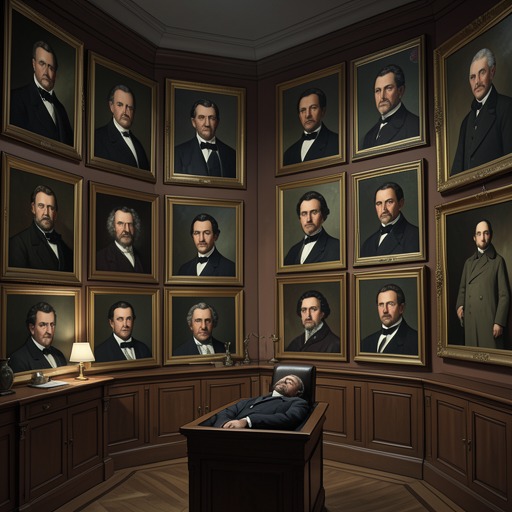
The warning leads into the room’s central display, a gallery of more than 150 portraits. Apart from a few young people who died prematurely and a mother superior, Roquentin observes, the sitters did not die bachelors, childless, intestate, or without the last rites. The display makes family, property, religion, and public standing seem to converge in a single, orderly passage through life and death. The portraits’ numbers and arrangement lend this convention the weight of an established history.
The civic story on display
The Salon Bordurin-Renaudas contains the men and women who belonged to Bouville’s elite between 1875 and 1910, painted by Renaudas and Bordurin. The men are credited with building Sainte-Cecile-de-la-Mer and founding the Federation of Shipowners and Merchants of Bouville in 1882, ostensibly to unite men of good will, support national recovery, and restrain disorder. The gallery’s civic narrative also associates them with a better-equipped port, lengthened and widened quays, an expanded Marine Terminal, and dredging that brought the anchorage at low tide to 10.7 meters. It records the growth of the fishing fleet’s catch from 5,000 barrels in 1869 to 18,000 twenty years later, technical and professional centres for workers, the defeat of the 1898 shipping strike, and the sons they gave to the country in 1914.
These achievements are presented as a continuous warrant for elite leadership. Olivier Blevigne’s museum biography traces his political course to the Commune insurrection: after taking refuge in Versailles, he vowed to devote his life to restoring order. He founded the Club de l'Ordre, married into the Pacome family, entered business and politics, and was repeatedly elected from 1885 onward. His displayed speech casts rule not as the elite’s privilege but as its primary duty. The gallery thus converts a particular class position into a public-minded obligation, treating hereditary advantage, education, experience, and authority as qualifications that naturally belong together.
The museum’s labels and visitors help that conversion feel ordinary. Before the portraits, a visitor identifies Remy Parrottin through the printed caption as a professor in Paris and an academician; her husband calls the portrait “History!” The exchange shows how an inscription and a title can make an image stand for more than an individual likeness. Elsewhere, the reverent visitors, the sleeping guardian, and the pale light on the paintings frame the collection as quiet, settled authority. The room is nearly empty of living activity, yet its many painted gazes address everyone who enters.
Portraits, manners, and class
For Roquentin, the gallery’s force lies not only in what it says but in how its images have been made to say it. He surveys Pacome, President Hebert, both Parrottins, and General Aubry, figures associated with the ceremonial meetings on Rue Tournebride. He remembers the Sunday greetings and the stately salutes exchanged with Madame Gratien, the mayor’s wife. The museum’s social world therefore extends beyond its walls: the manners enacted in public are preserved and dignified in paint.
Those manners are also a code of distinction. On Rue Tournebride, Roquentin has learned to distinguish people from the Boulevard Maritime from those of Coteau Vert by clothes and bearing: the new overcoat, soft felt hat, and dazzling shirt of one group contrast with the worn, sunken look and insolent faces he associates with the other. The Sunday ritual of hats being raised and hands clasped makes hierarchy visible through small gestures. In the museum, the same distinctions are refined into portraits, names, offices, and biographies: social position appears not as a contest over status but as a natural inheritance of public respect.
At first Roquentin admires the painted reign of humanity. The sitters’ faces seem clear as porcelain, stripped of the mysterious weakness that living faces possess. Their likenesses appear detached from trees, animals, and the material earth and water they have transformed. Renaudas and Bordurin have made the elite look as though it has mastered nature both around Bouville and within itself, adorning the result with the rights of man and citizen. But the very polish that grants the sitters composure also exposes the work of idealization: the portraits offer humanity as a finished civic achievement, cleansed of contingency.
Roquentin before the painted judgment
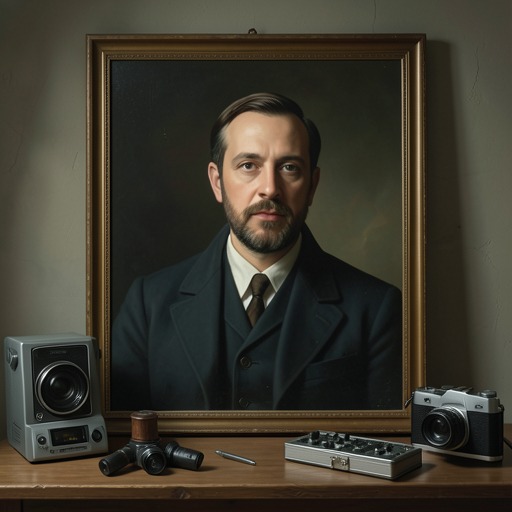
The portrait of Jean Pacome concentrates the gallery’s challenge. Roquentin sees a handsome man of about fifty, dressed with controlled elegance, holding a top hat and gloves against pearl-grey trousers. Small feet, slender hands, broad shoulders, and a composed face make him seem faultless; his grey eyes, however, do not smile. Roquentin first gives up looking for a flaw in him, then feels that Pacome’s gaze has not released him. The encounter reverses the usual direction of a museum visit: rather than simply judging a portrait, the visitor experiences himself as judged by it.
What separates the two men is not just wealth or appearance but their incompatible claims to existence. Roquentin recognizes that his own thoughts about Pacome cannot reach the dead man; they belong to the psychology of books. Pacome’s painted judgment, by contrast, seems to question Roquentin’s very right to exist. Roquentin admits that he has always sensed he had no such right: he has appeared by chance, existing like a stone, plant, or microbe, with his life reaching out toward small pleasures or producing only a harmless buzz. The portrait’s authority gives social privilege the appearance of ontological certainty, while the living observer feels the groundlessness that the image conceals.
In Roquentin’s reconstruction, Pacome’s heartbeat and bodily life had taken the form of rights demanding obedience. For sixty years he exercised a right to live without doubt, fulfilling what he understood as duties of son, husband, father, and leader; his family became Bouville’s richest. Roquentin imagines him reading Montaigne or Horace, and contemporary writers such as Barrès and Bourget, as part of a life in which even pleasure could be understood as a due. This is not a neutral biography but the logic Roquentin reads into the portrait: a life backed by family, property, learning, and office can mistake its advantages for a universal entitlement.
The limits of memorial authority
The gallery’s reverent surface does not survive Roquentin’s full inspection. He follows its long length, passing portraits of civic officers, businesspeople, religious figures, and artists. The display records different forms of public service and personal endurance, including Madame Thereson’s struggle with deep illness while she continues to organize meals and preside over welfare societies. Yet the painted convention makes these lives appear clear, complete, and reconciled. Roquentin looks for some relation between the sitters and the life of nature, and finds instead portraits that turn human achievements into evidence of humanity’s command.
The contrast between The Bachelor's Death and the elite portraits makes the museum’s moral architecture especially visible. The first painting warns that a solitary death leaves a person without family or care; the principal gallery answers with sitters who appear to have possessed the proper connections, rites, and legacies. The lesson is not simply that family and civic duties matter. The arrangement also makes social respectability look like the condition of a deserved afterlife, while the wealthy dead’s claims to life, work, wealth, command, respect, and immortality seem self-evident. What is preserved as public memory is therefore also a judgment about whose lives count as complete.
When Roquentin turns back after crossing the gallery, his leave-taking punctures its ceremonial grandeur. The painted flowers and figures that had stood for the city’s pride and reason for existing become, in his thought, bastards. The museum remains a material record of Bouville’s rulers and achievements, but it no longer secures their meaning. Its portraits show how a class can arrange its history into a monument to duty and rightful authority; Roquentin’s response exposes the distance between that composed narrative and existence as something that simply happens, without prior warrant.