Boulevard Noir
NauseaBoulevard Noir is a neglected industrial corridor at the edge of Bouville, defined by freight traffic, puddles, sparse gaslights, and stretches of darkness. During an evening walk, Antoine Roquentin turns toward it to escape the lively streets; there, the cold and apparent absence of life briefly displace his nausea, making the boulevard a landscape through which the novel renders estrangement from the human world.
Setting and Approach
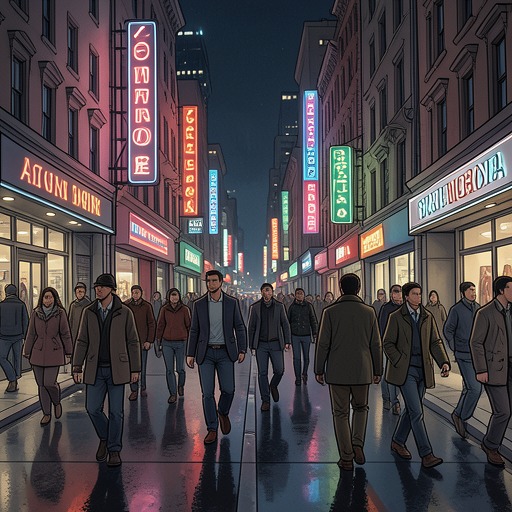
At seven-thirty, with no appetite and hours before the cinema begins, Antoine Roquentin rejects the bright central streets and their shops and entertainment. He has had enough, for the moment, of dogs, people, and the spontaneous movement of living bodies. Instead he turns onto Boulevard Noir, heading toward Avenue Galvani, drawn by a place of stones and earth that seem hard and still.
The boulevard’s first stretch is shaped by the old railway station. The station’s noise and industrial presence accompany a short run of streetlights and four cafés, including Railwaymen's Rendezvous. The cafés are quiet during the day and illuminate the street in the evening. After passing their pools of yellow light, Roquentin reaches Rue Paradis, where the asphalt ends abruptly; crossing into the unlit stretch, he steps into a puddle and soaks his sock. The physical discomfort marks his passage out of the inhabited, lit area and into the walk proper.
An Abandoned Edge of Bouville
Beyond the station’s immediate surroundings, Boulevard Noir is described as a place the town has effectively left behind. Its climate and barren soil seem hostile to settled life. A broken fence and a dilapidated wall reinforce the sense of neglect: the wall has no doors or windows and continues for two hundred yards before meeting a house. Torn posters cling to the fence, their remaining fragments no longer joined in their original design. Under a distant gaslight, they seem to form an unsettling new arrangement, while the railway lights show through the boards.
As Roquentin enters the darkness, the pinkish light of Avenue Galvani is visible far ahead, and the station’s cafés remain a faint point of light behind him. Other parts of Bouville are not wholly absent: people drink and play cards in pubs, and familiar sounds carry from the warmer, brighter streets. But the boulevard itself is described as empty of ordinary human activity. Its remoteness is not romantic wilderness; it is an overlooked urban margin, associated with the railway and industrial development rather than civic life.
The Boulevard’s Material Character
Roquentin regards Boulevard Noir as the reverse side of the more presentable streets. Unlike streets that appear to offer themselves to passers-by, it has not been decorated or maintained for display. The town cleans around the station because travellers use it, then abandons the boulevard beyond that limited zone. It runs forward without apparent purpose until it meets Avenue Galvani; a large mud-colored truck may thunder along it, but the street remains largely unattended.
The passage compares such corridors with similar districts near freight stations, tram depots, slaughterhouses, and gas tanks in larger cities. Their defining features are straightness, dirt, drafts, broad treeless pavements, and puddles that persist long after rain. Boulevard Noir’s mud and water can remain through most of the year, with August the exception. This detail makes its harshness enduring rather than the temporary result of one bad evening.
Nausea and Stillness
The boulevard becomes significant through the change it produces in Roquentin’s attention. In the darkness, the familiar noises of cars, voices, and dogs remain associated with the lit streets, while a distant ringing reaches him across the divide. He stops to listen. Although he is cold, his attention shifts away from his own discomfort and toward the stillness around him; he describes the surrounding purity as having won him over.
Here the Nausea has, in his account, stayed behind in the yellow light. The contrast is not a cure or a change in the boulevard itself, but a temporary alteration in his relation to what surrounds him. The place’s emptiness lets him imagine himself as nothing but cold air moving along a long channel toward the faint light ahead. His response reverses the usual association of urban illumination with safety and comfort: the inhabited streets are where living bodies and the nausea remain, while the abandoned, mineral-like corridor offers a moment of release from them.