Finn
NeuromancerFinn is a fence, a trafficker in stolen goods whose specialty is primarily software, but he is also a hardware technician, information broker, storyteller, and reconstructed personality. His decisive significance lies in the way he connects the material underworld of the Sprawl to the immaterial systems of memory, cyberspace, and artificial intelligence: he can inspect bodies for implants, modify consoles, interpret forbidden devices, and inhabit a memory-based simulation that remains recognizably himself while no longer being an ordinary living presence.
Identity and Introduction
Finn first appears in a hidden workshop reached through Metro Holografix, where Molly brings Case for an implant scan. His physical presentation is deliberately ungainly. He has very small ears pressed flat against a narrow skull, large front teeth that cant sharply backward, a battered tweed jacket, and a handgun that he quickly drops into his pocket. His workshop is protected by a thick circuitry panel fitted into the doorway, an exhaust fan, scanning pylons, and a white room furnished with a table and folding chairs. The setting makes him both a mechanic and a gatekeeper: entry is controlled, bodies are inspected, and time is measured as a chargeable resource.
Finn's manner is rough, comic, and commercially exact. He addresses Molly as Moll, calls Case a kid or sweetmeat, smokes Partagas, and treats even dangerous technical work as a negotiation over seconds and payment. During the examination he identifies Molly's silicon implant, its pyrolitic-carbon coating, her low-temperature isotropic-carbon glasses, and her retractable claws. He also establishes that Case has only cheap dental work and no biological implants, cortex bombs, or other small devices. His expertise is therefore practical rather than ceremonial: he reads the body as hardware without losing sight of its vulnerability.
Technical Work and the Wintermute Revelation
After Case returns from a five-hour session in cyberspace, Finn visits the loft carrying a filthy manila envelope and a featureless black rectangle sealed inside polycarbon. He explains that the factory prototype is booby-trapped against laser entry, X-ray examination, and ultrascan, but can still be opened. The device is a flip-flop switch that can be wired into Case's Ono-Sendai so that he can access live or recorded Simstim without jacking out of the matrix. Finn suspects that the equipment will let Case receive Molly's sensorium through a broadcast rig, turning the boundary between Case's console work and Molly's bodily experience into a technical connection.
Finn's more consequential intervention comes when Molly brings him information obtained through Lupus Yonderboy. After examining what she has acquired, Finn confirms that it is an artificial intelligence. He identifies Wintermute as the recognition code for an AI, gives its Turing Registry context, and explains that the system was built for Tessier-Ashpool S.A., which owns both the mainframe and the original software. The discovery changes the apparent structure of Armitage's operation. Molly and Case had been investigating who was running Armitage; Finn's answer suggests that Wintermute may be backing him, while the legal restrictions on AI autonomy make corporate control an immediate alternative explanation.
Finn does not present the revelation as a complete solution. He distinguishes the technical fact of Wintermute's identity from the still-open question of who controls it, and he places the AI inside the institutional history of Tessier-Ashpool S.A. His contribution is thus diagnostic rather than final: he turns rumor and anomalous communications into a concrete hypothesis, but leaves the larger mystery intact.
Storyteller of Silicon and Memory
Finn's account of Smith, another fence who had gone silicon, expands his role beyond repair work. Smith had installed multiple art-history programs and gallery-sales tables, gaining formidable professional knowledge through implanted software. Finn presents this story as something he has never told anyone before, and the anecdote gives his technical world a history: information can be bought, installed, and used as a trade skill, but the transformation also raises questions about what remains of a person when knowledge is detachable from a body.
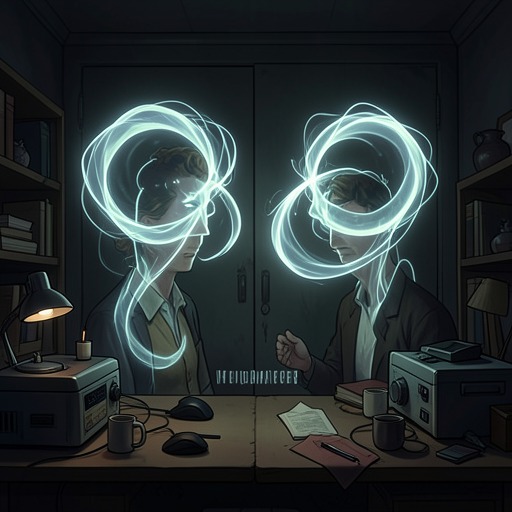
Later, Finn appears to Case inside Metro Holografix as a construct drawn from Case's own memory. The encounter is materially convincing enough to reproduce the shop's junk, dust, stale wool, yellowing magazines, and the smell of Cuban tobacco, yet Finn explains that the place is an arrangement of memory rather than a simple physical location. He says that memory is holographic and that he can tap Case's recollections, sort them, and feed them back. The construct can therefore move through remembered spaces, but its limits are equally important: it contains the parts of the world Case has seen, and places he has not experienced remain low in detail.
This reconstructed Finn is not merely an imitation used for exposition. He retains the mannerisms that define the living Finn, including the cigarette, the grin, the teasing speech, and the habit of turning an explanation into a provocation. At the same time, he knows that he is different and suggests that the very possibility of such a construct exposes what human beings have failed to do with their own understanding of memory. His existence makes the novel's distinction between person and representation unstable: a remembered personality can guide action, preserve a voice, and occupy a space without possessing the same status as the living body that once produced it.
Villa Straylight and Narrative Function
The construct leads Case through a simulated version of Villa Straylight, the Tessier-Ashpool residence. In freefall and through cylindrical corridors, Finn presents the villa's architecture as a body turned inward: secret chambers, intestine-like passages, narrow maintenance tunnels, and a silicon corporate core concealed behind elaborate internal growth. He relays Lady 3Jane Marie-France Tessier-Ashpool's unfinished essay, which interprets the family home as an expression of withdrawal from the open void of space and of the family's attempt to generate a sealed universe within its own wealth.
Finn's tour gives Case a conceptual map of the place before the physical operation reaches its decisive stages. The villa's inner labyrinth is not treated as decorative eccentricity alone; its convolutions express the Tessier-Ashpool family's history, wealth, fear of space, and concentration of power in a hidden technological heart. At the center stands a ceremonial terminal with a platinum-and-cloisonne bust, its synthetic-ruby eyes taken from the ship that carried the first Tessier and returned for the first Ashpool. Finn explains that the terminal requires Molly and the correct word, so technical force alone will not be enough to complete the intrusion.
His narrative function is consequently double. As a living fence, Finn enables the crew by providing scans, hardware, and information. As a memory construct, he becomes a threshold guide into the architecture and symbolism of the Tessier-Ashpool system. He is neither a conventional mentor nor a neutral technician: his advice is mixed with jokes, evasions, cigarettes, and reminders that every passage through the novel's technological world has a material cost.
Thematic Significance
Finn embodies the novel's recurring collapse of boundaries between body, machine, memory, and commerce. His first scene treats implants and claws as readable technical objects; his later work turns Case's Ono-Sendai into a bridge for Simstim; his story of Smith imagines professional identity as downloadable knowledge; and his construct form turns a shop, a man, and a set of memories into interchangeable layers of reality. Each version of Finn remains useful precisely because he is not wholly reducible to one of them.
His repeated presence also links the apparent freedom of cyberspace to systems of ownership and control. The matrix is described as a consensual hallucination built from data, while Finn's work reveals who owns the hardware, who controls the software, who can inspect a body, and who pays by the second. Even the most dazzling technological novelty is embedded in a black-market protocol of access, risk, and exchange. Finn understands that structure instinctively, and his rough professionalism gives the novel one of its clearest human measures for the powers moving through its artificial worlds.