Ratz
NeuromancerRatz is the bartender of the Chatsubo, a bar for professional expatriates in Night City, and one of the first figures through whom Case’s damaged life is made visible. His Russian military prosthesis, decayed steel teeth, rough humor, and practical command of the bar make him both an unmistakable physical presence and a local measure of the city’s hard, improvised survival. He does not drive the central conspiracy, but his encounters with Case frame the protagonist’s fall, isolation, and attempted return.
Identity and Setting
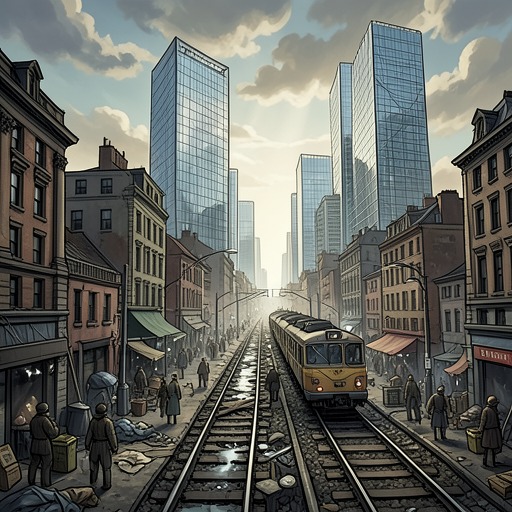
Ratz tends bar behind a counter crowded with expatriates, prostitutes, drunks, and transient operators. The Chatsubo’s social world is notably detached from its Japanese surroundings: a person can drink there for a week without hearing two words in Japanese. Ratz belongs to that rough international enclave, speaking in a deliberately eccentric mixture of English, German-inflected address, and compressed slang. His appearance is described through the contrast between bodily damage and an era in which affordable beauty is common. His ugliness therefore reads not as a private defect but as a stubborn refusal of the city’s cosmetic ideal, something almost heraldic in its conspicuousness.
His left or working arm is a Russian military prosthesis: a seven-function force-feedback manipulator enclosed in grubby pink plastic. It jerks and whines as he fills glasses, reaches for mugs, scratches his belly, wipes the bar, and handles objects with unexpected force. When Wage arrives with his two heavily augmented companions, Ratz crushes a thick shatterproof plastic ashtray in the claw, sending cigarette butts and green fragments across the table while warning that he wants no trouble in the Chatsubo. The prosthesis is thus not merely an emblem of injury. It is a tool integrated into his labor, his gestures, his threat display, and his authority over the room.
Relationship with Case
Ratz recognizes Case as a familiar customer and fellow marginal figure, addressing him as an artiste while mocking his talent for the slightly funny deal. Their exchanges are abrasive but intimate in the way of repeated contact. Ratz serves Case Kirin, tolerates his insults, and jokes that Case is allowed to work in the bar for entertainment value. Even the mockery establishes a form of recognition: Case is not anonymous here, although he is hardly dignified.
Ratz also remembers the change brought by Linda Lee’s absence. He tells Case that he saw Linda Lee the previous night, and when Case denies having a girl, Ratz recalls that Case laughed more when she was with him. His observation turns the bartender into a witness to a relationship Case tries to reduce to nothing. Ratz warns that Case’s present dedication to commerce and his increasingly artistic self-destruction may end with him in clinic tanks or reduced to spare parts. The threat is comic in wording but exact in its diagnosis: Case has become a man whose body, already damaged by his employers, is being consumed by drugs, fear, and loneliness.
Ratz’s humor repeatedly exposes the emotional defenses Case prefers to maintain. When Case dismisses him, Ratz describes the bar as a portable bomb shelter built of alcohol and stimulants, supposedly proof against the grosser emotions. He then urges Case to listen to fear and perhaps treat it as a friend. The exchange shifts the value of the scene from swagger to vulnerability. Case enters trying to conceal the pistol in his pocket and the flask in the other, but Ratz names the fear that those objects cannot suppress.
The Wage Encounter
Before Wage enters, Case asks Ratz whether he has heard about a fight in the arcade and whether someone was hurt. Ratz reports that a woman cut a security man. Case is trying to locate Wage, but his questions also reveal that he expects violence and needs information from the bar’s informal network. Ratz understands the approach before Case does, identifying Wage at the entrance and greeting him with elaborate, sarcastic politeness.
The encounter makes Ratz a threshold guardian for the Chatsubo. He tells Wage and the Joe boys that he wants no trouble, then demonstrates that the request is backed by force. His crushed ashtray and conversational warning are answered by a Joe boy’s taunt, while Kurt, the Brazilian bartender, stands on the bar aiming a Smith & Wesson riot gun at the trio. Ratz’s authority is therefore collective and practical: he can turn a shabby drinking establishment into a defended space without abandoning its casual tone. The scene also clarifies that Ratz’s prosthesis does not make him helpless. His altered body participates in the bar’s security and its theatrical economy of intimidation.
Memory, Recognition, and Return
Much later, Case returns to the Chatsubo after the events involving Wintermute, Neuromancer, the Tessier-Ashpool family, and the Straylight operation. The return is prompted by memory and by a desire to revisit a place connected with his earlier life in Chiba. Ratz does not recognize him immediately. When Case identifies himself, the bartender eventually answers with the old nickname, the artiste, but the recognition is weak and impersonal rather than restorative.
Ratz tells Case that Night City is not a place one returns to. The sentence is more than local cynicism. It rejects the fantasy that a person can re-enter a former life simply by finding its old rooms and faces. Case has crossed through bodily damage, dependence, violence, and the transformation of his employers’ scheme; the bar remains materially familiar, yet the relation between the place and the man has disappeared. Ratz’s failure to offer sentimental recognition makes the return starkly concrete: memory belongs to Case, but it does not oblige the city to remember him.
Narrative Function and Significance
Ratz serves as a recurring social barometer for Case. At the beginning, the bartender’s comments connect Case’s professional ruin to Linda Lee’s death or disappearance from his life, his drug dependence, and his withdrawal into commerce. During the Wage encounter, Ratz reveals the danger already gathering around Case and helps define the Chatsubo as a precarious refuge. At the end, his restrained recognition and warning about Night City prevent Case’s survival from becoming a simple homecoming.
The character also complicates the novel’s treatment of altered bodies. Ratz is described through prosthesis, decay, and exaggerated physical grotesquerie, but the narration gives those features practical and social dimensions: the arm performs work, threatens intruders, and becomes part of his habitual manner. He is not presented as a patient awaiting repair, nor as a symbol detached from ordinary life. His body is simultaneously damaged, useful, comic, repellent, and authoritative. That combination makes him a concise embodiment of the world’s central condition, in which flesh is vulnerable but technology does not erase vulnerability; it becomes one of the means by which people continue to live, work, and claim space.