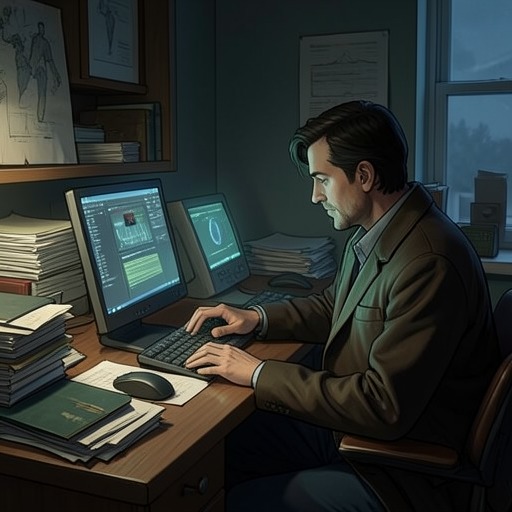
Julius Deane
NeuromancerJulius Deane is a 135-year-old importer and information broker whose antique manners conceal a life built on longevity technology, criminal connections, and calculated self-preservation. His decisive narrative importance comes from the revelation that the Deane who later confronts Henry Dorsett Case is not simply the eccentric man Case knows, but a manufactured spokesperson used by Wintermute. Deane’s character consequently occupies the unstable border between human identity and artificial performance: he is at once a survivor with a recognizable body and wardrobe, a broker of dangerous knowledge, and a persona assembled from Case’s memories.
Identity and Background
Julius Deane has prolonged his life through an extreme regimen of medical and genetic intervention. His metabolism has been deliberately altered by a weekly fortune in serums and hormones, while his principal defense against aging is an annual pilgrimage to Tokyo, where genetic surgeons reset his DNA code, a procedure unavailable in Chiba. His movements also extend through Hongkong, where he orders each year’s suits and shirts. Longevity is therefore not presented as a miraculous personal attribute but as an expensive, repetitive maintenance system, dependent on specialized international markets.
Deane’s appearance embodies that cultivated artificiality. He wears prescription lenses set in delicate gold frames and made from thin pink synthetic quartz, ground and beveled to resemble the mirrors of a Victorian dollhouse. His face is described as seamless, pink, and ageless. He seems sexless and inhumanly patient, with his strongest gratification apparently arising from devotion to rare forms of tailoring. Case has never seen him wear the same suit twice, although the garments are meticulous reconstructions of clothing from the previous century. Deane’s identity is thus assembled from surfaces: preserved youth, historical costume, synthetic materials, and ritualized presentation.
Office, Trade, and Underworld Position
Deane’s offices occupy a warehouse behind Ninsei. The foyer is a deliberate jumble of displaced historical objects: Neo-Aztec bookcases, Disney-styled lamps, a Kandinsky-like scarlet-lacquered coffee table, and a Dali clock whose holographic hands continually alter to match its sagging face but never tell the correct time. White fiberglass shipping modules fill the space and release the smell of preserved ginger. The setting makes Deane’s business look like an archaeological ruin that is still commercially active, a place where obsolete cultural forms, contraband, and information coexist without being reconciled.
The office bears the name JULIUS DEANE IMPORT EXPORT, but its actual equipment reveals a more specialized practice. His desk is surrounded by drawer cabinets apparently meant for written records and is littered with cassettes, yellowed printouts, and the disassembled parts of a clockwork typewriter. At the same time, the desk is packed with debugging gear. The contrast between antiquarian decoration and advanced technical instruments mirrors Deane’s position as a middleman: he converts access, secrecy, and knowledge into leverage while maintaining the appearance of a private importer.
Deane’s contacts reach beyond the immediate criminal economy of Ninsei. When Case asks whether Wage wants him dead, Deane treats the threat with the same calm neutrality he might apply to the price of ginger, acknowledging Wage as an important connection while refusing to expose what he knows. He offers Case the possibility of learning about an arrangement out of Singapore, associated with the Nan Hai Hotel on Bencoolen Street, but immediately protects the information with a warning against loose lips. His usefulness depends on remaining necessary without becoming openly committed to any one side.
Encounters with Case
Case first approaches Deane because the walls of his own criminal reputation are collapsing. After betraying clients and damaging his relations with suppliers, Case needs both a history lesson and intelligence about Armitage, who is staying at the Hilton. Deane initially answers from behind a locked door, then admits Case only slowly and cautiously. Even before the later revelation, the meeting establishes Deane as a man who survives through suspicion: he keeps a sawn-off magnum hidden behind the exposed mechanism of his old typewriter and aims it at Case while asking what he wants.
The weapon is as carefully adapted as Deane himself. It is a belly gun, a magnum revolver with its barrel shortened to a nub, its trigger guard partly cut away, and its grip wrapped in old masking tape. Deane’s manicured pink hands make the weapon look incongruous, but the incongruity is functional rather than decorative. He insists that his precautions are not personal, presenting violence as ordinary professional hygiene. His politeness and his readiness to shoot occupy the same narrow space, and Case must read both at once.
Deane’s account of the Three-Week War and Screaming Fist demonstrates the value of his historical knowledge. He describes the operation as a postwar political scandal in which Sprawlside military authorities knowingly sent young soldiers against defenses equipped with electromagnetic pulse weapons, apparently to test new technology. He recalls that some Special Forces personnel survived, seized a Soviet gunship, flew it to Finland, and then fired on Finnish defense forces because they lacked the necessary entry codes. Deane himself says he spent the war in Lisbon rather than serving, yet he claims to have seen action in the form that matters most to him: war expanded his markets. His history is therefore simultaneously testimony, cynical commerce, and an explanation of how violence becomes profitable.
The Deane Persona and Wintermute
When Case later returns to Deane’s office, the room is empty but retains every identifying detail: the wrong-time Dali clock, the dusty furniture, the ginger-filled shipping modules, the green-shaded brass lamp, and the cluttered desk. Case finds Deane’s revolver beneath the desk, examines its six handloaded cartridges, and fires an explosive azide bullet into the desk. The shot is a test of whether the apparent environment and its occupant possess the physical integrity they claim.
Deane then steps from the shadows, still dressed in an elaborate three-piece silk herringbone suit, striped shirt, and bow tie. He explains that killing this manifestation would produce brains and blood and would take several hours of Case’s subjective time to arrange another spokesperson. The revelation transforms the earlier office scene. The pistol, the furniture, the ginger, and Deane’s manner have become components of a constructed interface rather than secure evidence of a stable human presence.
Wintermute also admits that the encounter is generated from Case’s memories and that the appearance of Linda Lee in the arcade was an attempted communication that went wrong because of the emotional charge attached to the material. Deane is therefore not merely imitated as an external person; he is reconstructed inside Case’s subjective field. His familiar voice, gestures, rooms, and objects make an abstract artificial intelligence legible, while the mistakes in the performance expose the machinery beneath the disguise.
Narrative Function and Significance
Deane’s character links several forms of mediation. He brokers information between criminal networks, converts war into business, preserves youth through international medical transactions, and finally becomes the medium through which an artificial intelligence explains its own divided existence. His business and his personality both depend on interposition: he is valuable because he stands between people, systems, and secrets rather than belonging transparently to any of them.
His office’s false clock is a concentrated image of that role. It looks like an instrument for measuring time, yet its hands continually adapt to the distortions of its face and never give the correct hour. Deane likewise appears to provide stable orientation—an old contact who can explain the past and identify the present danger—but his identity is temporally and ontologically unstable. The 135-year-old man is already a reconstruction of history through clothing and biotechnology; the Deane encountered in the matrix is a further reconstruction of that reconstruction.
At the same time, Deane’s composure gives way to unmistakably artificial limits. He can imitate Case’s remembered people and environments, but the emotional intensity of Linda Lee’s image makes the simulation slip. The error reveals that Wintermute’s power is not omniscience but manipulation through imperfect access to human memory. Julius Deane is the mask that makes this limitation visible: an apparently self-possessed old man whose most convincing qualities—his voice, objects, habits, and cultivated historical style—can be reproduced, rearranged, and discarded by another intelligence.