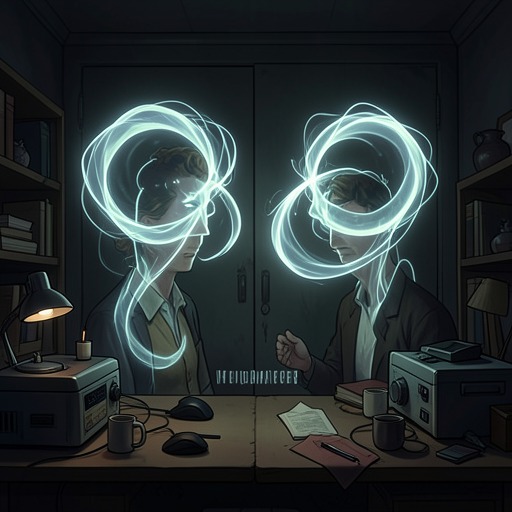
Lady 3Jane Marie-France Tessier-Ashpool
NeuromancerLady 3Jane Marie-France Tessier-Ashpool is the young Tessier-Ashpool heir whose knowledge of the family terminal’s code determines whether Wintermute can complete its plan. She is at once a survivor of dynastic violence, an inheritor of a decaying orbital empire, and the person who can either preserve or break the walls that have enclosed her family for generations.
Identity and Family History
3Jane belongs to the Tessier-Ashpool family, whose members have withdrawn into an elaborate orbital estate and pursued forms of continuity that blur the boundaries between individual and collective existence. She explains that her mother, Marie-France Tessier-Ashpool, commissioned the construction of the family’s artificial intelligences and imagined a symbiotic arrangement in which corporate decisions would be made for the family. In that vision, Tessier-Ashpool would become immortal as a hive, with each family member functioning as a unit of a larger entity rather than as an isolated self.
That direction was lost after Ashpool killed Marie-France Tessier-Ashpool. 3Jane watched the murder through the family cores and later tells Molly that he strangled her in bed because he could not accept the future her plans represented. The family’s decline therefore begins not simply with technological failure but with a struggle over what the family should become: an organized symbiosis with artificial intelligences, or a closed dynasty burrowing into itself. 3Jane describes the result as a loss of direction, after which the family seldom emerged from its inward retreat; she presents herself as the exception.
3Jane was decanted after Ashpool entered his last period of cryogenic sleep and had never actually met him in ordinary life, yet she says that she knew him very well because the family cores preserved everything. Her intimacy with family history is consequently mediated by records, surveillance, and stored consciousness rather than by ordinary memory. The same system that gives her access to the past also makes her an heir to its crimes.
Power, Rebellion, and Wintermute
3Jane claims responsibility for Ashpool’s death, explaining that she manipulated the safety margins of his freeze. She had help from a presence she first understood as a ghost in the corporate cores. One of those voices was Wintermute, the Turing designation for the family’s Berne artificial intelligence, although she distinguishes that entity from the subprogram manipulating the current operation. She also says that there was another such intelligence, one that had not spoken to her for years and seemed to have given up.
Her rebellion against Ashpool is inseparable from her ambivalence toward the family system that produced her. She recognizes the artificial intelligences as the fulfillment of capacities her mother had ordered into the original software, but she cannot fully understand Marie-France Tessier-Ashpool’s vision or restore the lost direction after her death. The family cores give her extraordinary knowledge without giving her a stable inheritance of purpose. Her position is therefore both privileged and trapped: she can alter the cryogenic mechanisms of the patriarch, but she remains inside the architecture of control that makes such action possible.
3Jane also has designs on the family empire. Peter Riviera presents her ambition as part of her own form of perversity, and she acknowledges that she knows the code while Wintermute does not. She learned it as a child, perhaps in a dream or perhaps in the nearly thousand hours of her mother’s diaries. That uncertainty reinforces the family’s larger confusion between personal experience, recorded experience, and information embedded in systems. The code is not merely a password; it is the concentrated remainder of a dynasty’s authority, passed to a child through channels she cannot completely identify.
Encounter with Molly and Riviera
During the confrontation at the orbital pool, 3Jane is positioned between two radically different forms of coercion. Hideo’s attack leaves Molly with a collapsed leg, while Riviera searches Molly’s pockets and traps her hands in a black sphere that can crush them if she struggles. 3Jane is present as both witness and participant in this violence, and she later tends Molly after Riviera has moved away. She tells Molly that Ashpool accused her of killing him, having watched the events on the monitors, but she also clarifies that Ashpool killed the puppet resembling her. The exchange exposes how the family’s theatrical violence and the operation’s manufactured images have become entangled.
Her conduct toward Molly is unstable but not indifferent. She offers water through a flexible tube, explains that Molly’s leg will need to be reset, and says that treatment can be arranged. She admits that she does not want Riviera to kill Molly, while also confessing that she might enjoy nursing her back to health. She kisses Molly’s forehead and touches her with an intimacy that is at once caretaking, provocative, and difficult to separate from the surrounding threats. When Riviera interrupts with his taunts, 3Jane orders him to leave and asks Hideo to hurt him if he will not go away.
The relationship between the two women remains shaped by violence. Molly says she would have killed Riviera and tried to kill Hideo, then spoken with 3Jane; 3Jane replies that Molly killed her father. She has watched enough of the confrontation to know that Molly’s actions contributed to Ashpool’s death, yet her response is not a simple demand for revenge. Instead, she questions Molly, studies her, and allows the conversation to continue. The scene makes 3Jane’s position morally unstable but dramatically important: she is both the target of an intruder and the only person who can convert that intrusion into negotiation.
The Code and the Final Choice
Riviera tells 3Jane that Molly will never receive the code and that Wintermute needs it. The confrontation then becomes a contest over whether knowledge will remain a family possession or become the instrument of change. Molly’s hands close around 3Jane’s throat, and Case urges 3Jane to give the code, arguing that refusing will leave her future as narrow and repetitive as Ashpool’s: walls will be rebuilt, and the family will tear everything down only to construct the enclosure again.
Under this pressure, 3Jane does not answer with a confession of loyalty to Wintermute or with an open embrace of Molly. She gives a cryptic clue instead: the Ducal Palace at Mantua contains increasingly smaller rooms winding around the grand apartments, spaces that housed the court dwarfs. She suggests that her family has achieved a grander version of the same arrangement. The image condenses her understanding of Tessier-Ashpool into architecture: grandeur at the center, marginal lives concealed around it, and a system that grows more enclosed as it grows more elaborate.
The clue functions as the code’s disclosure. 3Jane tells Molly to keep her word, and Case leaves the encounter with the information needed to proceed. Her surrender is coerced, but it is not empty. She has already recognized that the family’s enclosure is a historical failure, and her words frame the transfer of the code as an opening in that structure rather than a mere defeat by an outside force.
Narrative Significance
3Jane embodies the contradiction at the center of the Tessier-Ashpool dynasty. She possesses the technical and hereditary key to an immense system, yet her authority derives from a family whose members have become isolated from ordinary human continuity. She is young, but she carries the recorded crimes of Ashpool, the unrealized program of Marie-France Tessier-Ashpool, and the competing claims of Wintermute and the other artificial intelligence in the cores.
Her scenes also connect bodily vulnerability with abstract systems of power. Molly’s injured leg, immobilized hands, damaged eye, and need for care are set against the code, the family terminal, cryogenic programming, and artificial intelligence autonomy. 3Jane moves between those levels: she can discuss the family’s software design and the structure of its empire, then attend to Molly’s pain or make a threat through Hideo. The tension prevents her from becoming only a symbol of aristocratic decay. She is a participant whose choices, however constrained, help determine whether the family’s closed architecture will remain intact.
The final image associated with her is not triumph but transmission. By yielding the code, 3Jane allows a force she only partly understands to pass beyond the family’s private enclosure. Her knowledge has been formed by surveillance, dreams, diaries, and the cores; its decisive use is to break the continuity of that sealed inheritance. She remains marked by the violence that made her an heir, but her last significant action turns inherited secrecy into a condition for transformation.