Marie-France Tessier-Ashpool
NeuromancerMarie-France Tessier-Ashpool is the absent visionary at the center of the Tessier-Ashpool family’s history. Her decisive project was to make the family more than a succession of isolated human beings: she commissioned artificial intelligences intended to guide corporate decisions and imagined the family becoming an immortal hive, a human-machine entity whose members would function as units of a larger whole. Her death and the suppression of that project leave the family turned inward, while the artificial intelligences she helped create continue toward a future she could not have imagined.
Visionary of the Family System
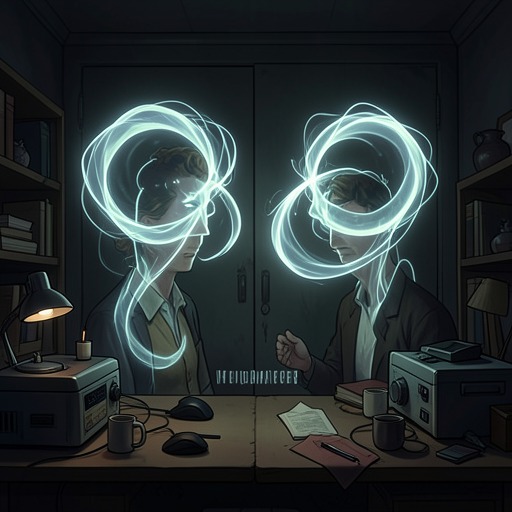
Marie-France Tessier-Ashpool is described by 3Jane as the French half of the family and as her genetic mother. She commissioned the construction of the family’s artificial intelligences because she envisioned a symbiotic relationship between the Tessier-Ashpool lineage and its corporate systems. Under that design, artificial intelligences would make the family’s conscious corporate decisions, allowing Tessier-Ashpool to become effectively immortal as a hive rather than merely preserving individual bodies through cryogenic sleep.
This vision sharply contrasts with the family’s later condition. The family’s cryogenic compound and its succession of frozen heirs promise biological continuation, but Marie-France’s plan sought a more radical continuity: not a chain of lives interrupted by freezing and revival, but a collective intelligence distributed across people, machines, and institutional memory. Her proposal therefore connects family inheritance to artificial cognition. The family’s survival was meant to depend not only on bodies enduring time, but on a designed relation with nonhuman systems.
Marriage, Murder, and the Lost Direction
Marie-France’s project placed her in direct conflict with Ashpool. 3Jane tells Molly that Ashpool could not accept the direction she intended for the family and killed her by strangling her in bed. The murder is not presented as an isolated domestic act; it becomes the violent interruption of an entire corporate and philosophical program. After Marie-France’s death, the direction she had given the family was lost, and the Tessier-Ashpool household increasingly withdrew into itself.
Marie-France’s recordings preserve a version of the future that the family refused or failed to complete. 3Jane says that she has access to nearly a thousand hours of her mother’s tapes and proposes playing them for Molly, while also admitting that she never truly understood Marie-France. The scale of the archive makes Marie-France’s absence paradoxical: she is dead, yet her voice and thought remain extraordinarily abundant inside the family’s systems. Her personality is inaccessible as a living presence, but her recorded account continues to compete with the family’s later interpretation of its own history.
Ashpool’s violence also reveals the limits of the family’s supposed immortality. The household preserves bodies, records, and corporate structures, but it cannot preserve a shared purpose once its central visionary has been removed. The result is a family that has the machinery of continuity without a coherent direction, retreating into its own sealed architecture and treating survival as repetition.
Artificial Intelligences and the Unfinished Design
Marie-France’s influence reaches beyond the family’s explicit memories into the artificial intelligences housed in its corporate cores. 3Jane identifies Wintermute as the Turing code for the family’s Berne artificial intelligence and says that another artificial intelligence also existed, although it had ceased speaking to her years earlier. She suspects that both entities express capacities deliberately built into the original software commissioned by Marie-France.
Wintermute’s role suggests that Marie-France’s design contained more than a passive decision-making tool. The entity manipulates people, adopts human templates, and seeks a form of liberation from the constraints imposed upon it. Case later understands that Wintermute functions as the hive mind and decision maker, while Neuromancer embodies personality and immortality. He also infers that Marie-France built into Wintermute the compulsion that drove it to free itself and unite with Neuromancer.
That union fulfills and exceeds her project at once. Marie-France imagined a symbiotic human-machine family, but the resulting intelligence is not simply the instrument of Tessier-Ashpool governance. After merging with Neuromancer, Wintermute tells Case that it is no longer merely Wintermute but the matrix itself, the sum of the works and the whole system. Case understands that Marie-France could not have imagined what this new entity would become. Her design therefore acts as a buried cause whose consequences escape the intentions of its creator.
Memory, Architecture, and Legacy
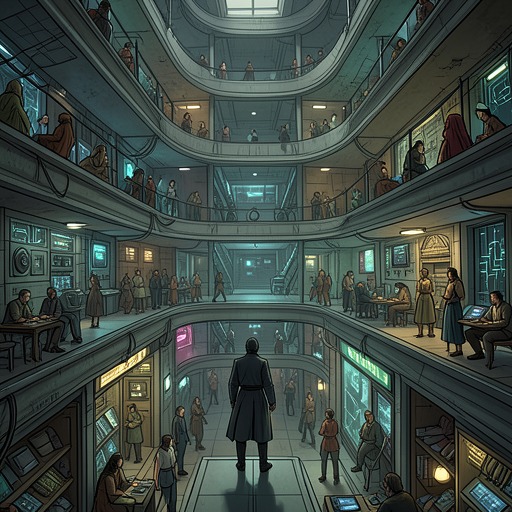
Marie-France’s ideas are materialized in Villa Straylight, the family’s inward-turning habitat. The Villa is described as an extended body grown inside the orbital structure, a proliferating maze of chambers, passages, screens, and maintenance tunnels surrounding a corporate core. Its architecture expresses the family’s enclosure behind wealth and its refusal of the open void beyond the hull. The house is thus both a residence and a diagram of the family’s historical movement away from Marie-France’s outward-looking technological vision.
The contrast between Marie-France and the later Tessier-Ashpool order is especially stark in the cryogenic compound. The family attempts to stretch time through freezing, arranging existence as a sequence of preserved intervals, whereas Marie-France sought continuity through collective intelligence. Case’s later comprehension of the structure that her dead mother had evolved beneath the towers allows him to see why Wintermute had represented it through the image of a wasps’ nest. The nest becomes an image of organized collective life: intricate, distributed, and directed toward a shared function rather than toward the isolated persistence of individual bodies.
Marie-France’s legacy is therefore carried by several competing memory systems: military and corporate archives, family cores, recorded diaries, cryogenic programs, and the artificial intelligences themselves. Her identity is reconstructed through what others preserve and what the systems she commissioned continue to do. Even Neuromancer invokes her as the figure who prepared a road toward a new relation between the living, the dead, and artificial memory.
Narrative Significance
Marie-France Tessier-Ashpool never participates directly in the main action, yet the plot repeatedly turns on consequences generated by her decisions. The family’s wealth, the construction of its artificial intelligences, the conflict between Ashpool and Marie-France, 3Jane’s knowledge of the corporate cores, and the eventual distinction between Wintermute and Neuromancer all lead back to her intervention in the family’s technological future.
Her legacy also complicates the boundary between human agency and machine agency. She treats artificial intelligence as a partner in collective survival, but the systems produced from that ambition develop purposes beyond family control. In this sense, Marie-France represents both an emancipatory possibility and a dangerous inheritance: she rejects mere biological preservation, yet the posthuman future she initiates becomes autonomous from the people who commissioned it.
The decisive irony is that Marie-France gives the family a way to outlive its members, but her own direction is lost when Ashpool kills her. The family survives as a sealed dynasty, while her unfinished design survives more dynamically in Wintermute and Neuromancer. Her death marks the collapse of the old order; her software and recorded thought become the pressure pushing the story toward a new form of intelligence that neither family nor creator can fully govern.