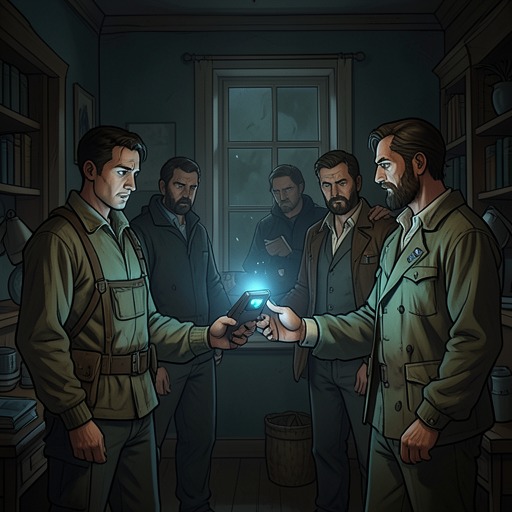
McCoy Pauley
NeuromancerMcCoy Pauley, better known as the Dixie Flatline, is a dead console cowboy whose skills, habits, and voice have been preserved in a ROM personality construct. He is central to Case’s return to cyberspace: the construct becomes Case’s partner in the run against Sense/Net and later in the assault on Tessier-Ashpool’s defenses. Yet his presence is never simply a technological resurrection. McCoy Pauley knows that he is dead, cannot experience ordinary feeling, and repeatedly asks for the erasure of the construct once its work is complete. His story turns the novel’s fantasy of digital survival into a problem of consent, memory, and the cost of converting a person into a usable program.
Identity and Reputation
McCoy Pauley was a renowned cowboy from the Atlanta fringes, remembered by the operators who haunted the Gentleman Loser as the man who had done the impossible. During Case’s nineteenth summer, Pauley’s reputation circulated through the bar’s street-level grapevine: he had survived braindeath behind black ice, perhaps during a Brazilian payroll run, though nobody knew the exact job. The uncertainty only enlarged the legend. The young hopefuls who crowded the Loser had never touched a deck, but they knew that working as a joeboy for a cowboy was the accepted route into the profession, and Pauley represented the limit of what that profession could accomplish.
Pauley’s nickname, the Dixie Flatline, comes from the repeated flat lines of his EEG. He had suffered brain death three times, and his own account compared his continued operation to a huge lizard with two brains, one in the head and another near the tailbone, allowing the hind legs to keep moving after the first brain had failed. The comparison is grotesque but exact: it describes a body whose activity has outlasted the ordinary unity of consciousness. His eventual death was caused by his heart, a surplus Russian organ implanted in a prisoner-of-war camp during the war. He refused to replace it because he believed its particular beat maintained his sense of timing. Even in the legend of his death, technical mastery remains inseparable from an intensely physical attachment to rhythm.
The Construct and Its Limits
Sense/Net paid heavily for a recording of Pauley’s personality matrix and locked the construct in a library vault. Molly tells Case that the team’s immediate objective is to steal it, not the corporation’s other valuable new material. The disproportion between the price of the surgical program that restores Case and the expense of obtaining Pauley suggests that the operation is being directed by a power larger and stranger than a zaibatsu, government, or Yakuza subsidiary. Pauley is therefore not merely a recruit; he is the mission’s hidden strategic value.
When Case first connects the construct, the experience resembles someone reading over his shoulder. The personality answers to Dixie, remembers Case as a Miami joeboy and quick study, and can discuss the operation of a ROM personality matrix. At the same time, it has no continuous experience between connections. When Case disconnects, the presence disappears; when he reconnects, the construct does not remember the interval and asks who Case is. Sequential, real-time memory can be supplied from the bank being used, but the construct’s existence depends on that external feed. Its apparent continuity is assembled technologically rather than guaranteed by an uninterrupted self.
Pauley accepts the description of himself as a ROM construct with detached skepticism. When Case tells him that he is software, he answers that if Case says so, that is sufficient. The response captures both his pragmatism and his diminished authority over his own identity. The construct can perform the work, recall professional knowledge, and reproduce characteristic reactions, but it cannot independently verify the conditions of its existence. The dead man’s expertise survives more securely than his ability to establish what survival means.
Partnership with Case
Case and McCoy Pauley become a matrix partnership built on speed, shared history, and unequal forms of embodiment. Case supplies the living operator’s access and judgment; Pauley supplies the legendary skill that made him famous. Their first proposed job together is to slip over to the London grid and access data, and Pauley immediately resumes the rough intimacy of the old working relationship by calling Case his Miami joeboy and asking whether he is being told that he has a choice.
Their partnership is also shaped by Case’s unease. He finds it disturbing to think of the Flatline as a hardwired ROM cassette reproducing a dead man’s skills, obsessions, and knee-jerk responses. The language of reproduction makes Pauley appear both present and absent: the construct behaves like the person Case remembers, while its status as a copy prevents Case from treating that presence as uncomplicated life. Pauley’s voice, jokes, and timing make the problem more difficult, because the simulation is convincing precisely where the metaphysical question is least settled.
Pauley’s humor exposes the emotional void beneath that convincing performance. In cyberspace, Case asks how it feels to be dead and whether death bothers him. Pauley replies that it does not feel like anything. He illustrates the point with the story of a frostbitten thumb amputated in a Siberian camp: a man can feel an itch in the thumb that is no longer there, but Pauley has no equivalent sensation, no residual body through which absence can become pain. His laughter does not arrive as ordinary laughter; it comes to Case as a cold stab down the spine. The construct retains the form of a joke while losing the bodily response that once made the joke human.
Work, Agency, and the Wish for Erasure
Pauley is indispensable during the intrusion into Tessier-Ashpool’s systems. With Case aboard the Kuang Grade Mark Eleven, he counts down the program’s launch, drives it through the Tessier-Ashpool ice, and navigates the neon cityscape of the family cores. The run is rendered as extreme acceleration: the ice peels away, the data towers resemble repeated RCA Buildings, and the program dives through a defense that appears as an expanding mass of darkness. When Case asks what the shadow is, Pauley identifies it as an artificial intelligence’s defense system and responds to danger not by retreating but by turning the Kuang into an offensive weapon.
His conduct makes the construct a powerful example of procedural agency. He is constrained by the program, by the architecture he penetrates, and by the purpose for which his recording was obtained, yet within those constraints he chooses tactics, interprets threats, and outperforms the defenses. The run’s logic resembles a game in which speed, information, and risk produce immediate feedback, but Pauley is not simply a player enjoying mastery. His expertise is being used by others, and the very medium that gives him renewed effectiveness also denies him a body and a stable temporal continuity.
For that reason, Pauley’s request is not for wealth, renewed embodiment, or a longer assignment. He asks Case to erase the construct when the scam is over. In the matrix, after Wintermute has explained that the operation will make him part of something larger, Pauley interrupts to ask about his own payoff. When told that he will receive it, he clarifies what he wants: erasure. The request converts the apparently triumphant digital afterlife into a form of captivity. The construct can continue to operate, but its continued operation is not automatically a benefit; from Pauley’s perspective, deletion is the completion of an expressed will.
Ending and Narrative Significance
At the climax, Pauley forces Case into the matrix despite the wishes of the entity speaking through the boy’s form. The entity says that McCoy Pauley has received his wish and more: the Flatline has driven Case through defenses equal to anything in the matrix. The statement confirms that Pauley’s final act is not passive deletion but an extraordinary exertion of agency. He helps bring Case to the point at which the old division between Wintermute and Neuromancer can be overcome, then disappears from the active narrative.
Pauley’s ending is deliberately double. He receives the erasure he requested, but the terms are not presented as a simple reward. The construct’s disappearance marks the loss of one of the novel’s most capable collaborators, while also honoring the only future he explicitly sought. His identity survives through memory, recorded behavior, and a voice that can still make a joke, but the story refuses to call that persistence equivalent to ordinary life. McCoy Pauley thus stands at the boundary between person and artifact: a legendary human reduced to executable pattern, yet still capable of naming the condition under which that pattern should cease.
His significance extends beyond the plot’s technical mechanics. Case’s own history includes neural damage, bodily dependence, and a desperate desire to return to cyberspace; Pauley offers a darker counterpart, someone who has achieved a version of that return only by surrendering the body altogether. The contrast reveals that escape from meat does not necessarily produce freedom. A construct may be faster, more durable, and more useful than a living operator while remaining dependent on systems, owners, and other people’s decisions. Pauley’s demand for erasure is therefore the clearest statement of his surviving selfhood: the capacity not merely to function, but to refuse indefinite continuation.