Archaeological Survey of Planet Four
OzymandiasThe archaeological survey of Planet Four is an attempt to recover a vanished civilization from a world that seems to have kept almost none of its material past. Its early excavations produce only eroded foundations and empty ground; its decisive find, made by Dr. Leopold, is Ozymandias, a surviving guide whose voice turns a barren landscape into a record of Thaiquen history. That transformation also makes the survey the point at which archaeological discovery collides with military control.
Mission and Conditions
The expedition was assigned to investigate worlds near the Galactic Rim that an earlier survey had passed over after finding no living inhabitants. Its five archaeologists, led by Dr. Leopold, were charged with studying dead civilizations; Colonel Mattern and his military personnel searched instead for fissionable material, alien weapons, and strategic resources useful to the United States of America. The military had supplied most of the expedition’s budget, while its charter nonetheless reserved the archaeologists a limited period to work.
The contrast shaped the survey from the outset. Mattern regarded archaeological work as an expense with little practical return, while the archaeologists understood that their time on each world was restricted and that the military could press to leave. On Planet Four they had only a week, and the narrator notes that the planet might never again receive a visit from Earth scientists. The team therefore began under a deadline imposed by the expedition’s competing purposes, not by the scope of the history they hoped to uncover.
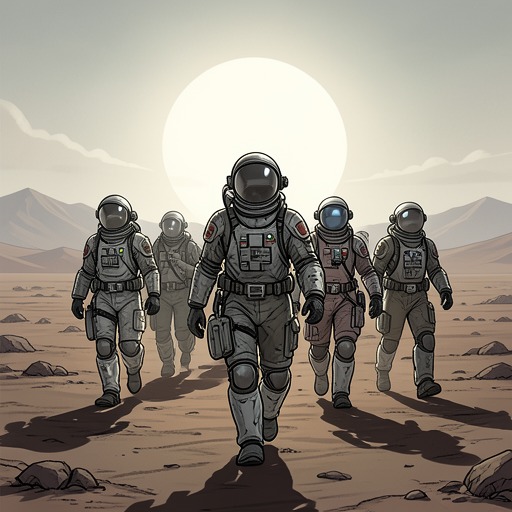
Planet Four appeared to confirm Mattern’s pessimism. It had been dead for about a million years, and its surface was a dry, wind-swept expanse where sand had accumulated over former settlements. The archaeologists prepared breathing masks and field equipment before leaving the ship. Their limited time made the prospect of an empty world more than a disappointing first impression: if erosion had erased the evidence, the team could not simply return later and try again.
Field Survey and Failed Excavation
The team divided into three units. Dr. Leopold went alone west toward a dry riverbed, intending to examine alluvial deposits. Marshall and Webster took a halftrack southeast toward signs of a buried city, while the narrator and Gerhardt drove north in search of another settlement. Their vehicles carried cameras and digging tools, including picks, shovels, and camel’s-hair brushes. The work began across a landscape where wind drove sand against the vehicles and the tracks crunched over ground undisturbed for millennia.
After covering twenty miles without finding a promising site, the narrator and Gerhardt continued another ten. They reached a linear city, perhaps six or seven hundred miles long and no more than half a mile wide, though the team had no time to establish its full dimensions. Sand covered most of it. What remained visible were foundations and weathered lumps of structural concrete and reinforced metal, so they unloaded a power shovel and began excavating.
The first dig made the limits of the evidence stark. After an hour of moving thousands of cubic yards of soil, the archaeologists had produced a large hole but no artifact: no skull, tooth, utensil, or other tangible remnant. Building foundations had survived, reduced to stumps by a million years of sand, wind, and rain, but they could indicate little beyond the former existence of a civilization. Unlike a paleontologist reconstructing an animal from a fragment of bone, the team could not infer a culture, its laws, technology, or philosophy from bare foundations. They moved on and dug again, but time had left them no better evidence.
At the end of seven hours in the field, the northern team had only a few hundred feet of tridimensional film showing foundations. The day was drawing to a close on a planet with a thirty-five-hour day; they returned by a route three miles east of their outbound track in the forlorn hope of spotting something new. The other archaeological units had likewise found no material of value. The survey appeared to have confirmed the most discouraging interpretation of the planet: it was a ruined world whose surviving traces could not tell the researchers much about its former inhabitants.
Ozymandias and the Recovery of History
That assessment changed when Dr. Leopold radioed that he had found something too heavy to manage alone and asked both other units to come to his coordinates. The object was a massive, ancient robot. When addressed, it produced a high-pitched voice in an unfamiliar language, its mouth-receptors accompanied by a clanking sound. The moment expanded the expedition’s horizon: humans had been hearing languages from Earth for three centuries of space exploration, but had not previously heard a language that originated beyond Earth.
Dr. Leopold’s first explanation remained tentative. He thought the robot might be a guide to the ruins, built to inform passersby and surviving its creators and their monuments alike. The machine turned on its base, gestured toward the surrounding landscape, and continued speaking. The narrator compared the scene to a guide recounting the history of a famous monument, an apt image for the contrast between the robot’s explanatory performance and the vanished city around it. Dr. Anderson named it Ozymandias, invoking the poem’s ruined monument and the irony of a memorial that outlasts the civilization it was meant to celebrate.
The robot’s survival did not merely supply a new artifact; it altered what the archaeological team could know. At first, Dr. Leopold proposed trying to decipher its language. When the group returned the next day, however, Ozymandias greeted them in English. The researchers realized it had somehow deciphered their language, and its words formed coherent concepts rather than simply repeating scraps of their conversation. The team’s initial uncertainty about whether it understood them gave way to direct communication.
Within a short time, Ozymandias could hold a passable conversation. It freed its legs from the sand that had bound them for centuries and began performing the function for which it had been built: leading the visitors on a tour of the civilization that made it. The archaeologists could now question a machine that had outlasted the visible remains and could answer in a language they understood. The field survey’s discoveries thus changed from traces to testimony, although the testimony came through the robot’s own preserved memory rather than through excavated objects.
The Archive and Its Limits
Ozymandias identified its people as the Thaiquens and said their civilization had flourished for three hundred thousand years. In its declining days, they had built the robot as an indestructible guide to their indestructible cities. The intended permanence had failed: the cities had crumbled, while Ozymandias alone remained, carrying memories of what had been. This reversal made the robot at once a surviving monument and an archive whose contents could restore a history the landscape no longer displayed.
Its account supplied details that excavation had not yielded. Ozymandias described Durab as a city that once held eight million people and located the Temple of Decamon, sixteen hundred feet high, along the Street of the Winds. It dated the beginning of the Eleventh Dynasty to the accession of Chonnigar IV in the city’s eighteen thousandth year, and recalled the dynasty’s era as the time when the neighboring planets were first reached. The scale and specificity of these records gave the archaeologists a chronology, urban geography, and account of expansion unavailable from the eroded foundations.
The robot also described the Library of Durab, which had contained fourteen million volumes. None survived in the city, but Ozymandias said it had read the books long after their builders were gone and memorized them. It could therefore preserve knowledge from a vanished collection as well as details of the physical city. Its recollections ranged beyond architecture and political chronology: it recounted a plague that killed nine thousand people a day for more than a year.
As Ozymandias absorbed the archaeologists’ comments and added words to its vocabulary, its account became more detailed. The team followed it through the desert while their recorders captured its speech, and the prospect of studying the stored information for years overturned the earlier conclusion that the planet held almost nothing of archaeological value. Yet the archive’s abundance did not settle every question. Its memories revealed a civilization’s history, but the material evidence around the team remained starkly incomplete, and the later explanation for the planet’s lifelessness came from military interpretation rather than from the excavations themselves.
From Archaeological Find to Military Asset
The discovery also exposed how little the two halves of the expedition knew about one another’s actions. Colonel Mattern said that Dr. Leopold had concealed the robot’s existence, although Leopold replied that he had intended to disclose it before departure. Mattern explained that his men had investigated the area after the archaeologists’ behavior the previous night drew their attention to it; their detectors registered a metal object about twenty miles to the west. Ozymandias, for its part, had been surprised to learn that other Earthmen were present.
Dr. Leopold asked Mattern and his personnel not to interfere with the robot. Mattern answered by redefining the discovery: Ozymandias was, he said, of military use, and the military had brought it to the ship and placed it in sealed quarters under top-level security. He then declared the expedition ended and ordered an immediate return to Earth with the robot. The archaeological find had become a contested asset, and Mattern’s authority allowed the military to end the survey before the archaeologists could continue their study.
Mattern justified the seizure by claiming that Ozymandias held detailed information about ancient Thaiquen weapons. He argued that the planet’s complete lack of life could not be explained by a million years alone and attributed it to a Thaiquen superweapon; he also said the civilization had developed other formidable weapons and that the robot knew their details. These statements establish the military’s rationale for taking the machine, but the account presents them as Mattern’s explanation, not as a conclusion demonstrated by the archaeological work described here.
The archaeologists offered no effective answer when Mattern asserted that Ozymandias belonged to the military because it could make the United States of America impregnable. Their expedition had begun under a charter that included archaeology, but its budget, strategic aims, and military chain of command determined who could ultimately control the discovery. The survey therefore ends, in the available account, not with the completion of its historical investigation but with that investigation interrupted: the robot who had made the lost civilization legible is removed from the archaeologists’ reach. The contrast is exacting. An ancient people built Ozymandias to preserve the memory of their cities; the modern expedition discovers that archive, only for military priorities to recast it as weapon intelligence.