Ozymandias Society Learn English
OzymandiasOzymandias’s acquisition of English transforms the archaeological team’s encounter with an ancient machine: what first seemed an uncomprehending guide to empty ruins becomes a speaking interlocutor and a route into the history of the Thaiquen civilization. The change occurs after the robot listens to the team, works out their language, and begins a conversation the next morning. Its new ability makes its stored knowledge accessible, but also helps bring the expedition’s scientific purpose into conflict with military control.
From apparent silence to a new language
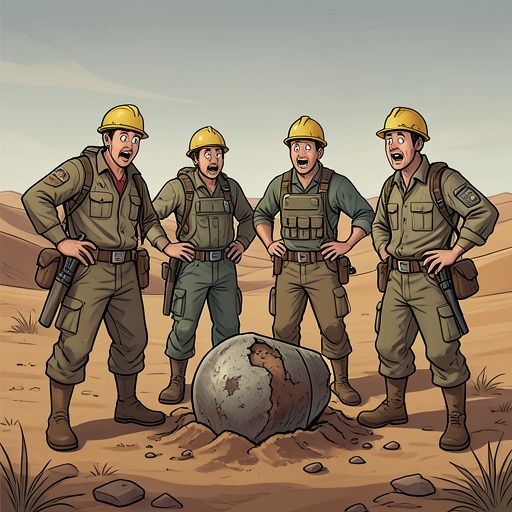
The team’s expectations had been shaped by failure. After moving thousands of cubic yards of soil, the archaeologists had found no artifacts, bones, or smaller traces of past life; only weathered building foundations remained. Against that near-total absence, Ozymandias was an extraordinary survivor: an ancient machine built to explain the civilization whose monuments had largely disappeared. Dr. Leopold thought it functioned as a guide to the ruins, but at first the robot spoke only in an alien language, and the team did not know whether it understood them.
The first sounds came when Dr. Leopold addressed it directly. To the narrator, the robot’s high-pitched voice was startling not simply because it spoke, but because it made audible a language that had not originated on Earth. Its speech initially offered no shared vocabulary through which the team could question it. The machine’s age and apparent purpose were visible; its understanding remained uncertain.
Listening, inference, and the first exchange
After the team left, Ozymandias listened to the conversation they had held the previous night. The next morning it greeted them in English, saying, “Ozymandias have remain here.” The sentence was unpolished but immediately intelligible. Its significance lay in the fact that the robot had not merely repeated a sound on cue: when it followed with “Ozymandias decipher the language somehow. Seem to be a sort of guide,” Dr. Anderson recognized that it was expressing coherent ideas.
The team’s surprise turned into a realization of what the machine had done. Ozymandias had applied its ancient mind to the problem of organizing the humans’ sounds into meaning. It could report that it understood, while acknowledging that it did “Not have words enough” and inviting them to “Talk more.” Those limits made the achievement legible: the machine had established a working grasp of English, but still needed vocabulary to extend what it could say.
The humans responded by feeding it words as quickly as they could and defining them when possible, so that Ozymandias could relate new terms to concepts already formed in its mind. Two hours of this exchange passed almost unnoticed. By the end, the robot could hold a passable conversation. The learning is presented as a sequence of observation, inference, and further input: Ozymandias first listened to language in use, then produced meaningful speech, and then expanded its command through direct interaction.
From language to access to the past
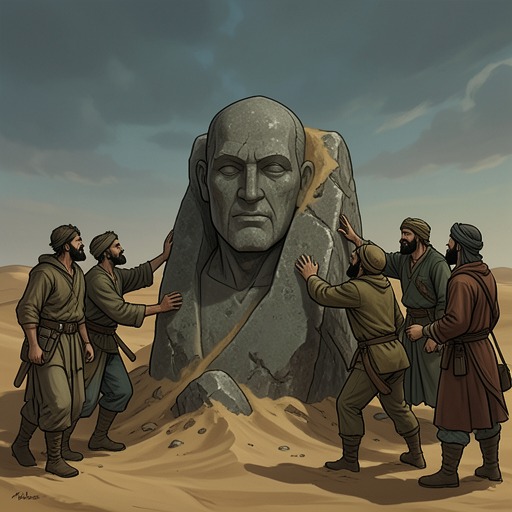
English changes the team’s relation to Ozymandias. Before the breakthrough, it seemed to be a surviving exhibit of a vanished society, perhaps capable of delivering a fixed guide’s recitation. Once it could converse, the team could begin treating it as a source to question and develop their vocabulary with. Its original function as a guide to passersby became active again: Ozymandias tore its legs free of the sand that had bound them for centuries and led the archaeologists on a tour of the civilization that had built it.
The narrator calls the robot a “walking and talking Rosetta Stone,” a comparison that captures both the linguistic and archaeological stakes of the breakthrough. Ozymandias was not simply translating a known inscription; it was making communication possible with an ancient intelligence that held information about the civilization itself. Dr. Leopold saw it as a fabulous storehouse of archaeological data, knowledge the team might investigate for years. The contrast with the earlier excavation is sharp: where the sand yielded no portable remains, a conversation with the machine opened a new route to the past.
The military consequence of understanding
The new communication also makes the robot’s knowledge valuable to people pursuing aims beyond archaeology. Colonel Mattern later explains that Ozymandias has information about ancient Thaiquen weapons, including a superweapon that he believes accounts for the planet’s lifeless condition. He says the military has already learned things from the robot and argues that its knowledge could make America impregnable. The conversation that began as a means of sharing words has thus made the machine’s stored information available for strategic use.
Mattern’s account places the language breakthrough within the expedition’s conflict over who controls what has been discovered. He reveals that his men found Ozymandias after investigating a metal signal about twenty miles west, following the archaeological party’s failure to tell him of the robot. The machine was surprised to learn that other Earthmen were present. Mattern then declares the expedition ended, says Ozymandias has been taken to the ship and placed in sealed quarters, and orders an immediate return to Earth. Dr. Leopold objects to military interference, but the other archaeologists offer no effective support. Ozymandias’s newly accessible knowledge has enabled scientific inquiry; in Mattern’s hands, that same access becomes a reason to seize the robot and bring the expedition to a halt.