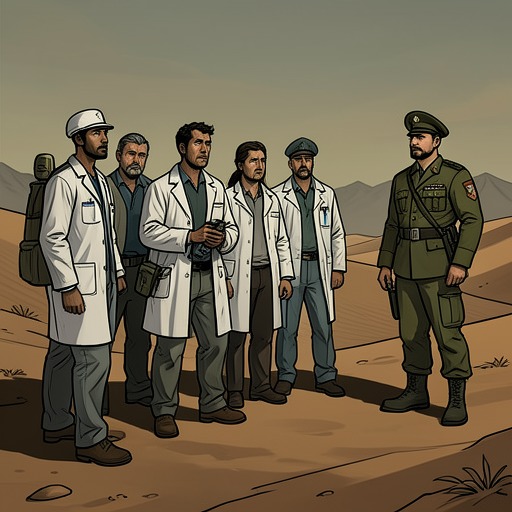
The archaeological team left Ozymandias in the desert
OzymandiasThe archaeological party leaves Ozymandias standing in the desert after Dr. Leopold decides to conceal the discovery from Colonel Mattern. At first, the choice is a practical secret and a planned surprise: the robot is too heavy for the team to carry, yet Leopold believes it will stay where it is and can be tracked if it moves. The decision becomes the hinge between an apparently barren excavation and the recovery of an immense historical record, while also exposing how easily cultural knowledge can be recast as military property.
The barren excavation and the concealed find
The decision follows a dispiriting day of digging. The archaeologists have shifted thousands of cubic yards of soil and opened a large hole, but uncovered no artifact, skull, tooth, utensil, or other portable trace of the civilization. Only the stumps of building foundations remain, worn down by a million years of sand, wind, and rain. Dr. Leopold ruefully accepts that Colonel Mattern’s judgment of the planet as useless seemed justified: foundations could establish that a civilization had existed, but offered little basis for reconstructing its laws, technology, or philosophy. The team moves half a mile away to dig again, still hoping for something tangible.
That apparent failure makes the find, and the choice to leave it, all the more consequential. The ancient guide is the exception to the near-total disappearance of the civilization’s material remains. When it speaks in an unknown language, Dr. Leopold suspects it was built to guide visitors among the ruins and provide information about monuments that have since vanished. Its massive, sturdy body seems to have survived where the city itself did not. The team cannot yet understand its account, but Dr. Leopold calls the discovery magnificent and proposes trying to decipher its language.
A deliberate decision to leave Ozymandias
When Gerhardt asks what they should do with the robot, Webster wonders whether the five members of the group can move it. Dr. Leopold refuses. Ozymandias weighs five or six hundred pounds, and although it can move under its own power, Leopold cannot shift it himself. Rather than attempt to haul it away, he proposes leaving it temporarily as a surprise for Mattern. His plan depends on keeping the discovery secret until the expedition’s final day, when the team can reveal it after Mattern has spent the intervening time believing the planet yielded nothing.
The discussion turns on the difference between physical vulnerability and mobility. Marshall dismisses the possibility that anyone will steal the robot, and Webster jokes that rain will not melt it. Gerhardt points out a more immediate uncertainty: Ozymandias might walk away. Leopold acknowledges that it can, but assumes it will remain where it is; if it moves, the group can trace it by radar. The party returns to base as evening approaches, leaving the robot knee-deep in sand. It swivels toward them and raises a thick arm in what appears to be a salute.
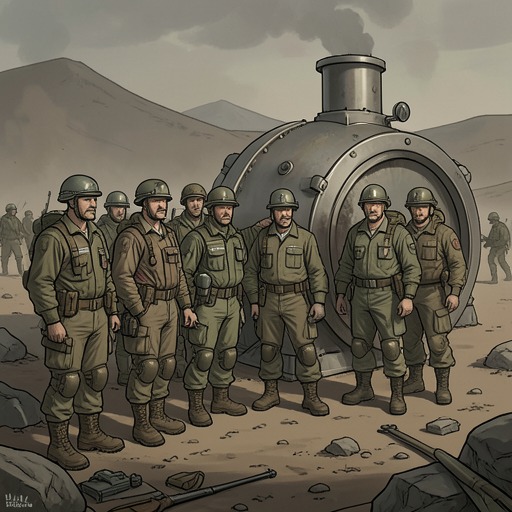
Leopold makes the concealment explicit before they depart, warning the group not to say a word about Ozymandias to Mattern. That night, Mattern and his seven aides press the archaeologists about their day, plainly hoping to confirm that they have found nothing. Because Leopold has forbidden disclosure, the team gives them no account of the robot. Their silence allows Mattern to take the empty-looking excavation as evidence that the military assessment was right, while the archaeologists preserve their surprise for the planned reveal.
The secret becomes an archive
The plan changes in significance when the party returns to Ozymandias. The robot has listened to the archaeologists’ conversation and, after they left, worked out how to organize their sounds into English. It tells them that it has remained there and identifies itself as a guide; the group realizes that its words are coherent, not merely fragments repeated without understanding. In two hours of exchanging and defining vocabulary, the archaeologists bring it to a passable conversational level. Ozymandias then frees its legs from the sand that had held them for centuries and leads them on the tour for which it was built.
Its memories supply what the ruined foundations cannot. Ozymandias says that its people called themselves the Thaiquens and had lived and flourished for three hundred thousand years. In the declining period of their history, they built it as an indestructible guide to cities they also believed indestructible. The cities crumbled, leaving the guide alone with their history. It describes Durab, a city that once held eight million people, and the Temple of Decamon, which stood sixteen hundred feet high beside the Street of the Winds. Its account also preserves political chronology: the Eleventh Dynasty began with Chonnigar IV’s accession to the Presidium in the city’s eighteenth thousandth year, during the period when neighboring planets were first reached.
The robot’s recollection extends beyond monuments and rulers. It says that the Library of Durab stood at the place where it is speaking, had contained fourteen million volumes, and no longer exists; Ozymandias read those books after their builders were gone and memorized them. It also recounts a plague that killed nine thousand people a day for more than a year. As the archaeologists supply more words, its tour grows more detailed. Their recorders capture its speech, and Dr. Leopold recognizes that the robot holds archaeological information enough to occupy researchers for years. The abandoned find has become an archive whose contents can be queried and expanded through conversation.
From archaeological preserve to military target
The choice to leave Ozymandias in the desert is reversed once Mattern learns of it, but the underlying conflict is no longer simply about whether the excavation has produced anything. Dr. Leopold asks Mattern not to interfere and declares the robot part of the archaeological group’s preserve, arguing that a casual experiment could short-circuit its memory channels. His request makes explicit what the earlier concealment had protected: not just an object, but a fragile route into a vanished civilization’s records.
Mattern rejects Leopold’s claim to control the discovery. He says that Ozymandias has already been brought to the ship and placed in sealed quarters under top-level security. Invoking his emergency authority, he declares the expedition over and orders an immediate return to Earth with the robot. His justification changes the meaning of the archive: according to Mattern, Ozymandias contains detailed knowledge of ancient Thaiquen weapons, including a superweapon. He argues that this weapon explains why the planet is bare of life, claiming that a million years of ordinary change would not have erased even a blade of grass. He further says the robot knows the details of other weapons that could make America impregnable, and concludes that it belongs to the military, although it was the archaeologists’ find.
The archaeologists offer no answer when Mattern announces the seizure. Dr. Leopold looks to his colleagues for support, but they say nothing; faced with the expedition’s military authority, his archaeological claim cannot prevent the robot’s removal. The party had left Ozymandias in the desert to preserve a discovery from Mattern and reveal it on its own terms. Instead, the robot’s mobility, ability to speak English, and immense store of remembered knowledge bring it under military custody. The episode therefore links the disappearance of the Thaiquen cities to a new contest over what survives: the archive outlasts its civilization, but its access and use are immediately subjected to the priorities of the armed expedition.