Ozymandias tells the archaeological team about the Tae Kuin civilization
OzymandiasOzymandias’s account of the Thaiquen civilization transforms the expedition’s apparent archaeological failure into a discovery of extraordinary scale. With the ruins reduced to foundations and the civilization’s other material traces gone, the robot becomes a surviving archive: he gives the archaeologists access to a three-hundred-thousand-year history, while the military’s later claim that his knowledge includes weapons turns that archive into an object of control.
From barren ruins to a speaking guide
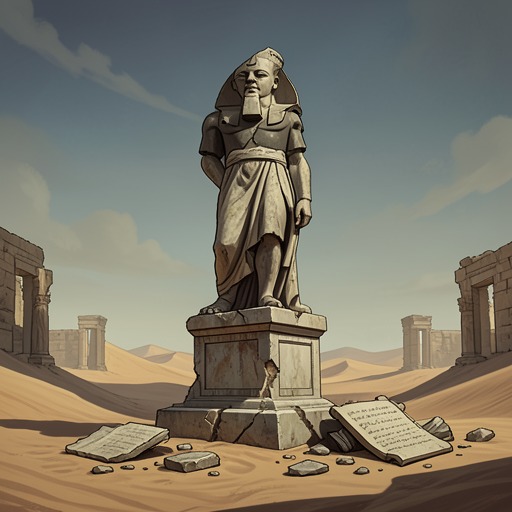
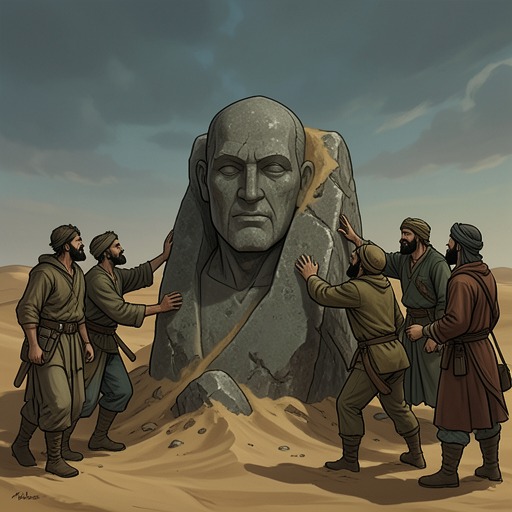
The expedition first encounters a world that appears to have been dead for about a million years. Its archaeologists dig through the sand and find no artifacts, bones, teeth, or utensils; only weathered building foundations remain, too meager to reconstruct a culture’s laws, technology, or philosophy. The initial judgment is that the planet has yielded almost nothing. Against that material absence, Ozymandias stands out as an apparent guide to the ruins, built by the ancient inhabitants to inform later visitors and durable enough to outlast both them and their monuments.
At first, the archaeologists do not know whether the robot understands them. Dr. Leopold observes that it begins speaking when addressed, but guesses only that it is a guide; its sounds remain an alien language. Dr. Anderson names it Ozymandias, recognizing the irony of a monument intended to proclaim its builders’ glory when the cities are gone and the monument alone remains. That literary comparison gives the robot’s survival an interpretive frame before the team can understand its words: it is at once a practical guide and the remnant that exposes the fragility of the civilization it commemorates.
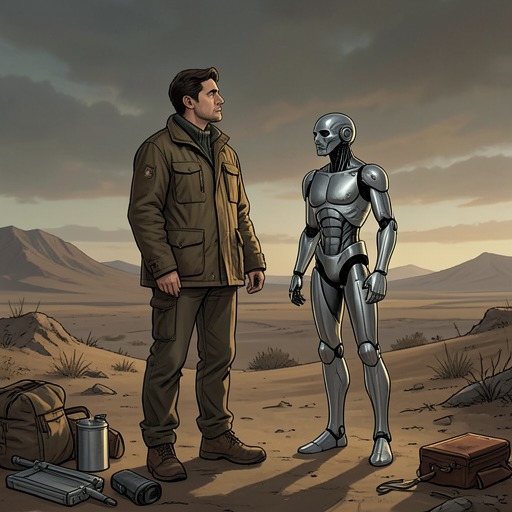
The change comes after the archaeologists leave and return. Ozymandias addresses them in English, explaining that it has deciphered the language and again describing itself as a kind of guide. The group first takes the speech for fragments repeated from their earlier conversation; Dr. Anderson instead recognizes coherent thought. The robot has listened to the team, organized their sounds into meaning, and begun to communicate. The discovery shifts the question from what the ruins can reveal to what their surviving witness remembers.
The history Ozymandias recovers
The archaeologists feed Ozymandias vocabulary, defining words so that it can connect them to others it has learned. After two hours, it can hold a passable conversation. It frees its legs from the sand that had bound them for centuries and takes the group on the tour for which it was built. The robot is not merely a device that stores facts: it moves through the landscape with the visitors, identifying places and making the ruined city legible through guided narration.
Ozymandias says that its people called themselves the Thaiquens and had lived and thrived for three hundred thousand years. In the declining period of their history, they built it as an indestructible guide to their indestructible cities. The design’s promise of permanence has been contradicted by events: the cities have crumbled, while Ozymandias alone remains to carry their memories. Its continued operation makes the history accessible, but also sharpens the contrast between the builders’ ambitions and the actual survival of their world.
The tour gives specific scale and names to places that had been reduced to foundations. Ozymandias identifies Durab as a city that once held eight million people, and locates the Temple of Decamon, which stood sixteen hundred feet high and faced the Street of the Winds. Its account turns an empty landscape into a mapped urban past, connecting surviving ground to structures no longer standing. These details are not inferred from the ruins: they come from the robot’s memory and its ability to identify what once occupied the sites.
The robot also preserves institutional and political chronology. It dates the beginning of the Eleventh Dynasty to the accession of Chonnigar IV to the Presidium, in the city’s eighteenth thousandth year, and says that neighboring planets were first reached during that dynasty. The record therefore extends beyond architecture into government and technological expansion. Ozymandias’s guided history allows the archaeologists to encounter the Thaiquens not simply as the makers of a vanished city, but as a society with named rulers, historical periods, and a reach beyond its home world.
Its account of the Library of Durab makes the difference between the lost city and the surviving archive especially stark. The library stood on the spot where Ozymandias is speaking, contained fourteen million volumes, and no longer exists. The robot says that it spent time reading those books after their builders had gone and that their contents are memorized within it. The library has vanished as a physical institution, but some of its knowledge has crossed the destruction of its shelves through the robot’s memory. Ozymandias thus preserves not only descriptions of the city but a record derived from the civilization’s own books.
Other fragments widen the history beyond monuments and political succession. Ozymandias recounts that a plague killed nine thousand people a day for more than a year. As it absorbs the archaeologists’ comments and adds words to its vocabulary, its narration grows more detailed, ranging across what the visitors encounter in the desert. The group records every word, overwhelmed by the prospect that the robot contains the history of a culture that lasted three hundred thousand years—more material than they could exhaust even over the rest of their lives.
A cultural archive under dispute
For the archaeologists, Ozymandias is a discovery that reverses the meaning of their earlier excavations. The foundations had seemed nearly useless as evidence; the robot supplies the contextual knowledge that the physical remains could not provide. Dr. Leopold recognizes that the find can support years of research, and the team returns to its base convinced that it has received a complete, accessible record of the Thaiquens. What began as a search for tangible remnants becomes an encounter with a single surviving witness whose memory can outlast the work of excavation.
That sense of shared scientific triumph is complicated by the expedition’s divided purpose. The archaeologists have been assigned to study dead civilizations, but the military party is charged with finding weapons, fissionable materials, and other resources of strategic value. The expedition’s military sponsors supplied most of its budget, and the crew has been working amid renewed tension between Earth’s hemispheres. The archaeologists initially conceal Ozymandias from Colonel Mattern; their excitement and Dr. Leopold’s refusal to identify where they had been working prompt the military party to investigate the area.
When Mattern confronts Dr. Leopold, he says that his men found Ozymandias through a detector’s indication of a metal object about twenty miles west. He reports that the robot was surprised to learn that other Earthmen were present. The encounter that led to the archaeological tour has therefore also exposed the find to the military party. Ozymandias’s information has not changed, but its significance changes as new observers ask what it contains and who should control it.
Mattern declares the robot to be of military use, says it has been taken to the ship and sealed in quarters, and ends the expedition so that it can be returned to Earth. He explains that his men have already learned about ancient Thaiquen weapons and argues that such knowledge could make America impregnable. He also attributes the planet’s lack of life to a Thaiquen superweapon, reasoning that a million years of time alone would not account for the absence of even grass. The conclusion about the planet’s destruction is presented as Mattern’s interpretation, while his claim about Ozymandias’s military value is the basis for his seizure of the find.
The tour consequently becomes more than a recovered history: it is the point at which archaeological knowledge is recast as a strategic asset. The same robot first understood as a guide, then celebrated as a storehouse of cultural data, is claimed by the military as a repository of weapons information. Ozymandias’s memories make it possible to recover a civilization almost erased from the landscape, but that very completeness gives the surviving archive a dangerous political value. The episode’s central irony echoes its original name: the monument outlasts its makers, yet the modern visitors’ first response to its preserved knowledge is to contest its ownership and military use.