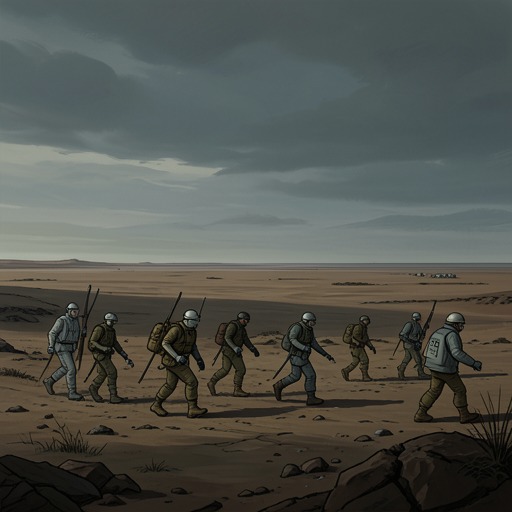
Leopold insists on staying on the planet for a week
OzymandiasLeopold’s insistence on spending the expedition’s full 168-hour research allowance on the barren planet is a small but consequential defense of scientific inquiry against a military mission built to extract strategic advantage. The clause gives his archaeological team one week of protected access; it cannot, however, prevent Colonel Mattern from later claiming Ozymandias for military use and ordering the expedition home.
The expedition’s competing mandates
The expedition had been sent to investigate worlds near the Galactic Rim that an earlier survey had passed over after finding no signs of life. Its charter divided the work: Leopold led the archaeological study of dead civilizations, while Mattern’s military team searched for fissionable material, alien weapons, and resources such as lithium and tritium. The military’s priorities were backed by 70 percent of the budget, provided by the General Staff of the Armed Forces of the United States of America, which expected results useful to national defense.
That imbalance was institutional as well as financial. The narrator describes the archaeologists as having been added partly to answer public resistance to purely military expeditions; in practical terms, they were treated as ballast. Meanwhile, tension between America and the Other Hemisphere made the search for weapons and strategic materials urgent in the eyes of the military. The argument over one week on one planet therefore unfolds within an expedition whose official scientific purpose is real but whose dominant pressure is military.
Leopold invokes the research clause
When the planet appeared lifeless, Mattern argued that it had no strategic value and that the crew should pack up. Leopold, head of the expedition’s non-military segment, answered that he would apply the limiting clause: since they had landed, the team would spend the minimum time allotted for scientific research. He stated the entitlement more specifically as a right to explore any world where they landed for at least 168 hours.
Mattern challenged the decision as an unnecessary show of intellectual superiority, but Leopold denied that he was making the dispute personal. The narrator emphasizes that the clause had been written into the expedition’s charter and that Leopold was within his rights. Mattern recognized that he had little case against him: despite his protest, he eventually conceded that Leopold could keep the team on the planet for one week, while warning that they had better be ready to depart as soon as the time expired.
A temporary limit on military authority
The clause gave Leopold a defined interval, not control over the expedition’s ultimate purpose or the discoveries it might make. The distinction becomes decisive when Mattern later says that Ozymandias is a storehouse of information about ancient Thaiquen weapons. He reports that the robot has been taken aboard the ship and confined in sealed quarters under top-level security, then invokes emergency authority to declare the expedition over and order an immediate return to Earth.
Mattern’s action reveals the boundary of Leopold’s earlier victory. The research allowance had compelled the military to tolerate time spent on archaeology, but it did not secure the archaeologists’ ownership of a discovery or their right to continue studying it once it was judged militarily useful. Mattern’s announcement also gives the earlier argument its larger consequence: the clause protects an opportunity to investigate, while military authority can still determine what happens when that investigation yields strategic knowledge.
Significance
Leopold’s stand is neither an escape from the expedition’s military framework nor a simple triumph for science. It is a procedural safeguard within that framework, secured by public-relations concerns and expedition rules even though the military supplies most of the money and defines the practical stakes. The one-week limit makes the conflict concrete: scientific time is protected, but only in a narrow, temporary form.
The episode also sets up the clash over the ownership and use of knowledge. The archaeology team’s work brings Ozymandias to light, yet Mattern’s claim that the robot’s knowledge can make America impregnable converts discovery into a national-security asset. The right to study a dead civilization thus proves weaker than the power to seize what that study uncovers.