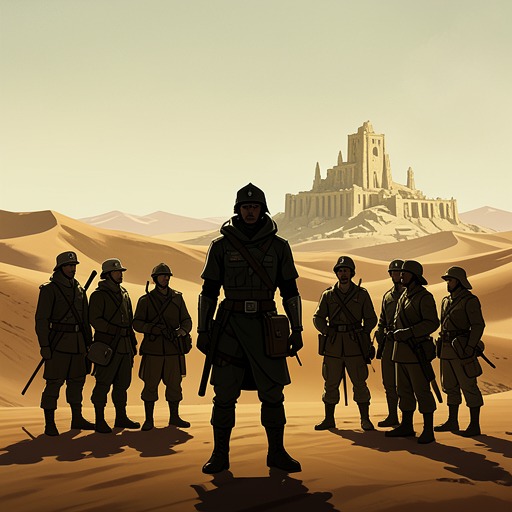
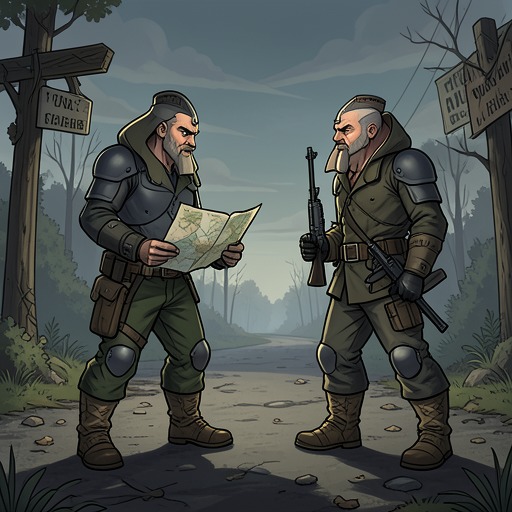
Mattern seized Ozymandias and ended the expedition
OzymandiasColonel Mattern’s seizure of Ozymandias and termination of the expedition is the decisive reversal in which archaeological discovery becomes military property. After the archaeologists uncover a surviving guide who can preserve and explain an entire extinct civilization, Mattern’s men remove him to the ship, classify his knowledge as a security matter, and prepare to return to Earth with him. The act resolves the immediate contest of authority in the military’s favor while exposing the expedition’s deeper purpose: knowledge gathered in the name of exploration is ultimately answerable to the strategic interests that financed the mission.
Causes and Institutional Background
The conflict is built into the expedition’s charter and funding. Its two segments have distinct assignments: Dr. Leopold leads the archaeologists, charged with researching dead civilizations, while Mattern and his men search for fissionable material, alien weapons, and resources such as lithium or tritium that might serve military purposes. The General Staff of the Armed Forces of the United States of America supplied 70 percent of the budget and expected practical results, not merely archaeological research. The archaeologists’ inclusion also reflects a political compromise: public opinion in America had long frowned on purely military expeditions, so five archaeologists were added as a concession to national conscience.
That compromise never erased the imbalance. Mattern regarded his men as the expedition’s truly important members and the archaeologists as ballast. The narrator’s account places that hierarchy against renewed tension on Earth: the Other Hemisphere might end a century of quiescence and resume its advance into space, making any discovery of military value part of an arms race. The expedition’s archaeological and military tasks therefore coexist uneasily from the outset, but they do not carry equal institutional weight. Once a discovery can be presented as a weapon or intelligence source, the military’s claim can overrule the archaeologists’ purpose.
Discovery and the Attempt to Conceal It
The immediate cause of the seizure is the archaeologists’ discovery of Ozymandias and their decision to keep him from Mattern. When Dr. Leopold addresses the robot, it responds with speech in an unknown language. Leopold first understands it as a guide to the ruins, built to provide information to passersby and still operating after the civilization and monuments it once served have disappeared. The team recognizes that they have found more than an artifact: they may be able to decipher its speech and recover a historical record otherwise lost.
They do. After two hours of teaching Ozymandias words and helping him connect them to what was already engraved in his mind, he can hold a passable conversation. Freed from the sand that had bound his legs for centuries, he takes the archaeologists on a tour of the civilization that built him. He identifies his people as the Thaiquens and describes a civilization that flourished for 300,000 years. Built in its declining days as an indestructible guide to indestructible cities, Ozymandias has outlasted those cities and retained their history. Dr. Leopold regards him as an archaeological storehouse whose contents could occupy researchers for years.
After leaving Ozymandias in the desert and returning to base, the archaeologists agree to hide the find from Mattern. Their excitement betrays them, however, and Leopold refuses to say exactly where they have been working. During the night, Mattern and his men set out in halftracks to investigate. They follow detector readings indicating a metal object about twenty miles to the west, find Ozymandias, and encounter the robot’s surprise at the appearance of other Earthmen. The concealment meant to protect the archaeological find instead alerts the military to its existence and gives Mattern the immediate opportunity to claim it.
The Seizure and the End of the Expedition
At breakfast the next morning, Mattern tells the archaeologists that his men have been up all night conducting what he calls archaeological prospecting. He confronts Leopold about concealing an object of extreme strategic importance, naming Ozymandias directly. Leopold says he had intended to disclose the discovery before departure, then asks Mattern and his men to stay away from the robot. He argues that Ozymandias is an archaeological treasure and that a careless experiment might short-circuit his memory channels. Leopold invokes the archaeologists’ right to designate the robot part of their preserve and declare him off limits to the military.
Mattern reverses that claim. He asserts that Ozymandias belongs to the military preserve, explaining that he has already brought the robot to the ship and placed him in sealed quarters under top-level security. Using the authority entrusted to him for emergencies, Mattern declares the expedition over and orders an immediate return to Earth with Ozymandias. The dispute is no longer about who may examine an object in the field: Mattern has removed the object from the archaeologists’ reach and made the end of the expedition itself part of his decision.
The authority of that declaration is reinforced by the narrator’s description of the mission’s actual balance of power. Although archaeologists had been attached to the crew, it was fundamentally a militaristic undertaking; the search for general knowledge was subordinate to the pursuit of weapons and strategic materials that might be used against the Other Hemisphere. Mattern’s decision turns that implicit order into an explicit one. Leopold recognizes that he cannot stop him, and the archaeological team offers no effective intervention.
Strategic Claim and Consequences
Mattern justifies the seizure by redefining Ozymandias’s historical knowledge as military intelligence. He claims that the robot contains detailed information about ancient Thaiquen weapons and says his men have already learned things of astonishing scope from him. He further argues that the planet’s lifeless condition cannot be explained by the passage of a million years alone: in his account, a Thaiquen superweapon destroyed life there, and Ozymandias knows its details, along with those of other weapons. The evidence establishes this as Mattern’s explanation and justification for taking the robot, not an independent demonstration that the military has already verified every claim.
The consequence is a transfer of control over both the robot and the knowledge he carries. To Leopold, Ozymandias is an irreplaceable archaeological record and a guide to a civilization whose cities have vanished. To Mattern, the same surviving memory is a repository of weapons information that could make America impregnable. The robot’s function thus changes in the eyes of the competing groups: from guide to the ruins, to a source of recoverable history, to a strategic asset secured behind sealed doors. The contest does not erase his archaeological value; it subordinates that value to the military’s claim that his information might be used in the confrontation with the Other Hemisphere.
Mattern’s seizure also exposes the cost of the expedition’s political compromise. Archaeological research was permitted aboard a mission funded chiefly for military purposes, but the archaeologists’ limited rights cannot protect their discovery once Mattern invokes security and emergency authority. The mission ends not when its assigned worlds have been fully studied, but when its military commander decides that one find is too useful to leave under civilian research control. Exploration brings the Thaiquens’ distant past within human reach; the expedition’s structure determines who gets to claim that past and for what purpose.