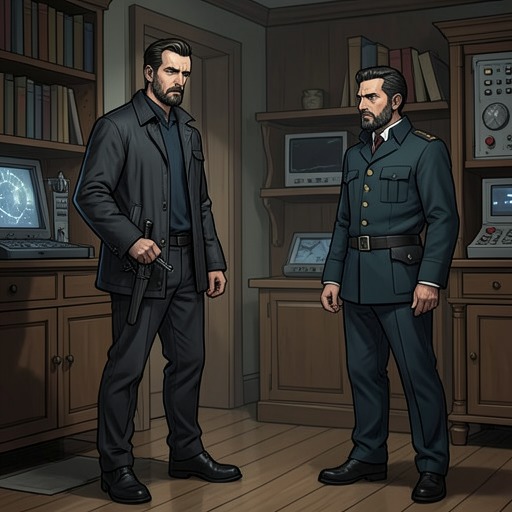
Bren Cameron and Banichi: man’chi and protective loyalty
PeacemakerBren Cameron and Banichi: man’chi and protective loyalty is a relationship shaped by a difference in how each understands attachment. Bren calls his feeling love; Banichi’s loyalty belongs to man’chi, an atevi bond of allegiance and responsibility. The terms do not align neatly, but the commitment behind them does: Banichi and his team have risked their lives for Bren, and Bren’s concern for them reaches beyond his need for protection.
From unfamiliarity to attachment
Bren’s understanding of the relationship is measured against his arrival in an unfamiliar world. He remembers entering his office as a young man with little experience of atevi life, obliged to adapt even in his clothing and the narrow braid on his ribbon. Years later, seated on a regular train beside his bodyguard, he recognizes how profoundly he has changed—and how close the people around him have become.
Banichi is part of the four-person team Bren identifies as the closest people in his life: Banichi, Jago, Tano, and Algini. Their formal appearance and guarded manner do not prevent intimacy. Bren says that he loves them, while recognizing that love is not an atevi category in the way humans understand it. The contrast is not simply a failure of translation. It reveals that Bren can name a feeling his protectors would frame differently, even as he understands the force of their commitment.
For Banichi and his team, man’chi means a loyalty that can demand a life. Bren sees that their allegiance is not an abstract principle: they have nearly died for him. He also understands that the feeling does not run in only one direction. His love is not the same thing as their man’chi, but his attachment to them is real, and he experiences their bond as something that has become mutual in practice even if it remains differently understood.
Protection and personal risk
The relationship is tested when Banichi confronts Haikuti, a former teammate with whom he has a bitter history. Banichi acts both to protect Bren and to defend Bren’s legal position, but his decision to face Haikuti also has a personal dimension: he wants Haikuti stopped. Banichi later questions whether that feud influenced his judgment more than his duty did. His concern is not merely that he took a risk; it is that his own motives may have compromised the protective role he owes Bren.
Bren understands the danger in Banichi’s choice but cannot reduce it to a simple failure of loyalty. Banichi had moved to protect him and to secure his legal position, yet had not used his body as a shield. The distinction matters to Banichi, who regards his action as possibly tainted by the old conflict. To Bren, the aftermath makes visible how much Banichi carries responsibility for the split-second decision, and how the standards of protection are internalized as personal obligations rather than just professional procedure.
Care without command
After the confrontation, Banichi insists on remaining involved in the next operation, despite needing rest. Tano says Jago will see to it that Banichi rests, and Bren hopes that a sedative will help enforce the advice. Bren does not treat Banichi’s willingness to continue as proof that he is well. He tells the team that risking Banichi’s health does not serve his man’chi, and that Banichi needs several days in bed.
When Algini reports that Banichi insists on joining the imminent operation and needs to be part of it, Bren accepts that the decision is unlikely to change. His understanding does not make the prospect emotionally easy. He has seen Banichi fall and worries about the risk of sending him back into danger. He tells the team that he relies on all of them and asks them to consider their value to the aishidi’tat, then corrects himself: their value to him matters too. He could continue performing his official duties if he lost one of them, he says in effect, but that would not make the loss acceptable.
This exchange shows care operating without control. Bren has authority and can express what he wants, but he cannot simply command away Banichi’s own judgment of his obligations. He makes his attachment explicit, while Algini helps convey the reasoning Banichi himself will not voice. Banichi remains determined to act because he believes withdrawing now would allow Haikuti to influence the outcome. His persistence is thus both a continuation of service and an attempt to answer what he sees as a failure in his conduct.
Trust within the team
Bren’s understanding of Banichi is also shaped by what the team does not say. Banichi’s teammates do not press him with deep questions about the confrontation, as far as Bren knows. Jago, who is Banichi’s daughter, does not question him either. Bren had taken years to learn their kinship, and nobody within the unit acknowledges it. The relationship’s inner life is therefore not made available to Bren through open explanation; he must understand it through actions, silences, and the trust the team places in him.
That reserve contrasts with Bren’s own effort to speak plainly. He struggles to express how worried he is, but persists in distinguishing his concern from mere operational calculation. The team knows his feeling, and Banichi knows it too, even though their language for loyalty differs. Their bond does not require them to resolve that difference. It is established instead through protection given, risk accepted, concern spoken aloud, and the continued reliance of a man who has learned that his bodyguard is also among the people he most fears losing.